Search

Dr. Padmalochan Dash

Bharat Assets Resilience Consortium

Dr. Padmalochan Dash

Founding Director & Lead Research Fellow

Bharat Assets Protection Institute™ (B.A.P-I)

Founding Member Member since 2020

Critical Infrastructure ProtectionStrategic StudiesMaritime SecurityNational Resilience ArchitectureDefence EcosystemSupply Chain Sovereignty

Founder, Director and Chief Research Architect of the Bharat Assets Protection Institute™. His work centres on Critical Infrastructure Protection, the Bharat National Resilience Index (BNRI) and India's national resilience architecture.

“Resilience is not merely the ability to withstand disruption. It is the capacity of a nation to anticipate change, adapt with confidence, and transform knowledge into enduring strategic strength.”

Dr. Padmalochan Dash is the Founder, Director, and Lead Research Fellow of the Bharat Assets Protection Institute™ (B.A.P-I), an independent multidisciplinary research institution dedicated to advancing scholarship and policy innovation in Critical Infrastructure Protection, National Resilience, Strategic Manufacturing, Supply Chain Security, Technology Sovereignty, and Integrated National Security Governance. Established in 2020, B.A.P-I was conceived as a long-term research initiative to bridge the gap between academic inquiry, public policy, industry practice, and national capability development. Under his leadership, the Institute has progressively evolved into a specialised platform examining the protection and resilience of strategic assets upon which modern nations depend: critical infrastructure systems, industrial ecosystems, logistics networks, cyber-physical environments, blue-water infrastructure, and emerging technology domains.

Dr. Dash's academic and professional work is guided by the belief that resilience is no longer simply a matter of disaster recovery or infrastructure protection, but rather a comprehensive governance function integrating economic continuity, technological advancement, environmental sustainability, industrial capability, societal preparedness, and state continuity. This philosophy forms the intellectual foundation of B.A.P-I's research architecture.

His current research focuses on the development of a comprehensive Critical Infrastructure Protection Programme (CIPP) for India, including the proposed Critical Infrastructure Protection Act (CIPA) and the Bharat National Resilience Index (BNRI), a multidimensional resilience assessment framework designed to measure, benchmark, and strengthen governance capability, infrastructure robustness, cyber resilience, supply-chain security, technological sovereignty, disaster preparedness, and institutional continuity across India's strategic sectors.

His scholarly interests extend across Critical Infrastructure Protection, Internal Security, Cyber-Physical Security, Strategic Manufacturing Ecosystems, Logistics and Supply Chain Resilience, Technology Sovereignty, Blue Economy and Maritime Security, Disaster Risk Governance, National Capability Assessment, and Indo-Pacific Strategic Affairs.

Academically, he represents a multidisciplinary convergence of security studies, governance, and civilisational thought. He holds advanced qualifications in South and Southeast Asian Studies and Internal Security. As an author and policy researcher, he has contributed extensively through publications in The Pioneer, FINS Journal of Diplomacy and Strategy, Uday India, and other thematic platforms.

His long-term vision is to help establish a comprehensive national resilience architecture for India, one that harmonises governance, technology, infrastructure, industry, innovation, and societal capability into a unified strategic ecosystem capable of anticipating, absorbing, adapting to, and recovering from the complex challenges of the twenty-first century.

B.API Score and Credit Bank
BAPI-C-2026-000001
Level in progress Rank in progress
0.00B.API Index
0.00Approved credits
0Certificates and honours

Scores and credits are approved by the Director of B.A.P-I. Detailed records are private to the member. About B.API · Verify a certificate

Publications by Dr. Padmalochan Dash

Bnri 2nd frontBharat National Resilience Index (BNRI)A Doctrinal Framework for Measurable Security, Safety and Systemic ContinuityCip programme frontCritical Infrastructure Protection ProgrammeNational Resilience Architecture and A Comprehensive Protection Framework for India from Global Best Practices
Bapi retro 01

The Mumbai Grid Disturbance of October 2020: India's Findings, the RedEcho Claims and the Cyber-Physical Reform Agenda for Grid Protection

Dr. Padmalochan DASH19 Oct 2026
Abstract Research Paper

On 12 October 2020 Mumbai lost power for between two and fifteen hours after a cascade of transmission trippings exceeded the capacity of the city's islanding scheme. In early 2021 a foreign threat intelligence report on a China-linked group called RedEcho, and a preliminary report of the Maharashtra cyber police, prompted claims of cyber sabotage. This retrospective places India's official record at the centre. The Union Government's investigation attributed the outage to human error and found that the attempted intrusions it detected were not linked to the Mumbai failure; CERT-In and NCIIPC had alerted the power system operator months earlier, the malicious addresses were blocked, and no data loss was found. The paper credits that early warning, traces the reform path from the 2021 CEA guidelines to the binding Cyber Security in Power Sector Regulations, 2026, and proposes the next step: a joint cyber-physical investigation protocol under which every major grid disturbance yields one early and authoritative Indian finding.

Read more
Bapi retro 02

Keeping the Lifelines Running: How India Sustained Essential Services and Freight in the 2020 Lockdown, and the Case for a Standing Continuity Doctrine

Dr. Padmalochan DASH19 Oct 2026
Abstract Article

India's first national lockdown, ordered on 24 March 2020 under the Disaster Management Act, 2005, suspended passenger transport and most commerce while exempting a list of essential services and the movement of essential goods. This retrospective examines how those lifelines were kept running. The legal architecture worked by exemption, and the Ministry of Home Affairs refined it through prompt clarifications as conditions on the ground became clear. Road freight faced constraints of labour and supporting services, which the Government addressed through measures on crew movement, staff passes, toll suspension and the Kisan Rath platform. Indian Railways kept freight moving, raised foodgrain loading above the previous year and ran thousands of Parcel Special trains. The paper credits these achievements and argues that the next step is to convert the experience of 2020 into a standing lifeline continuity doctrine, building on the 2025 amendments to the Disaster Management Act, that designates lifeline sectors and their enabling services in advance.

Read more
Bapi retro 03

Trusted Sources and Blocked Apps: How 2020 Turned India's Telecom Security Toward the Supply Chain of Digital Infrastructure

Dr. Padmalochan DASH19 Oct 2026
Abstract Policy Commentary

In 2020 India took two sets of decisions that changed how the state secures its digital infrastructure. Between June and November the Ministry of Electronics and Information Technology blocked a large number of mobile applications under Section 69A of the Information Technology Act, 2000, to protect sovereignty, defence, state security, public order and the data of Indian citizens. In December the Union Cabinet approved the National Security Directive on the Telecommunication Sector, under which operators would buy new network equipment only from trusted sources. This commentary looks back at both measures as the foundation of an Indian supply-chain doctrine for digital infrastructure. It traces how the directive was written into licence conditions from June 2021, shaped India's 5G trials, entered the Telecommunications Act, 2023 and is being considered for other critical sectors. It credits the clarity and resolve of these decisions and sets out a reform agenda to carry them forward: published general criteria for trust, a review mechanism, and a cross-sector regime within a Critical Infrastructure Protection Act.

Read more
Bapi retro 04

Oxygen on the Move: How India Mobilised Medical Oxygen Logistics in the 2021 Second Wave, and the Lesson for Critical Health Infrastructure

Dr. Padmalochan DASH19 Oct 2026
Abstract Case Studies

In April and May 2021, as the second wave of COVID-19 placed heavy demands on Indian hospitals, demand for medical oxygen rose to nearly three times its first-wave peak. Meeting it required moving liquid medical oxygen quickly from a production base concentrated in the eastern industrial belt to hospitals in the north and west. This case study revisits that effort as a logistics and supply-chain achievement. It examines the orders issued under the Disaster Management Act, 2005 that directed industrial oxygen to medical use and guaranteed free inter-state movement of tankers, the expansion of production and of the tanker fleet, the Oxygen Express trains run by Indian Railways, the airlift of tankers and containers by the Indian Air Force and the deployment of Indian Navy ships, and the Supreme Court's National Task Force on scientific allocation. It then considers the distributed oxygen capacity built afterwards. The paper argues that medical oxygen should now be designated as critical health infrastructure, with a standing logistics reserve, tracked fleets and a tested allocation protocol.

Read more
Bapi retro 05

When the Mountain Fell on the Powerhouse: Chamoli 2021 and the Unfinished Protection of Himalayan Hydropower

Dr. Padmalochan DASH19 Oct 2026
Abstract Research Paper

On 7 February 2021 a rock and ice avalanche from Ronti Peak in Chamoli, Uttarakhand, turned into a debris flow that destroyed the Rishiganga small hydro project, struck the Tapovan-Vishnugad project and left more than 200 people dead or missing, most of them project workers. This retrospective revisits the scientific reconstruction, which showed a slope failure with visible precursors and a clear seismic signature rather than a glacial lake outburst, and sets it against the national response and the official record of damage assessment and restoration at Tapovan-Vishnugad. It then credits what has changed since: a firmer position on new hydropower in the upper Ganga basin, a national programme for glacial lake hazards and a Chamoli warning pilot. The paper argues that the next stage of reform is to widen this effort from lakes to all mountain hazards, and recommends basin-scale multi-hazard assessment as a condition of approval, warning chains that reach tunnels and riverbed works, and an independent resilience audit for every high Himalayan dam.

Read more
Bapi retro 06

Ransom at the Valve: Colonial Pipeline, RedEcho and the Defence of India's Energy Chain

Dr. Padmalochan DASH19 Oct 2026
Abstract Article

In 2021 the energy sector received two warnings. In May a ransomware attack on Colonial Pipeline, which entered through a single virtual private network account without multi-factor authentication, led the operator to halt fuel supply to much of the American East Coast. In February, when a threat intelligence firm reported that a China-linked group had targeted Indian power organisations, the Ministry of Power stated that CERT-In and NCIIPC had already detected the threat, issued alerts and contained it with no data loss. This retrospective examines both episodes, the regulatory response in the United States, and what followed in India, including further intrusions into state load despatch centres, a ransomware attack on Oil India and new cyber security rules for the power sector. It argues that India's early warning success should now be extended from the grid to the whole energy chain, and recommends binding cyber obligations for the oil and gas midstream, chain-wide exercises across sectors, and a standing energy-chain threat intelligence cell.

Read more
Bapi retro 07

Five Servers and a National Hospital: The AIIMS Ransomware Attack of 2022 and Health as Critical Infrastructure

Dr. Padmalochan DASH19 Oct 2026
Abstract Case Studies

In November 2022 a cyber attack on the All India Institute of Medical Sciences, New Delhi, encrypted about 1.3 terabytes of data on five servers hosting the e-Hospital application, and the hospital ran registration, admissions, laboratories and records manually for about two weeks while continuing to treat patients. This case study first sets out the official account placed before Parliament, which traced the compromise to improper network segmentation, confirmed that no specific ransom had been demanded and recorded that all e-Hospital data was restored from an unaffected backup. It then describes the government response: investigation under the cyber terrorism provision of the IT Act, CERT-In remedial measures and a health sector advisory, system hardening at AIIMS and the hospital's successful blocking of a further malware attack in 2023. Building on these steps, the paper argues that apex hospitals and national health data platforms should be designated as critical information infrastructure, and recommends protected system status, mandatory segmentation with tested backups and rehearsed manual operations plans.

Read more
Bapi retro 08

Six Hours to Report: The CERT-In Directions of 2022 and the Making of India's Incident Governance

Dr. Padmalochan DASH19 Oct 2026
Abstract Policy Commentary

On 28 April 2022 CERT-In issued directions under Section 70B of the Information Technology Act requiring entities to report listed cyber incidents within six hours, keep system logs for 180 days, synchronise clocks with national time servers and, for data centre, cloud and VPN providers, retain subscriber records for five years. This policy commentary revisits the government's rationale, the response of industry bodies, and the FAQs and extension through which CERT-In clarified that individuals and corporate VPNs were outside scope, that logs could be held abroad if producible and that initial reports could be partial. It argues that the directions established India's first economy-wide discipline of incident governance and were, in their essentials, vindicated, and that the next step is to harmonise the reporting duties that have since emerged in sectoral and data protection rules. It recommends a single harmonised notification portal, severity-tiered reporting categories and a statutory footing for critical sectors through a Critical Infrastructure Protection Act.

Read more
Bapi retro 09

Chips as Strategic Infrastructure: The India Semiconductor Mission of 2022 and What a Resilient Electronics Supply Chain Requires

Dr. Padmalochan DASH19 Oct 2026
Abstract Article

The global semiconductor shortage of 2020 to 2022 showed that a component few citizens ever see could halt factories, delay vehicles and expose the dependence of an entire economy on a handful of foreign fabrication sites. India answered with the Programme for Development of Semiconductors and Display Manufacturing Ecosystem, approved in December 2021 and modified in September 2022 to offer uniform fiscal support of fifty per cent for fabs across all technology nodes, with the India Semiconductor Mission as its nodal agency. This retrospective revisits 2022 as the year in which chips moved from industrial policy into the vocabulary of national security. It traces the shock that prompted the programme, reads the 2022 modifications closely, and follows what happened afterwards, from approved fabs and packaging plants to the inauguration of a large memory assembly and test plant in 2026. It credits the programme with building, within a few years, a semiconductor base where none existed, and argues that the next stage should add trusted sourcing, stockholding, measurement and a governance home within the wider architecture of critical infrastructure protection.

Read more
Bapi retro 10

When the Coal Ran Short: The Power Crisis of April 2022 and the Lessons for India's Energy Supply Chain

Dr. Padmalochan DASH19 Oct 2026
Abstract Article

In April 2022 India's electricity system met a record peak demand while coal stocks at thermal power plants fell to about a third of the normative requirement. The Railways cancelled hundreds of passenger train services to free track for coal rakes, the Ministry of Power directed generators to import coal for blending and invoked emergency provisions of the Electricity Act, and fifty plants were left holding less than a tenth of their required stock. This retrospective revisits the episode with the benefit of four years of hindsight. It reconstructs the numbers from official and established sources, explains why a country with large coal reserves and rising production nonetheless came close to a generation crisis, and follows the recovery that brought plant stocks to record levels by 2025. It credits the coordinated response of the coal, power and railway ministries, which kept supply going through a record peak, and argues that lasting energy resilience depends on mandated buffers, logistics redundancy, commercial discipline and a single picture of risk across mines, rail and power stations.

Read more
Bapi retro 11

Keeping the Lights On Under Fire: Ukraine's Power Grid After October 2022 and the Lessons for Protecting India's Energy Infrastructure

Dr. Padmalochan DASH19 Oct 2026
Abstract Research Paper

From October 2022 Russia turned its missiles and drones systematically on Ukraine's electricity system, destroying, by the Ukrainian president's account, nearly a third of the country's power stations within a week and, over the following winters, damaging about half of its large network substations. Ukraine's response combined emergency repair, international supply of spare equipment, synchronisation with the continental European grid, layered physical protection of substations and a civil defence network of heated shelters for citizens without power. This research paper revisits 2022 as the year in which deliberate, sustained attack on a national grid became a practical rather than theoretical threat. Drawing on reports from the International Energy Agency, operators and established news sources, it reconstructs the pattern of attack and response and then draws lessons for India in three domains: physical protection of critical nodes, redundancy through spares, interconnection and decentralised generation, and civil defence planning that assumes prolonged outage. It argues that India, having put in place a strong cyber security framework for the power sector, is well placed to extend it to physical hardening.

Read more
Bapi retro 12

The Wrong Wire at Bahanaga Bazar: The Balasore Collision of 2023, Kavach and Rail Signalling as Critical Infrastructure

Dr. Padmalochan DASH19 Oct 2026
Abstract Case Studies

On the evening of 2 June 2023 the Coromandel Express, running at its permitted speed, was routed into a loop line at Bahanaga Bazar station in Odisha's Balasore district and struck a stationary goods train, and its derailed coaches were hit by a passing express on the adjacent line. Nearly three hundred people lost their lives. The Commission of Railway Safety traced the accident to a wrong signal produced by faulty wiring introduced during an alteration of signalling circuits, and found lapses at multiple levels in the signalling and telecommunication department. This case study revisits the collision, sets out what official inquiry and statements established, records the Railway Board's prompt corrective measures, and follows the rapid expansion of Kavach, India's indigenous automatic train protection system, in the years after. It argues that signalling is the nervous system of the railway and should be governed as critical infrastructure in its own right, with protection extending from design documents and maintenance discipline to independent verification and a measurable national rollout of train protection.

Read more
Bapi retro 13

Custody Before Consent: The Digital Personal Data Protection Act, 2023 and the Data Held by India's Critical-Sector Operators

Dr. Padmalochan DASH19 Oct 2026
Abstract Policy Commentary

The Digital Personal Data Protection Act, 2023 gave India its first general data protection law after a long wait. This retrospective reads the Act from the standpoint of critical infrastructure protection rather than privacy alone. It sets out what the Act asks of data fiduciaries, including reasonable security safeguards, breach intimation, erasure of data no longer needed and the heavier duties of Significant Data Fiduciaries, and notes that the largest penalty in the statute is reserved for security failure. It then places the Act beside the existing regimes of CERT-In and the National Critical Information Infrastructure Protection Centre, showing how a single incident at a hospital or utility can now trigger three separate reporting duties. The paper traces the notification of the Rules in November 2025 and their staggered commencement through 2027, and assesses what the regime means for power, banking, health and transport operators. It recommends a single incident intake and the deliberate designation of critical information infrastructure operators as Significant Data Fiduciaries.

Read more
Bapi retro 14

Two Hours on the Teesta: The South Lhonak Outburst, the Loss of Teesta-III and the Case for Coupling Early Warning to Dam Safety

Dr. Padmalochan DASH19 Oct 2026
Abstract Research Paper

On the night of 3 to 4 October 2023 an outburst from South Lhonak Lake in North Sikkim sent a flood down the Teesta valley that washed away the dam of the 1,200 MW Teesta-III project at Chungthang. Drawing on the 2025 scientific reconstruction, parliamentary replies and official records, this retrospective sets out what has been established: a frozen moraine collapse into the lake, a wave that breached the moraine, and roughly two hours between trigger and impact at the dam. It records the long Indian effort to monitor the lake, from the 2016 Sikkim expedition to the NDMA weather stations installed weeks before the flood, and the rescue mounted by the Army, the Indian Air Force and the NDRF. It argues that the Dam Safety Act, 2021, a landmark built around hazards that dams pose downstream, should now be extended to threats arriving from upstream. It reviews the national response since 2023 and recommends binding upstream lake monitoring to dam operations through GLOF-specific emergency action plans and pre-authorised gate operations.

Read more
Bapi retro 15

The Long Way Round: Red Sea Shipping Attacks, the Indian Navy's Response and Chokepoint Risk in India's Maritime Supply Chains

Dr. Padmalochan DASH19 Oct 2026
Abstract Article

From November 2023 Houthi attacks on merchant shipping in the Red Sea forced much of the shipping between Asia and Europe away from the Suez Canal and around the Cape of Good Hope. This retrospective examines what the crisis meant for India, half of whose exports moved through the Bab-el-Mandeb corridor. Drawing on official statements, parliamentary replies, naval releases and Indian trade analysis, it traces the rise in container freight rates, longer transit times and the uneven effect on exporters, together with the Government's measures to keep export credit cover affordable. It gives particular attention to the Indian Navy's response: the deployment of destroyers after the attack on Chem Pluto, the rescues of the crews of Lila Norfolk, Marlin Luanda and Ruen, and the first hundred days of Operation Sankalp, in which more than 110 lives were saved. The paper argues that India met the crisis with capability and recommends sector-wise chokepoint mapping, longer buffer horizons for critical inputs and standing doctrine built on the Sankalp model.

Read more
Bapi retro 16

One Update, Many Outages: The CrowdStrike Failure of July 2024 and Concentration Risk in the Software Supply Chains of India's Critical Services

Dr. Padmalochan DASH19 Oct 2026
Abstract Article

On 19 July 2024 a faulty configuration update to CrowdStrike's Falcon sensor crashed millions of Windows computers worldwide. It was not a cyber attack, yet it disrupted airlines, banks and manufacturers in many countries. This retrospective examines how the outage reached India: the shift to manual check-in and handwritten boarding passes at Indian airports, the Reserve Bank's same-day assessment that only a small number of banks and NBFCs were affected, the stock exchanges' statement that trading and clearing were unaffected, CERT-In's critical advisory and its later warning about phishing that exploited the confusion. It argues that India's light exposure reflected deliberate architecture and fast institutional response, and that the next step is to extend that discipline to vendor concentration. The paper treats the event as a demonstration of concentration risk in software supply chains for critical services, and recommends a national register of privileged software dependencies, staged updates and tested fallbacks for essential services, and the measurement of vendor concentration as part of national resilience.

Read more
Bapi retro 17

From District Forecast to Slope Warning: The Wayanad Landslides of 2024 and the Next Step for Landslide Early Warning in India's Hill Districts

Dr. Padmalochan DASH19 Oct 2026
Abstract Case Studies

In the early hours of 30 July 2024 a debris flow that began high above Mundakkai in Kerala's Wayanad district ran for about seven kilometres through Mundakkai and Chooralmala, taking more than two hundred lives and destroying the only bridge into the upper valley. This retrospective paper reviews what the meteorological, geological and attribution sources reported about the rainfall, the warnings and the losses, and what India has done since. It finds that the India Meteorological Department forecast the extreme rain, that central forces had been pre-positioned, and that the armed forces restored access within days, while the remaining task was to translate district-scale alerts into slope-level evacuation. It records the Geological Survey of India's expanding landslide forecasting system and national susceptibility mapping as substantial national assets. The paper argues that landslide early warning should be treated as critical infrastructure in its own right, built down to the slope and the settlement, tied to clear evacuation protocols, and supported by exposure reduction and redundant access in hill districts.

Read more
Bapi retro 18

Lifelines on the Seabed: The Red Sea Cable Cuts of 2024 and India's Case for Undersea Cable Security, Repair Capacity and Route Redundancy

Dr. Padmalochan DASH19 Oct 2026
Abstract Research Paper

In late February 2024 three Red Sea submarine cables, Seacom, AAE-1 and EIG, were severed, most probably by the dragging anchor of the Rubymar, abandoned after a Houthi missile strike. Traffic between Asia, Europe and the Middle East had to be rerouted, and repairs were delayed for months by conflict and permits. India, which has landing stations on all the affected systems, came through with its connectivity largely intact thanks to route diversity, while the Indian Navy mounted its largest deployment in the region. The episode also confirmed the reform agenda its own regulator had already set out: concentration of landing stations in Mumbai and Chennai, dependence on foreign repair vessels based in Singapore and Dubai, and repair response times measured in months. This retrospective paper reviews what happened, India's exposure, and policy since, including the November 2024 critical telecommunication infrastructure rules. It argues for building on these strengths by treating submarine cables as sovereign critical infrastructure, with Indian repair capacity, diversified landings and a single accountable protection mandate.

Read more
Bapi retro 19

Thirty Times the Threshold: The Francis Scott Key Bridge Collapse of 2024 and the Case for Vessel-Collision Risk Assessment of India's Bridges, Ports and Approach Channels

Dr. Padmalochan DASH19 Oct 2026
Abstract Article

On 26 March 2024 the container ship Dali lost electrical power twice while leaving Baltimore, struck a pier of the Francis Scott Key Bridge and brought the bridge down, killing six highway workers and blocking the main shipping channel into the port of Baltimore until June. The National Transportation Safety Board traced the blackout to a single loose wire, but its more consequential finding concerned the bridge: it was almost thirty times above the accepted risk threshold for vessel collapse, no vulnerability assessment had been done, and dozens of other bridges were in the same position. This retrospective paper reviews what the Board found, including its finding that the Indian crew's initial response was timely, and draws the lesson for India, whose ports now receive the world's largest container ships. It argues that India can lead by adopting a mandatory, periodic vessel-collision risk assessment of every bridge over a navigable channel, pier protection where thresholds are exceeded, and motorist and worker warning systems tied to port control.

Read more
Bapi retro 20

From Challenge to Contract: iDEX, India's Deep-Tech Support Architecture in 2024, and How Start-ups Can Serve Critical Infrastructure Protection

Dr. Padmalochan DASH19 Oct 2026
Abstract Article

By 2024 India had assembled a recognisable architecture for supporting deep-technology start-ups. Its most mature defence component, Innovations for Defence Excellence (iDEX), launched in 2018, had moved from grants to procurement, and in March 2024 it was extended through the ADITI scheme, which offers larger grants for critical and strategic technologies. Around it stood the Startup India programme, the Fund of Funds for Startups, a draft national deep-tech start-up policy and, in 2025, a research, development and innovation fund of Rs 1 lakh crore. This retrospective paper reviews what the iDEX model achieved by 2024, the reforms that would strengthen it further, and what its design offers to a field it was not built for: the protection of civilian critical infrastructure. It argues that the decisive feature of iDEX is not the grant but the identified user with a problem statement and a route to purchase, and it proposes a comparable challenge-to-contract mechanism for power, telecommunications, water, transport and port operators under a national resilience mandate.

Read more
India japan bharat assets protection institute

When Diplomacy Takes a Tidal Turn: The Anujā-Onii-san Bonhomie and the Indo-Japan Strategic Convergence

Dr. Padmalochan DASH07 Jul 2026
Abstract Article

The Sixteenth India-Japan Annual Summit of July 2026 introduced the imagery of civilisational bonhomie into contemporary statecraft when Prime Minister Narendra Modi addressed Japanese Prime Minister Sanae Takaichi as his “younger sister” and the relationship was reciprocally framed through the vocabulary of an elder brother. This article argues that the Anujā-Onii-san Bonhomie Diplomacy is not a symbolic gesture alone but a strategic multiplier that accelerates convergence across security, economic resilience, critical infrastructure, technology, maritime cooperation, and Indo-Pacific governance. It proposes that Japan’s deepening engagement with India is driven by two existential imperatives that operate beneath the surface of summit declarations: capital continuity, arising from an ageing, demographically declining economy whose accumulated savings and industrial capital require a safe, growing, and trusted continental destination for long-term preservation; and geographic insurance, arising from an archipelago situated on the Ring of Fire, seismically and volcanically exposed, climatically vulnerable to intensifying typhoons, rising sea levels, and the spectre of territorial contraction, for which India’s vast continental landmass, demographic dividend, and resource base represent a civilisational insurance partner without parallel in the Indo-Pacific. It is argued that these two imperatives together explain why the India-Japan partnership is evolving beyond conventional bilateral cooperation into a structural programme through which Japan’s critical infrastructure ecosystems, strategic manufacturing ecosystems, and supply chain ecosystems are being gradually transferred, preserved, banked, partnered, and maintained with India through a mixed approach that ensures their survival and operational continuity regardless of what the future holds for the Japanese archipelago. The article examines this convergence across five strategic domains and concludes that the partnership constitutes the construction of a continental ark for Japan’s civilisational, industrial, and technological inheritance. It concludes that India must accept what the ark carries because it serves Bharat’s own industrial transformation; but the compass of strategic autonomy must remain in Indian hands, for the freedom to define its own Indo-Pacific choices is the one civilisational inheritance that India cannot afford to entrust to anyone else.

Read more
Bapi article 2

From Drought to Development: The Strategic Promise that the Kalpasar Project Will Manifest

Dr. Padmalochan DASH30 May 2026
Abstract Field Report / Case Study

The Kalpasar Project, conceptualised across the Gulf of Khambhat in Gujarat, represents one of India’s most instructive cases in point for the design and strategic planning of integrated resilience infrastructure where hydrological security, coastal engineering, transport connectivity, industrial sustainability, agricultural stabilisation, and climate adaptation converge within a single infrastructural framework. This study examines the project as a model initiative from which other Indian states confronting comparable challenges of hydrological stress, coastal salinity, industrial water demand, and infrastructure fragmentation may derive transferable strategic principles for their own developmental planning. The project proposes the construction of an integrated marine barrier system of approximately 60 km along with a freshwater reservoir whose capacity has been variously estimated at 7,807 million cubic metres (MCM) in the 2022 pre-feasibility report and May 2026 environmental clearance application, and at nearly 13,000 MCM in broader policy-level discussions, with estimated project expenditure ranging from ₹1,33,246 crore (May 2026 environmental clearance filing) to approximately ₹1.57 lakh crore (government-linked policy reporting, April 2026). Drawing upon official government documents, policy assessments, media reporting, and secondary analytical sources, this study presents the Kalpasar Project as a model of integrated infrastructure planning while preserving both interpretations wherever technical specifications have evolved or diverged across different assessment phases. The study argues that the project’s deliberate integration of water retention, salinity mitigation, transport connectivity, industrial water assurance, and climate adaptation within a unified developmental platform offers a replicable conceptual architecture for future state-level resilience infrastructure planning across India.

Read more
Critical minerals and india&

Critical Minerals and India's Strategic Manufacturing Ecosystem: Repositioning India within the Emerging Digital-Industrial Order

Dr. Padmalochan DASH26 May 2026
Abstract Article

The transition of critical minerals from peripheral industrial inputs to foundational strategic assets marks one of the defining shifts within the contemporary digital-industrial order. These resources now underpin the full breadth of advanced manufacturing spanning semiconductor fabrication, renewable-energy infrastructure, defence-industrial production, artificial intelligence computing ecosystems, and the overarching architecture of technological sovereignty. Intensifying geopolitical competition over mineral access, downstream refining capability, and manufacturing integration has accompanied the global acceleration toward electrification, clean-energy deployment, and digitally integrated industrial systems. Against this backdrop, the present paper examines the strategic significance of critical minerals within a wider framework encompassing industrial resilience, national security imperatives, supply-chain vulnerability, and techno-economic rivalry. India's structural predicament characterised by deep import dependence, insufficient refining infrastructure, binding technological constraints, and limited downstream integration despite substantial rare earth potential is evaluated in detail. The paper further analyses the strategic relevance of lithium, cobalt, nickel, copper, graphite, rare earth elements, gallium, germanium, silicon, titanium, and other technologically indispensable minerals across defence, energy, semiconductor, and strategic manufacturing domains. Adopting a B.A.P-I analytical perspective, the study advances the argument that critical minerals must be embedded within India's long-term strategic resilience architecture specifically the Bharat National Resilience Index (BNRI), where mineral security intersects with Critical Infrastructure Protection, industrial sovereignty, supply-chain resilience, and comprehensive national security planning.

Read more
Dr padmalochan dash bapi food security bharat assets

Turning Fiscal Liability into Nutrition Security- Proposing the MAHĀBHĀRAT–TASTE TOURISM NETWORK-ODISHA: A Statewide Antardaya-Integrated Food Sovereignty, Disaster Nutrition and Heritage Tourism Infrastructure Framework

Bharat Assets Protection Institute™, Dr. Padmalochan DASH09 Jan 2026
Abstract Case Studies

Turning Fiscal Liability into Nutrition Security: Proposing the MAHĀBHĀRAT–TASTE TOURISM NETWORK-ODISHA:

A Statewide Antardaya-Integrated Food Sovereignty, Disaster Nutrition and Heritage Tourism Infrastructure Framework

Policy White Paper for Institutional Adoption,

Pilot Implementation and Statutory Structuring


This White Paper proposes a fundamental restructuring of Odisha’s food security and tourism architecture by transforming nutrition from a recurring fiscal liability into a self-financing public infrastructure system. It advances the Mahābhārat–Taste Tourism Network as a statewide civilisational food circulation framework that integrates tourism movement, decentralised livelihood generation, Antardaya-positioned welfare provisioning and standing disaster nutrition readiness into a single territorial governance field. The proposed architecture redefines tourism as regulated public circulation rather than hospitality commerce, and formalises food as a stabilising public medium through which dignity feeding, hospital nutrition continuity, surplus redistribution and emergency feeding capacity are institutionalised as permanent public functions.

Through the Antardaya Seva Bhojan Sangrahalaya pooling architecture, routine tourism consumption is converted into a continuous nutrition financing stream that sustains orphanages, old-age homes, hospital attendant feeding networks and disaster nutrition vaults. Temple annadānam corridors, tribal superfood belts, forest produce kitchens, highway millet parks, coastal night districts and urban heritage rasoi zones are structurally reorganised as living public food infrastructure estates operated by local families, Self-Help Groups and tribal collectives. Inter-state heritage food corridors are further proposed to formalise India’s diverse culinary traditions as regulated public nutrition economies embedded within Odisha’s territorial circulation field.

The White Paper introduces a unified Single Window Control Architecture, integrated digital governance grids, consolidated fiscal routing gateways, sanitation and food safety control systems, transport mobility command networks, ecological compliance frameworks and professional human resource cadres to institutionalise accountability, transparency, disaster readiness and employment continuity across the entire network. Collectively, the framework positions Odisha as India’s first Food Sovereignty Tourism State, where daily tourism movement functions as deployable nutrition infrastructure, decentralised livelihood machinery and permanent disaster feeding capacity embedded within routine public circulation rather than episodic welfare intervention.

Read more
Bapi education infra publication

The Viksit Bharat Shiksha Adhishthan Bill, 2025: Re-Engineering India’s Civilisational Knowledge-Production Architecture

Dr. Padmalochan DASH04 Jan 2026
Abstract Article

The Viksit Bharat Shiksha Adhishthan Bill, 2025 represents a decisive reorientation of Indian higher education from a distributive credential system into a long-cycle national capacity institution. Emerging from the intellectual reforms initiated by the National Education Policy 2020 and the reintegration of Indian Knowledge Systems, the Bill establishes a unified statutory architecture that recentres research, multidisciplinarity and civilisational cognition as core national priorities. This framework will restructure universities as permanent knowledge-producing institutions capable of sustaining generational memory, indigenous theory formation and doctrinal continuity. The Bill, in essence, rightfully introduces the institutional conditions necessary for population-scale originality, spatial redistribution of intellectual capacity, and the emergence of a sovereign knowledge economy. Over extended horizons, the made architecture will enable Bharat to move from imported conceptual dependence toward indigenous global rule-setting of reimagined development discourse-to-action-plan paradigms by setting the refreshed order of techno-ecological governance with ethical jurisprudence, repositioning higher education as a civilisational continuity engine rather than a mere service utility.
Read more
The prahari bharat assets protection institute

The Prahari: Proposing the National Continuity Command Framework with India’s Critical Infrastructure Protection at core.

Dr. Padmalochan DASH25 Dec 2025
Abstract Article

India’s critical infrastructure now functions as a tightly coupled cyber-physical organism where disruption in one node propagates across national systems within minutes. Conventional sector-bound protection models no longer address this operational reality. This strategic piece presents the Prahari as a consolidated national continuity architecture that converts Bharat National Resilience Index classification into defended operational control across power, transport, data, logistics, water, industrial, and urban service systems. It prescribes a permanent continuity force, unified command lattice, measurable recovery ceilings, enforceable redundancy depth, and endurance-based governance that reposition infrastructure continuity as a sovereign security function. The framework integrates physical security, cyber control, electromagnetic stability, industrial restart sequencing, disaster sustainment, intelligence correlation, and statutory audit discipline into a single national continuity enforcement system designed to preserve service depth, deny cascading collapse, and restore national performance under persistent disruption conditions.

Read more
Putin in india 1

Putin Has Landed: Reflection Points on the Multilateral, Multisectoral and Civilisational Logic of the India–Russia Super Strategic Partnership

Dr. Padmalochan DASH14 Dec 2025
Abstract Research Paper

India’s foreign policy practice is increasingly defined by continuity rather than reaction. Strategic decisions are no longer framed as responses to immediate crises or alliance expectations, but as calibrated choices shaped by long-term national interest, historical experience, and material capacity. In this setting, partnerships are evaluated less for declaratory alignment and more for their ability to preserve autonomy, absorb pressure, and sustain resilience across political, economic, and security domains. The India–Russia relationship occupies a distinct place within this evolving posture. It neither operates as a legacy arrangement nor as a tactical instrument within contemporary power rivalries. Instead, it reflects a structurally embedded partnership built over decades through defence co-creation, energy security, technological depth, and institutional familiarity. Recent high-level engagements, including President Vladimir Putin’s visit to India, have brought renewed attention to these foundations, highlighting patterns of convergence that extend beyond bilateral diplomacy and into the wider Eurasian landscape. This paper approaches the relationship from that perspective. It does not catalogue diplomatic outcomes or offer prescriptive commentary detached from operational realities. The analysis treats India–Russia engagement as a strategic system shaped by civilisational cardinals such as strategic autonomy, sovereign capability, demographic strength, resource continuity, technological resilience, and multipolar agency. These are examined as working principles that increasingly guide Indian state behaviour rather than as abstract or rhetorical constructs. The discussion situates this partnership within a broader Eurasian context marked by contested supply chains, fragmented financial systems, technological rivalry, and shifting centres of power. By tracing convergence vectors and identifying policy management challenges across these domains, the paper seeks to clarify how India is sustaining engagement, managing risk, and preserving decision-making space under conditions of sustained external pressure. The emphasis remains on strategic coherence and institutional continuity, consistent with India’s long-cycle national trajectory and diplomatic practice.

Read more
Bsf article photo bapi

Escalating Firepower and Mandated Authority: Assessing the Border Security Force’s Expanded Role in National Sovereignty Protection through Capacity Modernisation, Jurisdictional Empowerment, and Legal Sanctions Against

Bharat Assets Protection Institute™, Dr. Padmalochan DASH02 Dec 2025
Abstract Article

Post-Operation Sindoor, India’s border security posture has shifted into a decisive phase characterised by offensive deterrence, heightened legal consequence, and multi-domain enforcement supported by technology. The evolving threat environment, defined by drone-assisted arms delivery, hybrid warfare, organised infiltration pipelines, and demographic manipulation, has accelerated the transformation of the Border Security Force into a more strategically empowered national-security institution with expanded jurisdictional reach, enhanced military capability, and sharper operational focus. This evolution reflects a structural recalibration rather than a short-lived reactive adjustment, positioning border protection as inseparable from safeguarding democratic continuity, territorial integrity, and sovereign identity. It is now treated as a strategic determinant of internal stability rather than an isolated law-and-order concern. The post-Sindoor environment signals the rise of a new enforcement paradigm in which real-time surveillance, strengthened interdiction capability, and coordinated response frameworks shape a doctrine of pre-emptive security. Within this shifting landscape, the Border Security Force is positioned as a central pillar of national security, tasked with preventing hybrid threats, sustaining territorial security, and upholding constitutional legitimacy in an increasingly volatile geostrategic context.

Read more
Bnri infra at

Building the Foundations of a National Assets Governance Regime: PRAGATI, PMG, and the Case for a BNRI-Aligned Resilience Framework

Bharat Assets Protection Institute™, Dr. Padmalochan DASH25 Nov 2025
Abstract Article

India’s infrastructure governance is shifting from fragmented oversight to platforms that enforce visibility and timely decision-making. PRAGATI reshaped administrative behaviour through leadership-level review and real-time monitoring, while PMG under DPIIT created a structured escalation pathway for high-value and strategic projects, reducing procedural inertia and enabling coordinated intervention (News Updates, 2015; DPIIT, n.d.; PD&MD-PMG, n.d.). Both systems show progress, yet their scope remains largely limited to delivery and commissioning, leaving utilisation, asset condition, renewal planning and resilience governance outside formal oversight. This gap becomes sharper in security-sensitive geographies and critical infrastructure networks. The analysis positions this moment as a policy turning point, where India must shift from project monitoring to full lifecycle asset governance. A future framework aligned with resilience logic and measurable performance could place the Bharat National Resilience Index as a reference instrument for a national continuity-driven asset governance regime.

Read more
Critical minerals

G20 Johannesburg and the Critical Minerals Turn: India’s Strategic Push for Shared Governance and Global South Resilience

Bharat Assets Protection Institute™, Dr. Padmalochan DASH23 Nov 2025
Abstract Article

Critical minerals emerged as a central governance priority in the Johannesburg G20 deliberations, positioned alongside energy transition, digital governance and climate resilience. The Leaders’ Declaration affirmed the creation of a “G20 Critical Minerals Framework… for sustainable development, inclusive economic growth, and resilience” (ANI, Nov. 23, 2025). India advanced a norm-shaping role by proposing a “G20 critical minerals circularity initiative to promote recycling, urban mining, second-life batteries and related innovations” (PTI News, Nov. 22, 2025) and calling for a “G20 Open Satellite Data Partnership” to make shared space-based analytics accessible to the Global South (MEA, Nov. 22, 2025). The discussions acknowledged structural inequities, including supply concentration and the reality that China is “leverag[es] its chokehold over rare and critical minerals” (TOI, Nov. 23, 2025), while recognising that many producer states face “under investment, limited value addition and beneficiation, [and] lack of technologies” (ANI, Nov. 23, 2025). India’s framing that “critical minerals… should be seen as a shared resource for humanity” (MEA, Nov. 22, 2025) encapsulated an emerging shift toward equity-based governance, circular value chains and Global South leadership in minerals policy.

Read more
One nation one chemical policy

One Nation, One Chemical Policy: The Case for a Unified, Risk-Aligned Chemical Governance Framework in India

Dr. Padmalochan DASH22 Nov 2025
Abstract Research Paper

India’s chemical sector has entered a phase where industrial expansion, global compliance pressures, and national security obligations intersect, exposing the limitations of a fragmented, multi-rule regulatory inheritance that evolved after industrial disasters and incremental policy responses rather than through a unified governance doctrine (MSIHC-Rules, 1989; CA-EPPR, 1996; NDMA, 2019). The sector contributes to pharmaceuticals, petrochemicals, specialty chemicals, defence manufacturing, and export-driven industrial value chains, yet operates without a central statute, integrated licensing regime, or traceability-backed oversight system aligned to international regulatory models such as EU REACH, TSCA reforms, K-REACH, or AICIS frameworks (IBEF, 2023; REACH, 2006; TSCA-EPA, 1976; K-REACH, n.d.; AICIS, n.d.). The proposed policy establishes a unified national governance architecture integrating statutory mandates under a consolidated framework, a national digital chemical registry, BNRI-linked resilience scoring, lifecycle compliance controls, single-window licensing, and a CIPA-aligned enforcement hierarchy capable of addressing dual-use risks, cyber-physical manipulation, hazardous logistics chains, and disaster vulnerability within chemical infrastructure systems (CMSR, n.d.; CERT-IN, n.d.; CISA-CFATS, 2007; BAPI-CIPA, 2025; BAPI-BNRI, 2025). Hazard oversight, industrial safety, precursor tracking, storage verification, and high-risk transport are reframed as regulated national continuity functions rather than procedural compliance obligations, ensuring traceability, control, accountability, and interoperability across federal and state authorities through the proposed National Chemical Centre acting as an apex statutory institution (DCPC, n.d.; NACWC, n.d.; NDMA, 2019). The implementation roadmap adopts a phased transition approach where policy notification, registry activation, licensing convergence, enforcement tiering, and global harmonisation evolve into a unified national operating model supported by IoT-based monitoring, QR-enabled movement governance, SCADA cybersecurity, and AI-powered anomaly detection for high-hazard installations (ICRH-CMSR, n.d.; REACHLaw, n.d.; OPCW, 2021). Compliance is measured through a BNRI-based scoring framework that determines facility status, inspection cadence, export eligibility, and enforcement escalation under a national penalty and shutdown ladder linked to CIPA oversight jurisdiction and dual-use monitoring protocols (PCPIR-Policy, 2007; CMP, n.d.; BAPI-CIPA-Legis, 2025). The framework positions chemical regulation as a core national security, economic competitiveness, and public safety mandate, establishing India’s chemical ecosystem as a digitally governed, resilience-aligned, legally enforceable, internationally interoperable system capable of safeguarding industrial growth, community safety, and sovereign control of high-risk chemical assets.

Read more
Colombo 2

Critical Infrastructure at the Core: How the Colombo Security Conclave Is Transitioning from Maritime Dialogue to an Operational Security Architecture

Bharat Assets Protection Institute™, Dr. Padmalochan DASH21 Nov 2025
Abstract Article

The Colombo Security Conclave is gradually shifting from a maritime discussion forum to an operational regional security framework. The momentum behind this transition is shaped by geopolitical competition, growing external strategic presence in the Indian Ocean, and emerging cyber and hybrid threats that now extend across maritime, digital and infrastructure domains. The adoption of a five-pillar mandate reflects this broader horizon, where maritime security sits alongside counterterrorism, transnational crime, disaster response, cybersecurity and the protection of critical infrastructure. The growing emphasis on critical infrastructure protection in 2025 signals a clear recognition that resilience, interoperability and preparedness are now central to regional security thinking. CSC’s activities increasingly interface with other Indo-Pacific mechanisms, including IORA, IONS, BIMSTEC and QUAD-linked initiatives, suggesting a complementary role in a wider regional security ecosystem. Looking ahead, cyber standards, coordinated operational protocols, intelligence fusion, legal coherence and recurring preparedness exercises are likely to form the backbone of its cooperative agenda. In this evolving environment, CSC is positioning itself as a practical and operational mechanism in the Indo-Pacific, with critical infrastructure protection emerging as a defining priority for long-term regional stability.

Read more
Street optics

From Street Optics to System Failure: Resilience by Design and Deterrence Strategy for Critical Infrastructure Sovereignty

Dr. Padmalochan DASH12 Nov 2025
Abstract Research Paper

India’s critical infrastructure has emerged as a primary arena where street mobilisation can be converted into systems failure. Adversarial coalitions utilise a hybrid sequence: legitimacy is cultivated through student wings, NGOs and influencer ecosystems; crowds are synchronised at pressure points across the urban landscape; and low-footprint sabotage or cyber intrusion is directed at power, telecom or transport systems to produce visible governance collapse. The objective is not protest, but institutional delegitimisation by generating outrage that forces political intervention or concessions. This paper proposes an immediate national response grounded in two instruments: the Bharat National Resilience Index, a measurable readiness and recovery mechanism that assesses redundancy, digital-twin stress testing and continuity heatmaps; and the Critical Infrastructure Protection Act, which provides statutory authority to integrate cyber and physical resilience, interdependency assessments and crisis-transparent accountability. The policy message is direct: deterrence now depends on resilience by design. India has the capability to harden critical nodes, reduce recovery time and apply attribution discipline, preventing adversarial coalitions from converting public discontent into engineered infrastructure failure or political instability.

Read more
Dr. Padmalochan Dash

The Bharat National Resilience Index (BNRI): A Doctrinal Framework for Measurable Security, Safety, And Systemic Continuity Compliance

Dr. Padmalochan DASH28 Oct 2025
Abstract B.A.P-I National Resilience Series (BNRS)

India's critical infrastructure operates today as an interdependent cyber-physical ecosystem. Power grids, ports, logistics corridors, data networks, defence manufacturing corridors, and governance platforms are interlinked through algorithms, control systems, and human oversight. A disruption at any single node can cascade across sectors within minutes. Yet India possesses no unified metric to measure, audit, or enforce resilience across this interconnected architecture. Governance remains fragmented across ministries; recovery benchmarks remain advisory; and compliance operates without statutory consequence.

The Bharat National Resilience Index (BNRI) is proposed as India's first statutory instrument to quantify resilience as a measurable systems property. It converts resilience from a policy aspiration into a graded, penalised, and incentivised obligation of governance. BNRI integrates threat assessment, zero-tolerance compliance, adaptive governance, defence-in-depth engineering, and all-hazards consequence mapping within a single national framework anchored in the proposed Critical Infrastructure Protection Act (CIPA).

Read more
Cipa new act

Legislating Resilience: Why India Needs a Critical Infrastructure Protection Act for the Cyber-Physical Age

Dr. Padmalochan DASH16 Oct 2025
Abstract Editorial

India’s expanding digital and physical interdependence has transformed its Critical Information Infrastructure (CII) into both an engine of growth and a domain of vulnerability. The surge in hybrid threats, state-sponsored intrusions, ransomware, and supply-chain disruptions, demands a unified statutory framework that transcends fragmented governance. This article calls for the enactment of a Critical Infrastructure Protection Act (CIPA) to institutionalise cyber-physical resilience through structured vulnerability assessments, coordinated response mechanisms, and measurable performance indices such as the Bharat National Resilience Index (BNRI). By aligning technology, policy, and accountability, CIPA can redefine national security as the sustained continuity of India’s essential systems, ensuring that resilience becomes both a legal mandate and a strategic instrument of comprehensive national power.

Read more
Bnri bapi

Proposing the Bharat National Resilience Index (BNRI): Building Secure and Continuity-Ready Infrastructure for India

Dr. Padmalochan DASH15 Oct 2025
Abstract Article

India’s critical infrastructure has evolved into an interdependent cyber-physical ecosystem where disruptions cascade across sectors with unprecedented speed. The absence of a unified resilience metric has left governance fragmented and recovery uneven. The proposed Bharat National Resilience Index (BNRI) seeks to quantify resilience as a measurable systems property, integrating threat assessment, zero-tolerance compliance, adaptive governance, and defence-in-depth engineering into a cohesive national framework. By combining all-hazards consequence mapping with public–private coordination, BNRI transforms resilience from reactive crisis management into anticipatory continuity planning. It establishes a technical and policy foundation for harmonised regulation, transparent accountability, and sustained service integrity across India’s critical sectors.

Read more
Dr. Padmalochan Dash

The Strategic Necessity of a Critical Infrastructure Protection Act (CIPA): A National Imperative for India’s Security and Resilience

Dr. Padmalochan DASH12 Oct 2025
Abstract Editorial

India’s expanding geopolitical footprint and accelerating economic integration have exposed its critical infrastructure (CI) systems to unprecedented risks from terrorism, cyber-espionage, hybrid warfare, and transnational extremism. This paper argues for the urgent enactment of a Critical Infrastructure Protection Act (CIPA) to establish a unified legal and institutional framework for national resilience. Drawing on regional security dynamics, global best practices, and the Bharat Assets Protection Institute™’s (B.A.P-I) proposed Bharat National Resilience Index (BNRI), the article outlines how legislative codification can transform fragmented protection mechanisms into an integrated national doctrine. By linking technological fortification, statutory governance, and inter-agency coordination, CIPA would position India to deter asymmetric threats, secure supply-chain continuity, and ensure socio-economic stability across a volatile Indo-Pacific environment.

Read more
Dr. Padmalochan Dash

Proposal for the Creation of an Inter-Border Security Force (IBSF): Securing India’s Federal Seams and Internal Sovereignty

Dr. Padmalochan DASH12 Oct 2025
Abstract Article

India’s inter-state borders have transformed from administrative demarcations into volatile seams where internal disorder, external interference, and hybrid threats intersect. These corridors, once intended for governance, now function as operational sanctuaries for insurgents, smugglers, narco-terror syndicates, and demographic manipulators. The absence of a neutral federal mechanism has repeatedly produced jurisdictional paralysis and political confrontation, as evident in the Assam–Mizoram firefight of 2021, Red Corridor insurgencies, and the pandemic-induced collapse of inter-state logistics. This article proposes the creation of an Inter-Border Security Force (IBSF), a neutral, technology-driven, and intelligence-fused federal entity mandated to stabilise disputed corridors, dismantle illicit economies, secure supply chains, and ensure humanitarian mobility during crises. Functioning under a dedicated Act of Parliament and aligned with the Bharat National Resilience Index (BNRI), the IBSF would bridge centre–state coordination, embed cyber-physical surveillance within governance corridors, and convert India’s internal fault lines into resilient arteries of national unity.

Read more
Road min

Aligning Ministerial Initiatives with Ground-Level Execution: Bridging the Policy–Practice Divide in India’s Road Safety Framework

Dr. Padmalochan DASH16 Apr 2025
Abstract Editorial

India recorded 4,61,312 road accidents in 2022, with 1,68,491 deaths, roughly nineteen every hour, most of them among citizens aged fifteen to forty-nine. This editorial argues that the crisis is no longer a transport problem but a question of public health, economic strength and national security. It reviews the reforms led by the Ministry of Road Transport & Highways, including the Motor Vehicles (Amendment) Act 2019, the Sadak Suraksha Abhiyaan and road-safety education in schools, and sets them against rising fatalities and uneven state execution. It identifies three weak links: driver training and licensing, infrastructure and enforcement, and fragmented institutions. It proposes a National Road Safety Coordination Council, outcome-linked central funding, empowered state Road Safety Authorities, unified data systems and the inclusion of road-safety metrics in the Bharat National Resilience Index, so that national intent translates into fewer deaths on the ground.

Read more
Bharat assets publications bip 22

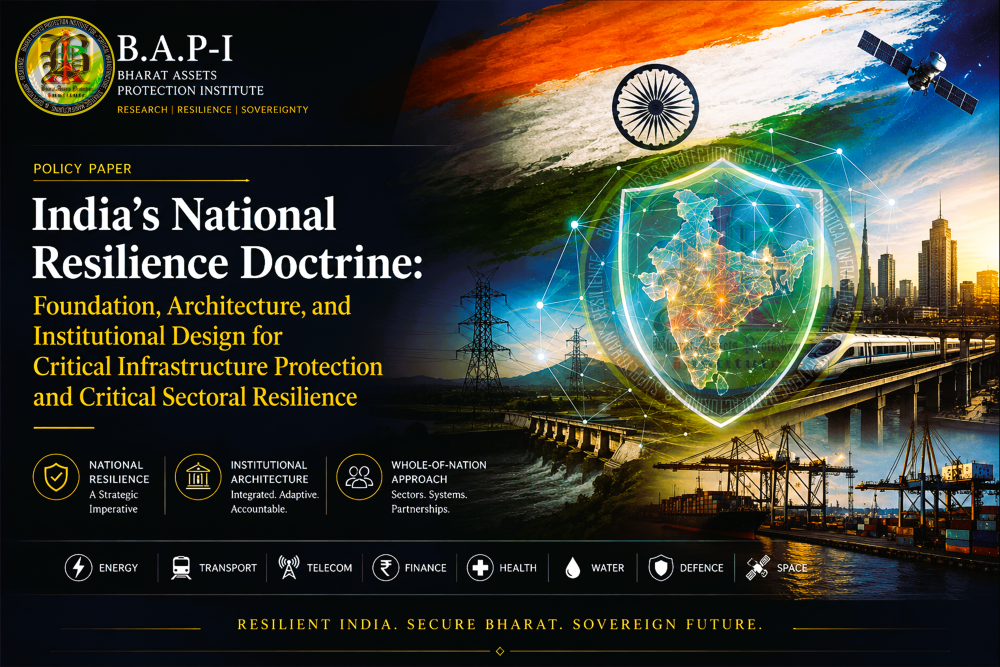
India’s National Resilience Doctrine: Foundation, Architecture, and Institutional Design for Critical Infrastructure Protection and Critical Sectoral Resilience

Dr. Padmalochan DASH30 Jan 2025
Abstract B.A.P-I National Resilience Series (BNRS)

India’s national security architecture has operated through two established pillars. External security is governed by the Ministry of Defence, the armed forces, and the external intelligence apparatus; while internal security is governed by the Ministry of Home Affairs, state home ministries, central police organisations, state police forces, and the domestic intelligence system. Between these two pillars lies a domain that has grown in strategic consequence faster than any institution has been built to govern it.

That domain is critical infrastructure and strategic sectoral clusters. India’s economy, security, and survival rest upon twelve strategic sectoral clusters encompassing more than 150 stand-alone sectors whose continuous functioning keeps the country operational and whose disruption would constitute a national function failure. These sectors encompass energy grids, communications networks, financial systems, transport corridors, health facilities, water supply systems, digital platforms, logistics chains, strategic manufacturing, satellite systems, maritime assets, and the commercial-industrial base; they constitute the material foundation upon which both external defence and internal governance depend. Without functioning infrastructure, external deterrence loses its industrial base; internal governance loses its delivery mechanisms; and the state’s capacity to function as a sovereign entity comes under direct threat. Yet this domain has had no dedicated doctrine, no statutory authority with cross-sectoral jurisdiction, no operational force, no independent audit mechanism, and no quantitative measurement framework. It has remained, in institutional terms, the unguarded centre of India’s national security.

This paper proposes the Bharat National Resilience Ecosystem (BNRE) as a national doctrine that positions critical infrastructure protection and critical sectoral resilience as the third pillar of India’s comprehensive national security. The doctrine is operationalised through an integrated institutional architecture comprising seven components: a unified legislative instrument (BIP-CARE, the Bharat Infrastructure Protection and Critical Assets Resilience Enactment); a national programme (BIP-CARP, the Bharat Infrastructure Protection and Critical Assets Resilience Programme); an apex governance directorate placed under the National Security Council (BIPCARD, the Bharat Infrastructures Protection and Critical Assets Resilience Directorate); a multi-stakeholder coordination platform bringing together sectoral operators, managers, and authorities (SOMA); an independent audit and assessment bureau for resilience measurement and synchronisation (RAS); a dedicated operational force trained for compound cyber-physical scenarios (Prahari); and a composite quantitative measurement index linking resilience performance to statutory consequences (BNRI, the Bharat National Resilience Index). Three doctrinal principles; Convergence, Distributed Resilience, and Measured Accountability; govern the ecosystem. A closed governance loop ensures that standards, implementation, assessment, and policy revision function as a continuous self-correcting cycle. The paper draws on comparative analysis of CIP regimes across the United States, European Union, Japan, Australia, Israel, and Singapore, and on the twelve-cluster BAP-I (Bharat Assets Protection Institute™) securitisation framework developed through the author’s doctoral and post-doctoral research programme (Dash, 2024; Dash, 2025, Jul. 1; B.A.P-I, (1)). The paper argues that no existing Indian institutional arrangement and no single international model combines all seven functions within one architecture; making the BNRE the first integrated national resilience doctrine designed for the full spectrum of cyber, physical, hybrid, environmental, economic, and geopolitical threats to critical infrastructure.

Read more
Bapi 16 bharat assets protection institute article cip b.a.p i

The Convergence of Critical Infrastructure Protection and Internal Security Management in India: Institutional Deficits and the Imperative of an Integrated Architecture

Dr. Padmalochan DASH22 Jan 2021
Abstract Article

India's critical infrastructure protection, when it comes to cyber-physical things including from the hybrid nature of threats, has remained without a dedicated statutory authority, a unified governance architecture, or an institutional mechanism where threat assessment, interdependency mapping and enforcement can integrate at the national level. This article examines the convergence of critical infrastructure vulnerabilities with the country's prevailing internal security management deficits, taking the events of 2025 including the coordinated cyber-physical assaults during Operation Sindoor as the empirical ground. By the means of comparative assessment of seven measured jurisdictions and diagnostic evaluation of the twelve-cluster BAP-I securitisation model against the existing NCIIPC framework, it is argued that sector-specific regulations and ad-hoc institutional arrangements are no longer tenable for the protection of India's critical sectors. The article traces the institutional failure to the same structural weakness that has characterised India's security reform trajectory since the post-1998 Kargil Review Committee process; and proposes the BIPCARD institutional architecture, the Critical Infrastructure Protection Act and the associated elements of SOMA, RAS, Prahari and the Bharat National Resilience Index as the integrated governance framework that the prevailing and emerging threat environment demands.

Read more