National Resilience | Deep-Tech Sovereignty | Strategic Preparedness
The Sector at a Glance
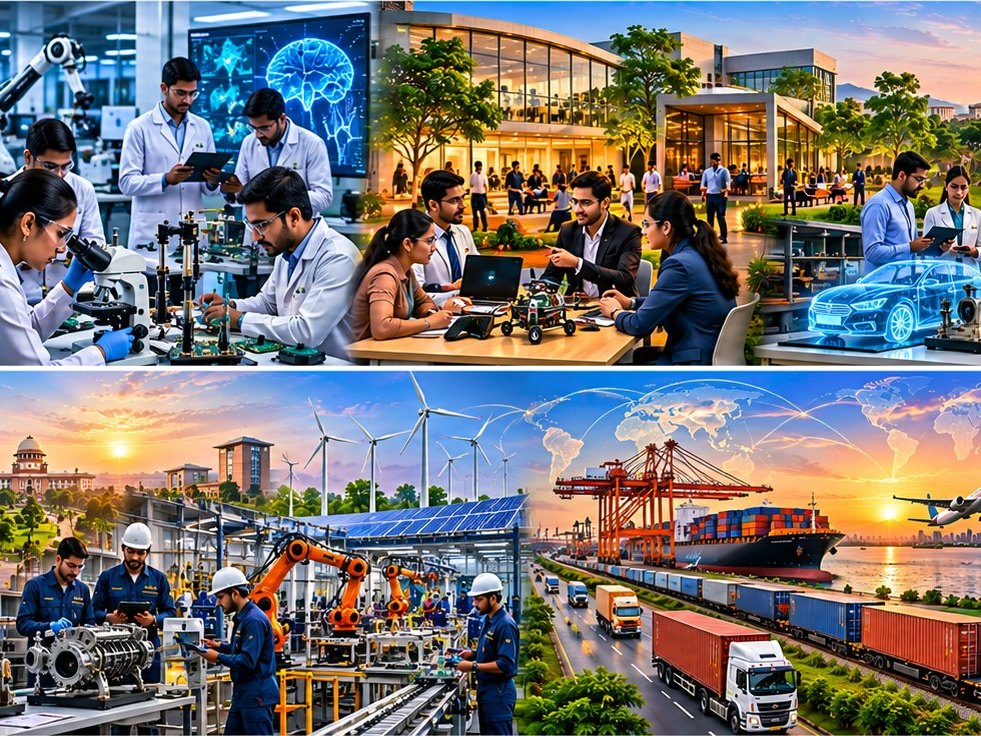
Deep-tech refers to ventures and products built on substantial scientific or engineering advances rather than on incremental changes to existing business models. The deep-tech commercialisation ecosystem is the system through which such advances move from research laboratories into qualified products, manufacturing lines and markets. The sector covered under this tab extends across semiconductors and advanced electronics, artificial intelligence and machine learning, quantum technologies, space technology, advanced materials and nanotechnology, biotechnology and synthetic biology, robotics and autonomous systems, advanced energy storage and clean energy technologies, photonics, and defence and dual-use technologies.
The scope of this tab is not limited to research breakthroughs. It covers the complete commercialisation pathway: discovery and invention, intellectual property protection, proof of concept, prototyping and pilot production, testing, certification and regulatory approval, first customer adoption, scale-up of manufacturing, and integration into national and global supply chains. It also covers the instruments that make this pathway possible, including patient capital, translational research funding, shared infrastructure, technology transfer arrangements, standards and public procurement. It is this complete pathway, and not the publication of papers or the filing of patents alone, that determines whether Bharat owns the technologies on which its security and prosperity will depend.
Why This Sector Is Critical
Deep-tech is where technological sovereignty is won or lost. The technologies that will define defence capability, economic competitiveness and critical infrastructure in the coming decades, including advanced chips, artificial intelligence, quantum communication and computing, space systems, advanced materials and biotechnology, are increasingly subject to export controls, technology denial and strategic competition among major powers. A nation that cannot commercialise its own deep-tech must import these capabilities on terms set by others, and in moments of crisis it may not be able to import them at all.
The vulnerabilities of the deep-tech pathway are distinctive. Development timelines are long and capital requirements are high; technical and market risk are both significant; specialised equipment, cleanrooms and testing facilities are expensive and scarce; regulatory and certification routes are often unclear; and early customers, particularly in government and defence, may be slow or reluctant to buy from unproven domestic suppliers. Many promising Indian research outcomes therefore fail in the so-called valley of death between laboratory and market, or are acquired and developed abroad. If deep-tech commercialisation fails, Bharat remains a consumer of strategic technologies, its scientific talent migrates, and the dependency travels upward into its defence, space, energy and digital systems; and this is why the BAP-I mandate treats deep-tech commercialisation as a core resilience concern.
The Bharat Context
Bharat possesses a strong base of scientific institutions, a large pool of engineering and research talent, and proven strategic programmes in space, atomic energy and defence research. A growing number of deep-tech start-ups are emerging in space, drones, semiconductor design, artificial intelligence, biotechnology and clean energy. Yet national investment in research relative to the size of the economy remains modest, private investment in deep-tech is limited, and links between academic research and industry are weak. Hardware and manufacturing-intensive ventures struggle to find patient capital, specialised facilities and early buyers, and the distance between laboratory demonstration and qualified, volume production remains the most persistent deficit of the ecosystem.
The enabling environment is now considerably stronger. The Anusandhan National Research Foundation, the India Semiconductor Mission, the National Quantum Mission, the IndiaAI Mission, the National Mission on Interdisciplinary Cyber-Physical Systems with its technology innovation hubs, the Technology Development Board, BIRAC for biotechnology, iDEX and the Technology Development Fund for defence, IN-SPACe for the opening of the space sector, and the National Green Hydrogen Mission together provide funding, infrastructure and policy support. Sovereign users such as DRDO, ISRO, the armed forces and public sector undertakings, along with the Make in India and Aatmanirbhar Bharat agendas, create demand for indigenous deep-tech. What remains missing is a unified research-to-resilience architecture that connects these missions, closes the valley of death and ensures that ownership of strategic technologies stays within Bharat; and this is the gap that BAP-I seeks to address through this tab.
Importance of the Sector
Economy
Deep-tech generates value that is unusually durable, because it rests on hard-to-replicate knowledge, protected intellectual property and specialised manufacturing capability. Successful deep-tech enterprises create new industries, attract high-value investment, reduce dependence on costly imported technology and generate exports with high value addition. Their spillovers reach far beyond their own sector: advances in materials, chips, artificial intelligence or biotechnology raise productivity across manufacturing, agriculture, health and infrastructure. It is argued that the long-term economic position of Bharat will be shaped less by the volume of what it produces and more by the depth of the technology it owns.
Employment
Deep-tech creates highly skilled employment for scientists, engineers, technicians, product developers and specialists in testing, certification, regulatory affairs and technology management. Scale-up of production then generates broader employment in precision manufacturing, assembly, quality assurance and field support. Deep-tech ventures also provide attractive opportunities that can retain Indian researchers who might otherwise move abroad and draw back members of the diaspora. The workforce challenge is considerable: the nation needs not only more doctoral researchers but also translational engineers, cleanroom and laboratory technicians, and managers who understand both science and business. Building this mix of skills is central to the employment dimension of this tab.
Entrepreneurship
Deep-tech entrepreneurship differs from conventional start-up activity. Founders are often researchers who must learn business, regulation and manufacturing; development cycles are long; and revenue may take years to arrive. Such ventures require patient capital, access to specialised facilities, clear technology transfer terms from their parent institutions, and early customers willing to buy and test indigenous products. Public procurement, challenge-based programmes in defence and space, milestone-based grants and shared pilot lines can shorten the route from prototype to qualified product. It is argued that Bharat's most strategically valuable enterprises of the coming decades will be built in deep-tech; provided that this route is made faster, cheaper and better supported.
Partnership
Deep-tech commercialisation cannot be achieved by any single actor. It requires partnership between research institutions and industry for technology transfer and joint development, between start-ups and large enterprises or public sector undertakings for manufacturing scale and market access, between government agencies and private investors for risk-sharing, and between sovereign users such as DRDO and ISRO and domestic suppliers for early adoption. International collaboration with trusted partners can accelerate access to equipment, materials and markets, but must be structured to build indigenous capability and protect strategic intellectual property. BAP-I positions itself as the convening platform where scientists, founders, investors, industry and policymakers can work on shared research questions.
Research Focus Possibilities
BAP-I invites original research articles, policy papers, technical reports, diagnostic assessments, case studies and white papers across the following indicative research streams. The list is open-ended; contributions that connect a new question to the resilience objective of this tab are equally welcome.
A. The Valley of Death and Translational Pathways
- Mapping where Indian deep-tech ventures fail between proof of concept and volume production, by technology domain, with case studies of successful transitions
- Technology transfer policies of Indian research institutions: licensing terms, equity models, faculty entrepreneurship rules and their effect on commercialisation
- Shared pilot lines, testbeds and prototyping facilities: utilisation, access pricing and gaps by domain
B. Capital, Procurement and Market Creation
- Patient capital for deep-tech: assessment of grant, venture, venture debt and blended finance instruments and the gaps between them
- Public procurement as a market maker for indigenous deep-tech, including defence and space challenge programmes and their conversion into production orders
- Valuation and investment due diligence methods suited to long-horizon, technology-intensive ventures
C. Strategic Technologies and Sovereignty
- Commercialisation roadmaps for priority domains such as semiconductors, quantum technologies, space systems, advanced materials and energy storage
- Export controls, technology denial and foreign ownership risks in Indian deep-tech ventures, and safeguards for strategic intellectual property
- Dual-use technology governance: enabling civilian markets while protecting security interests
- Critical inputs for deep-tech manufacturing, including specialty materials, equipment and software tools, and options to diversify supply
D. Talent, Standards and Ecosystem Design
- Workforce requirements for deep-tech scale-up, including translational engineers, technicians and technology managers, with curriculum gap analysis
- Standards, testing and certification pathways for new technologies, and the role of BIS and sector regulators
- Co-ordination across national missions such as the India Semiconductor Mission, National Quantum Mission and IndiaAI Mission, and the design of a unified commercialisation framework
- Retaining and attracting deep-tech researchers and diaspora founders to build ventures in Bharat
Who Can Participate
This tab invites participation from deep-tech founders and start-ups, IITs, IISc, IISERs, NITs, CSIR laboratories and other research institutions and their technology transfer offices, DRDO, ISRO, DAE and other sovereign research and user agencies, public sector undertakings and private manufacturers, the Anusandhan National Research Foundation, BIRAC, the Technology Development Board and mission directorates, venture and institutional investors, incubators specialising in deep-tech, standards and certification bodies, intellectual property practitioners, policy think tanks, international collaborators and individual researchers with domain expertise. Contributions from practitioners, policymakers and academics carry equal standing within the BAP-I research framework.
The Resilience Objective
Every contribution under this tab must serve one purpose: strengthening Bharat's capacity to carry its scientific and engineering advances from the laboratory to qualified products and markets, so that the nation owns its strategic technologies as a sovereign, self-reliant and globally competitive national asset. BAP-I treats research as the instrument through which deep-tech resilience is identified, measured and built.