Search

Focus area 3 of 6 · The Viswaguru Project

Supply Chains

Resilience and security of logistics networks, supply chain diversification, and the movement infrastructure that sustains national operations.

11 publications tagged

Focus area 3 of 6

About this focus area

Supply Chain is one of the six focus areas of the Viswaguru Project, the Bharat National Resilience Mission, and one of the lenses through which India's national resilience is understood, strengthened and advanced. It draws on several of the twelve Research Focus clusters and their 148 sectors, chiefly Logistics & Supplychain, Blue-Water Infra & Economy and Global Partnership, and brings their findings together into one resilience picture.

Resilience and security of logistics networks, supply chain diversification, and the movement infrastructure that sustains national operations. The project places supply chain within the eight-stage resilience cycle of Understand, Map, Assess, Protect, Strengthen, Govern, Sustain and Advance, so that research, policy and institutional capacity building in this area stay aligned with the national mission.

Each publication tagged to supply chain is read against the four resilience metrics: Critical Dynamics and Resilience Parameters (CDRP), Ecosystem Intelligence (EI), the National Resilience Data Grid (NRDG) and Ecosystem Resilience (ER). Together they will feed the Bharat National Resilience Index (BNRI) once its methodology is published, so that no dimension of resilience is studied in isolation.

Contributions are welcome from strategic studies, public policy, engineering, economics, international relations, law and management. The institute looks for work that connects research with operational policy, and builds a body of knowledge on supply chain that is rigorous and usable by those who make and carry out decisions.

The Viswaguru Project

Four resilience metrics

B.A.P-I Publications

Publications on Supply Chains

Book review modern supply chain playbook

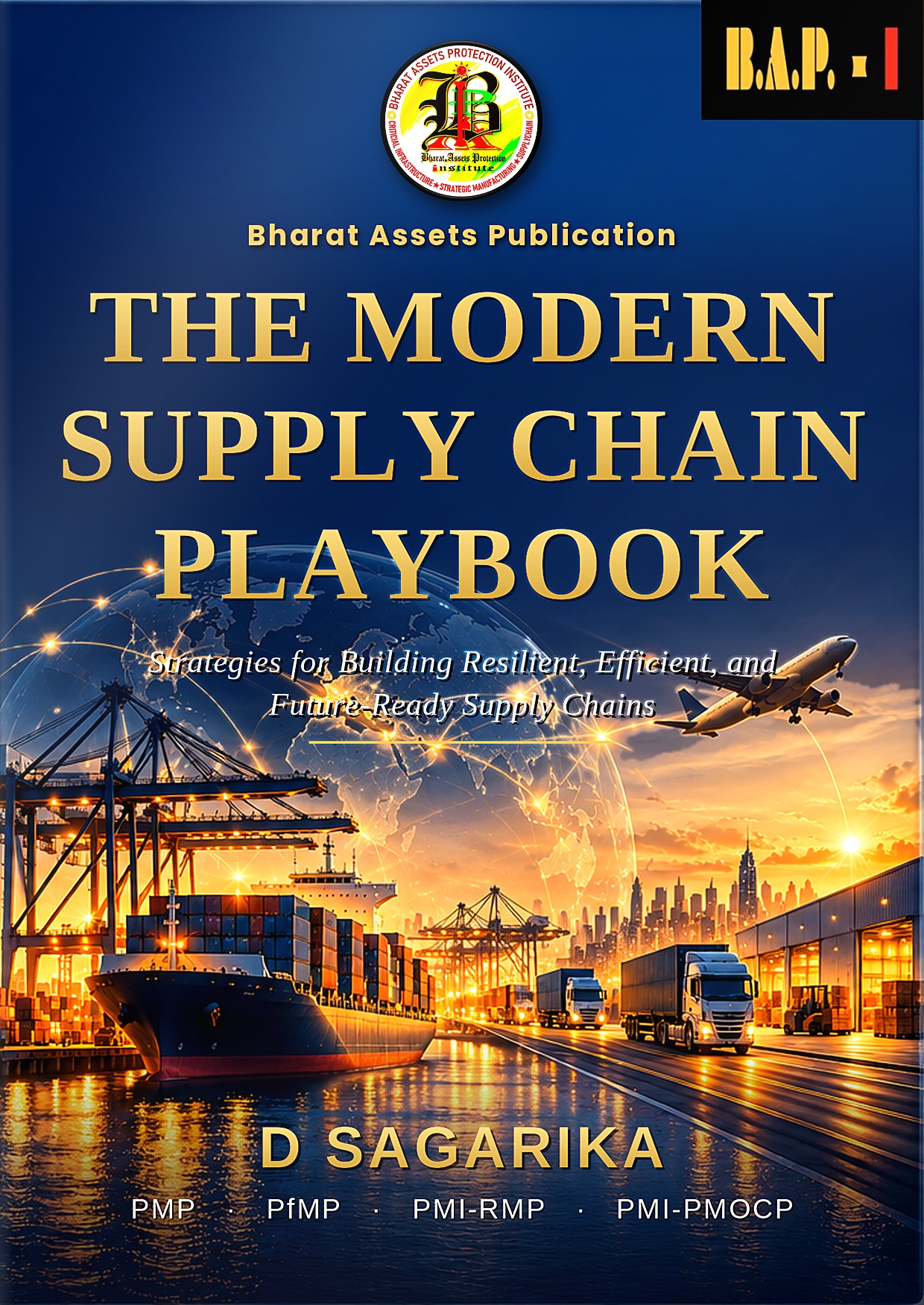
Designing Supply Chains as One System: A Review of The Modern Supply Chain Playbook by D Sagarika

Bharat Assets Protection Institute™20 Oct 2026
Abstract Book Review

Supply chains built only for efficiency have struggled with the volatility of recent years. This review examines The Modern Supply Chain Playbook: Governance, AI, Human Capability, and Customer-Driven Excellence by D Sagarika, a forthcoming book from Bharat Assets Publication. Drawing on the manuscript overview, chapter plan and research structure, it follows the book's eighteen chapters across five parts: foundations and customer-backwards design; system design, governance and risk; people, capability and organisational maturity; AI, platforms and the capability gap in Indian manufacturing; and the integrating idea of the Supply Chain Flywheel. It identifies the book's strengths as its research base of thirty-six supporting articles, its treatment of governance as design, its serious attention to people and its view of power in platform-led freight markets, sets out what readers will look for in the published text, and considers its relevance to India.

Read more
Book review logistics supply chain compliance

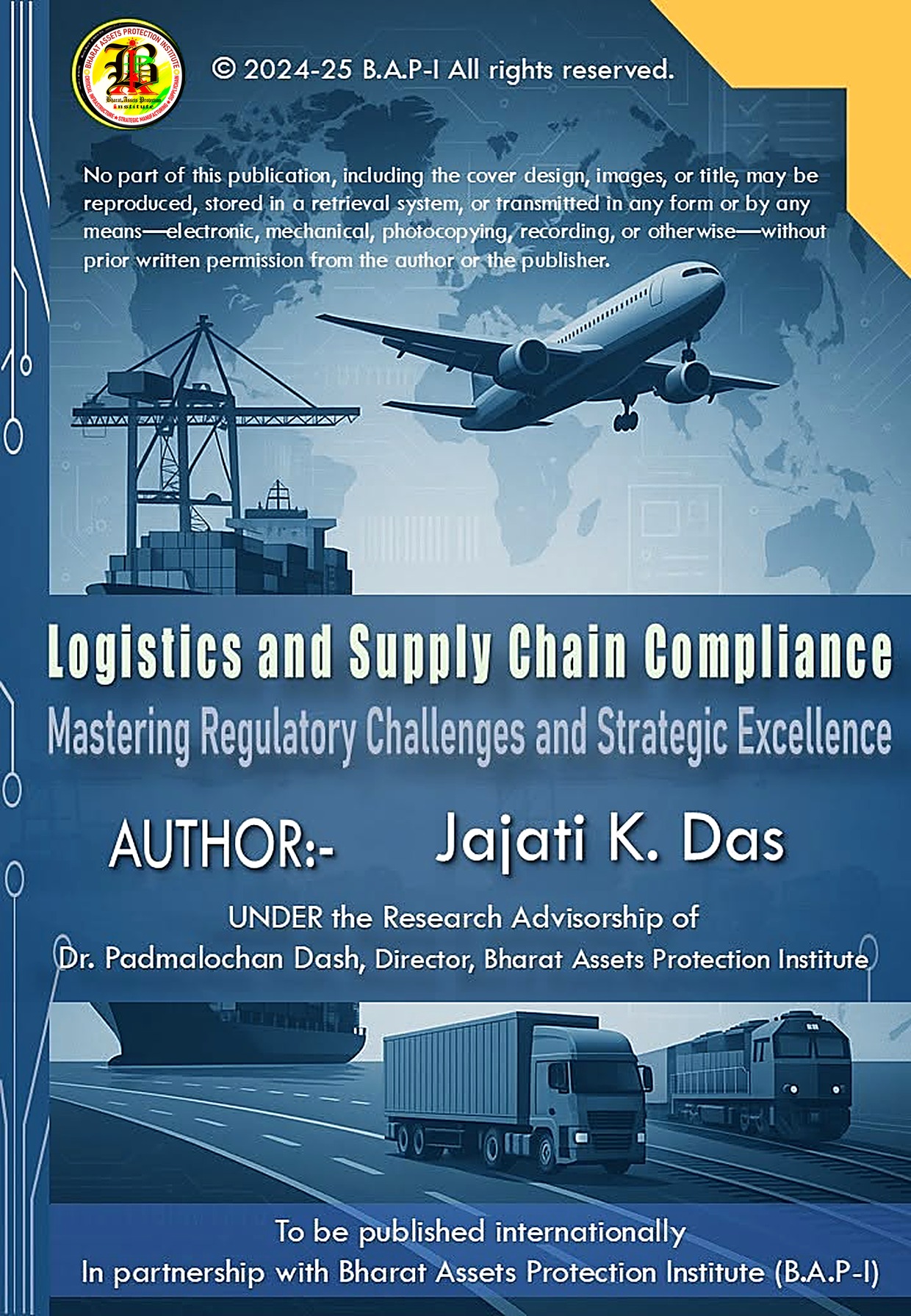
Compliance as Strategy: A Review of Logistics and Supply Chain Compliance by Jajati K. Das

Bharat Assets Protection Institute™16 Oct 2026
Abstract Book Review

Compliance has moved from the back office to the centre of supply chain strategy. This review examines Logistics and Supply Chain Compliance: Mastering Regulatory Challenges and Strategic Excellence by Jajati K. Das, a forthcoming book prepared in partnership with the Bharat Assets Protection Institute™ under the Research Advisorship of Dr. Padmalochan Dash. Drawing on the manuscript overview and chapter plan, the review traces the book's twelve chapters across four movements: strategic foundations; the regulatory landscape of customs, sector rules and ESG; operational execution in warehousing, transport and digital governance; and governance maturity, culture and future regulation. It identifies the book's main strengths as a clear business case for compliance, an integrated treatment of functions usually covered separately, serious attention to leadership and culture, and a forward-looking outlook. It also sets out what readers will look for in the published text, including worked examples, links to Indian instruments and practical tools, and considers the book's relevance to supply chain resilience in India.

Read more
India japan bharat assets protection institute

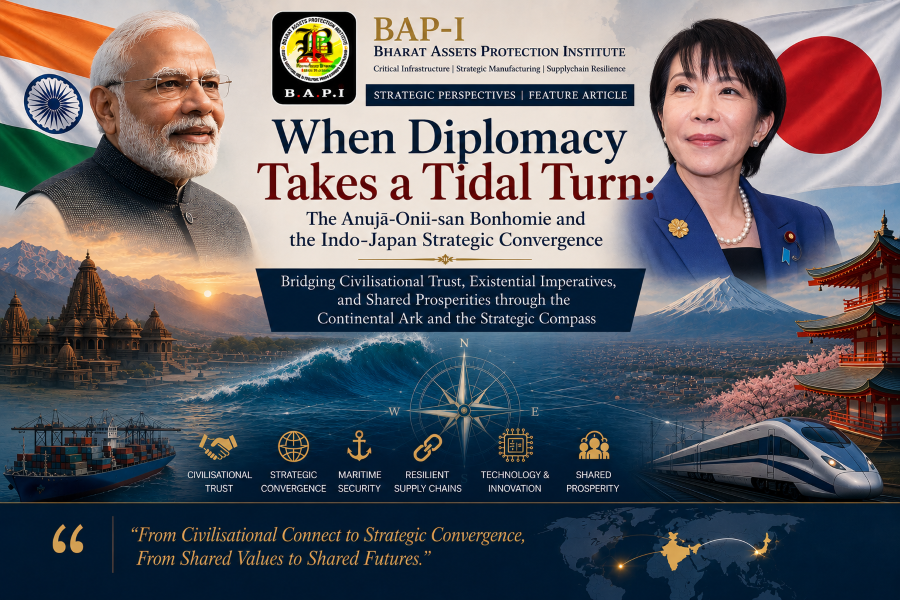
When Diplomacy Takes a Tidal Turn: The Anujā-Onii-san Bonhomie and the Indo-Japan Strategic Convergence

Dr. Padmalochan DASH07 Jul 2026
Abstract Expert Perspective

The Sixteenth India-Japan Annual Summit of July 2026 introduced the imagery of civilisational bonhomie into contemporary statecraft when Prime Minister Narendra Modi addressed Japanese Prime Minister Sanae Takaichi as his “younger sister” and the relationship was reciprocally framed through the vocabulary of an elder brother. This article argues that the Anujā-Onii-san Bonhomie Diplomacy is not a symbolic gesture alone but a strategic multiplier that accelerates convergence across security, economic resilience, critical infrastructure, technology, maritime cooperation, and Indo-Pacific governance. It proposes that Japan’s deepening engagement with India is driven by two existential imperatives that operate beneath the surface of summit declarations: capital continuity, arising from an ageing, demographically declining economy whose accumulated savings and industrial capital require a safe, growing, and trusted continental destination for long-term preservation; and geographic insurance, arising from an archipelago situated on the Ring of Fire, seismically and volcanically exposed, climatically vulnerable to intensifying typhoons, rising sea levels, and the spectre of territorial contraction, for which India’s vast continental landmass, demographic dividend, and resource base represent a civilisational insurance partner without parallel in the Indo-Pacific. It is argued that these two imperatives together explain why the India-Japan partnership is evolving beyond conventional bilateral cooperation into a structural programme through which Japan’s critical infrastructure ecosystems, strategic manufacturing ecosystems, and supply chain ecosystems are being gradually transferred, preserved, banked, partnered, and maintained with India through a mixed approach that ensures their survival and operational continuity regardless of what the future holds for the Japanese archipelago. The article examines this convergence across five strategic domains and concludes that the partnership constitutes the construction of a continental ark for Japan’s civilisational, industrial, and technological inheritance. It concludes that India must accept what the ark carries because it serves Bharat’s own industrial transformation; but the compass of strategic autonomy must remain in Indian hands, for the freedom to define its own Indo-Pacific choices is the one civilisational inheritance that India cannot afford to entrust to anyone else.

Read more
Critical minerals and india&

Critical Minerals and India's Strategic Manufacturing Ecosystem: Repositioning India within the Emerging Digital-Industrial Order

Dr. Padmalochan DASH26 May 2026
Abstract Research Paper

The transition of critical minerals from peripheral industrial inputs to foundational strategic assets marks one of the defining shifts within the contemporary digital-industrial order. These resources now underpin the full breadth of advanced manufacturing spanning semiconductor fabrication, renewable-energy infrastructure, defence-industrial production, artificial intelligence computing ecosystems, and the overarching architecture of technological sovereignty. Intensifying geopolitical competition over mineral access, downstream refining capability, and manufacturing integration has accompanied the global acceleration toward electrification, clean-energy deployment, and digitally integrated industrial systems. Against this backdrop, the present paper examines the strategic significance of critical minerals within a wider framework encompassing industrial resilience, national security imperatives, supply-chain vulnerability, and techno-economic rivalry. India's structural predicament characterised by deep import dependence, insufficient refining infrastructure, binding technological constraints, and limited downstream integration despite substantial rare earth potential is evaluated in detail. The paper further analyses the strategic relevance of lithium, cobalt, nickel, copper, graphite, rare earth elements, gallium, germanium, silicon, titanium, and other technologically indispensable minerals across defence, energy, semiconductor, and strategic manufacturing domains. Adopting a B.A.P-I analytical perspective, the study advances the argument that critical minerals must be embedded within India's long-term strategic resilience architecture specifically the Bharat National Resilience Index (BNRI), where mineral security intersects with Critical Infrastructure Protection, industrial sovereignty, supply-chain resilience, and comprehensive national security planning.

Read more
Dr padmalochan dash bapi food security bharat assets

Turning Fiscal Liability into Nutrition Security- Proposing the MAHĀBHĀRAT–TASTE TOURISM NETWORK-ODISHA: A Statewide Antardaya-Integrated Food Sovereignty, Disaster Nutrition and Heritage Tourism Infrastructure Framework

Bharat Assets Protection Institute™, Dr. Padmalochan DASH09 Jan 2026
Abstract Case Studies

Turning Fiscal Liability into Nutrition Security: Proposing the MAHĀBHĀRAT–TASTE TOURISM NETWORK-ODISHA:

A Statewide Antardaya-Integrated Food Sovereignty, Disaster Nutrition and Heritage Tourism Infrastructure Framework

Policy White Paper for Institutional Adoption,

Pilot Implementation and Statutory Structuring


This White Paper proposes a fundamental restructuring of Odisha’s food security and tourism architecture by transforming nutrition from a recurring fiscal liability into a self-financing public infrastructure system. It advances the Mahābhārat–Taste Tourism Network as a statewide civilisational food circulation framework that integrates tourism movement, decentralised livelihood generation, Antardaya-positioned welfare provisioning and standing disaster nutrition readiness into a single territorial governance field. The proposed architecture redefines tourism as regulated public circulation rather than hospitality commerce, and formalises food as a stabilising public medium through which dignity feeding, hospital nutrition continuity, surplus redistribution and emergency feeding capacity are institutionalised as permanent public functions.

Through the Antardaya Seva Bhojan Sangrahalaya pooling architecture, routine tourism consumption is converted into a continuous nutrition financing stream that sustains orphanages, old-age homes, hospital attendant feeding networks and disaster nutrition vaults. Temple annadānam corridors, tribal superfood belts, forest produce kitchens, highway millet parks, coastal night districts and urban heritage rasoi zones are structurally reorganised as living public food infrastructure estates operated by local families, Self-Help Groups and tribal collectives. Inter-state heritage food corridors are further proposed to formalise India’s diverse culinary traditions as regulated public nutrition economies embedded within Odisha’s territorial circulation field.

The White Paper introduces a unified Single Window Control Architecture, integrated digital governance grids, consolidated fiscal routing gateways, sanitation and food safety control systems, transport mobility command networks, ecological compliance frameworks and professional human resource cadres to institutionalise accountability, transparency, disaster readiness and employment continuity across the entire network. Collectively, the framework positions Odisha as India’s first Food Sovereignty Tourism State, where daily tourism movement functions as deployable nutrition infrastructure, decentralised livelihood machinery and permanent disaster feeding capacity embedded within routine public circulation rather than episodic welfare intervention.

Read more
Critical minerals

G20 Johannesburg and the Critical Minerals Turn: India’s Strategic Push for Shared Governance and Global South Resilience

Bharat Assets Protection Institute™, Dr. Padmalochan DASH23 Nov 2025
Abstract Policy Commentary

Critical minerals emerged as a central governance priority in the Johannesburg G20 deliberations, positioned alongside energy transition, digital governance and climate resilience. The Leaders’ Declaration affirmed the creation of a “G20 Critical Minerals Framework… for sustainable development, inclusive economic growth, and resilience” (ANI, Nov. 23, 2025). India advanced a norm-shaping role by proposing a “G20 critical minerals circularity initiative to promote recycling, urban mining, second-life batteries and related innovations” (PTI News, Nov. 22, 2025) and calling for a “G20 Open Satellite Data Partnership” to make shared space-based analytics accessible to the Global South (MEA, Nov. 22, 2025). The discussions acknowledged structural inequities, including supply concentration and the reality that China is “leverag[es] its chokehold over rare and critical minerals” (TOI, Nov. 23, 2025), while recognising that many producer states face “under investment, limited value addition and beneficiation, [and] lack of technologies” (ANI, Nov. 23, 2025). India’s framing that “critical minerals… should be seen as a shared resource for humanity” (MEA, Nov. 22, 2025) encapsulated an emerging shift toward equity-based governance, circular value chains and Global South leadership in minerals policy.

Read more
Bapi retro 19

Thirty Times the Threshold: The Francis Scott Key Bridge Collapse of 2024 and the Case for Vessel-Collision Risk Assessment of India's Bridges, Ports and Approach Channels

Dr. Padmalochan DASH17 Dec 2024
Abstract Case Studies

On 26 March 2024 the container ship Dali lost electrical power twice while leaving Baltimore, struck a pier of the Francis Scott Key Bridge and brought the bridge down, killing six highway workers and blocking the main shipping channel into the port of Baltimore until June. The National Transportation Safety Board traced the blackout to a single loose wire, but its more consequential finding concerned the bridge: it was almost thirty times above the accepted risk threshold for vessel collapse, no vulnerability assessment had been done, and dozens of other bridges were in the same position. This retrospective paper reviews what the Board found, including its finding that the Indian crew's initial response was timely, and draws the lesson for India, whose ports now receive the world's largest container ships. It argues that India can lead by adopting a mandatory, periodic vessel-collision risk assessment of every bridge over a navigable channel, pier protection where thresholds are exceeded, and motorist and worker warning systems tied to port control.

Read more
Bapi retro 15

The Long Way Round: Red Sea Shipping Attacks, the Indian Navy's Response and Chokepoint Risk in India's Maritime Supply Chains

Dr. Padmalochan DASH15 Mar 2024
Abstract Case Studies

From November 2023 Houthi attacks on merchant shipping in the Red Sea forced much of the shipping between Asia and Europe away from the Suez Canal and around the Cape of Good Hope. This retrospective examines what the crisis meant for India, half of whose exports moved through the Bab-el-Mandeb corridor. Drawing on official statements, parliamentary replies, naval releases and Indian trade analysis, it traces the rise in container freight rates, longer transit times and the uneven effect on exporters, together with the Government's measures to keep export credit cover affordable. It gives particular attention to the Indian Navy's response: the deployment of destroyers after the attack on Chem Pluto, the rescues of the crews of Lila Norfolk, Marlin Luanda and Ruen, and the first hundred days of Operation Sankalp, in which more than 110 lives were saved. The paper argues that India met the crisis with capability and recommends sector-wise chokepoint mapping, longer buffer horizons for critical inputs and standing doctrine built on the Sankalp model.

Read more
Bapi retro 10

When the Coal Ran Short: The Power Crisis of April 2022 and the Lessons for India's Energy Supply Chain

Dr. Padmalochan DASH06 Oct 2022
Abstract Case Studies

In April 2022 India's electricity system met a record peak demand while coal stocks at thermal power plants fell to about a third of the normative requirement. The Railways cancelled hundreds of passenger train services to free track for coal rakes, the Ministry of Power directed generators to import coal for blending and invoked emergency provisions of the Electricity Act, and fifty plants were left holding less than a tenth of their required stock. This retrospective revisits the episode with the benefit of four years of hindsight. It reconstructs the numbers from official and established sources, explains why a country with large coal reserves and rising production nonetheless came close to a generation crisis, and follows the recovery that brought plant stocks to record levels by 2025. It credits the coordinated response of the coal, power and railway ministries, which kept supply going through a record peak, and argues that lasting energy resilience depends on mandated buffers, logistics redundancy, commercial discipline and a single picture of risk across mines, rail and power stations.

Read more
Bapi retro 04

Oxygen on the Move: How India Mobilised Medical Oxygen Logistics in the 2021 Second Wave, and the Lesson for Critical Health Infrastructure

Dr. Padmalochan DASH14 Oct 2021
Abstract Case Studies

In April and May 2021, as the second wave of COVID-19 placed heavy demands on Indian hospitals, demand for medical oxygen rose to nearly three times its first-wave peak. Meeting it required moving liquid medical oxygen quickly from a production base concentrated in the eastern industrial belt to hospitals in the north and west. This case study revisits that effort as a logistics and supply-chain achievement. It examines the orders issued under the Disaster Management Act, 2005 that directed industrial oxygen to medical use and guaranteed free inter-state movement of tankers, the expansion of production and of the tanker fleet, the Oxygen Express trains run by Indian Railways, the airlift of tankers and containers by the Indian Air Force and the deployment of Indian Navy ships, and the Supreme Court's National Task Force on scientific allocation. It then considers the distributed oxygen capacity built afterwards. The paper argues that medical oxygen should now be designated as critical health infrastructure, with a standing logistics reserve, tracked fleets and a tested allocation protocol.

Read more
Bapi retro 02

Keeping the Lifelines Running: How India Sustained Essential Services and Freight in the 2020 Lockdown, and the Case for a Standing Continuity Doctrine

Dr. Padmalochan DASH27 Dec 2020
Abstract Case Studies

India's first national lockdown, ordered on 24 March 2020 under the Disaster Management Act, 2005, suspended passenger transport and most commerce while exempting a list of essential services and the movement of essential goods. This retrospective examines how those lifelines were kept running. The legal architecture worked by exemption, and the Ministry of Home Affairs refined it through prompt clarifications as conditions on the ground became clear. Road freight faced constraints of labour and supporting services, which the Government addressed through measures on crew movement, staff passes, toll suspension and the Kisan Rath platform. Indian Railways kept freight moving, raised foodgrain loading above the previous year and ran thousands of Parcel Special trains. The paper credits these achievements and argues that the next step is to convert the experience of 2020 into a standing lifeline continuity doctrine, building on the 2025 amendments to the Disaster Management Act, that designates lifeline sectors and their enabling services in advance.

Read more