Mining, Minerals & Strategic Raw Materials
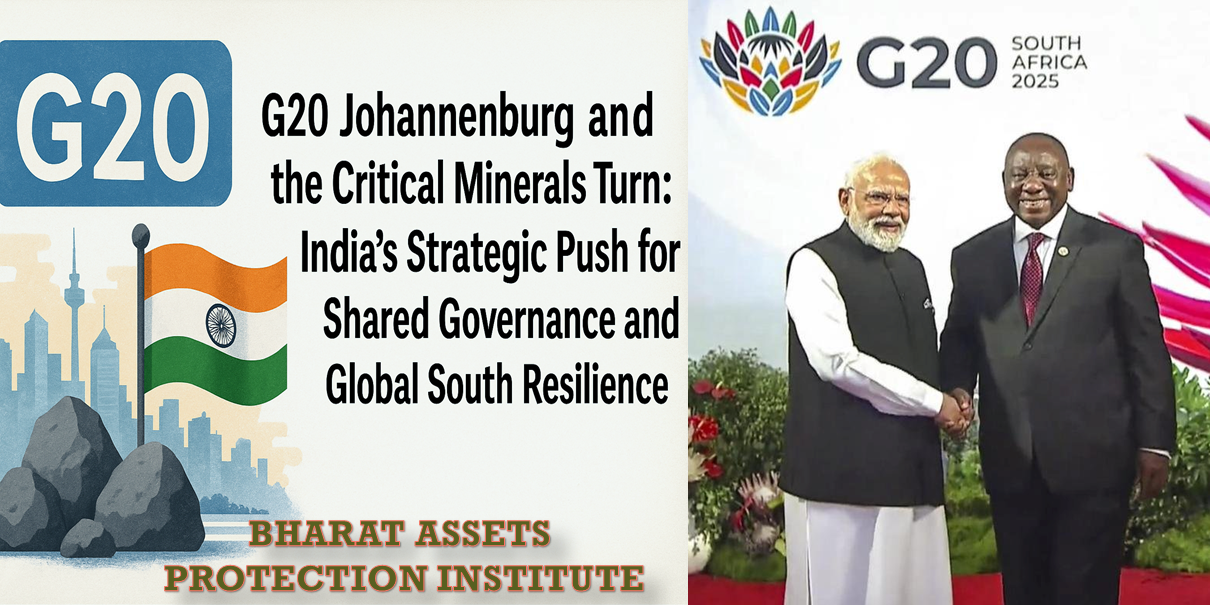
Critical minerals emerged
as a central governance priority in the Johannesburg G20 deliberations,
positioned alongside energy transition, digital governance and climate
resilience. The Leaders’ Declaration affirmed the creation of a “G20 Critical
Minerals Framework… for sustainable development, inclusive economic growth, and
resilience” (ANI, Nov. 23, 2025). India advanced a norm-shaping role by
proposing a “G20 critical minerals circularity initiative to promote recycling,
urban mining, second-life batteries and related innovations” (PTI News, Nov.
22, 2025) and calling for a “G20 Open Satellite Data Partnership” to make
shared space-based analytics accessible to the Global South (MEA, Nov. 22,
2025). The discussions acknowledged structural inequities, including supply
concentration and the reality that China is “leverag[es] its chokehold over
rare and critical minerals” (TOI, Nov. 23, 2025), while recognising that many
producer states face “under investment, limited value addition and
beneficiation, [and] lack of technologies” (ANI, Nov. 23, 2025). India’s
framing that “critical minerals… should be seen as a shared resource for
humanity” (MEA, Nov. 22, 2025) encapsulated an emerging shift toward
equity-based governance, circular value chains and Global South leadership in
minerals policy.
Keywords : Critical minerals governance, circular economy, Global South cooperation, supply-chain resilience, satellite data partnership, technology access equity, sustainable energy transition, value addition and beneficiation, geopolitical de-risking, multilateral resource diplomacy
1. Global Relevance of
Critical Minerals in the G20 Policy Architecture
Critical minerals entered
the Johannesburg G20 Summit as a structural theme shaping the architecture of
global economic governance rather than a sectoral topic. The agenda made this
explicit by confirming that “the final session, ‘A Fair and a Just Future for
All,’ will take up critical minerals, decent work and the governance of
artificial intelligence” (TNIExp., Nov. 19, 2025). The placement showed that
minerals are linked to work, technology regulation and distributional equity.
They now sit within the same policy register as AI oversight and labour
standards because the ability to secure, refine and govern minerals will
determine who controls advanced manufacturing, energy technologies and digital
supply chains.
The formal declaration
affirmed this shift, stating that “the G20 emphasised the establishment of the
G20 Critical Minerals Framework, aimed at leveraging critical minerals as a
catalyst for sustainable development, inclusive economic growth, and resilience”
(ANI, Nov. 23, 2025). The language indicated that minerals are no longer
treated as commodities traded in global markets but as instruments of
developmental leverage and geopolitical stability. The emphasis on resilience
acknowledged that uninterrupted access is now a security concern, given
concentrated supply patterns and geopolitical exposure.
India shaped the normative
edge of this discussion. The statement that “sustainability and clean energy
are essential for global growth. Critical minerals are crucial for this and
should be seen as a shared resource for humanity” (MEA, Nov. 22, 2025) placed
minerals within a distributive justice frame. The appeal for shared access
challenged monopolistic control structures and aligned with the Global South’s
demand for fairer participation in green industrialisation. This position
connected minerals to a rights-based development vision rather than a
competition-driven extraction economy.
The discussions also
reflected the scale of structural dependence forming around minerals.
Industrial restructuring, battery manufacturing, renewable grids, defence
platforms and digital infrastructure all require predictable mineral access.
These links were visible across statements and reporting, where minerals were
consistently linked to clean energy transitions, supply chain security and
technological capability. The policy narrative showed that critical minerals
now operate as a foundation layer for future economic governance, where
questions of access, processing, technology transfer and environmental
responsibility define the new contours of power within the G20 policy space.
2. India’s Strategic
Positioning as a Norm-Setter in Critical Mineral Diplomacy
India’s strategic posture
at the Johannesburg G20 Summit showed a thoughtful move to shape the rules
governing critical minerals rather than merely participate in them. The
bilateral meeting with Australia illustrated this shift, where cooperation
expanded across “defence and security, energy, trade and investment, critical
minerals, technology, mobility, education and people-to-people linkages” (DH.,
Nov. 22, 2025). This indicated that minerals are now embedded within broader
strategic, commercial and technological cooperation rather than treated as a
trade commodity. The geopolitical context reinforced this role, with reporting
noting that the summit marked “the fourth consecutive G20 Summit held in the
Global South,” reflecting a change in global leadership influence and agenda
control by developing economies (TNIExp., Nov. 19, 2025). India’s interventions
aligned with this environment and projected confidence rather than
proposal-testing. It was reported that “the gathering emphasised recycling,
urban mining, and battery innovations as part of India's commitment to a
greener future” (Devdis., Nov. 22, 2025). This message placed India in a
leadership role that promotes innovation and circular value chains for minerals
rather than dependence on primary extraction or external processing hubs. The
approach also reflected a broader ambition for rule-shaping authority within
the G20. India’s emphasis on recycling, technology and equitable access
signalled its intention to drive structural change in how minerals are governed
and distributed. The position suggested that India is not seeking entry into an
established mineral order but intends to redefine it around circularity, value
retention and fair participation for economies with limited historical
industrial advantage.
3. The G20 Critical
Minerals Circularity Initiative: Scope and Policy Logic
India’s proposal for a
circular minerals system at the Johannesburg Summit demonstrated a structured
policy direction rather than a symbolic diplomatic gesture. The initiative
appeared across multiple official and media references, consistently described
as “a G20 critical minerals circularity initiative to promote recycling, urban
mining, second-life batteries and related innovations” (PTI News, Nov. 22,
2025; Fp., Nov. 23, 2025; B.S., Nov. 22, 2025). The repetition signalled
intentional agenda-setting and an effort to normalise circularity as a
governing framework within G20 policy language. The framing rejected the
adequacy of linear extraction models in the current geopolitical and industrial
context. Statements noted that “the creation of the Critical Minerals
Circularity Initiative will foster recycling, urban mining, second-life battery
projects and related innovations,” with the objective of strengthening “supply
chain security and develop cleaner pathways of development” (NOA, Nov. 23,
2025). The wording reflects a shift toward recycling-led supply models as
demand grows and supply concentration becomes strategically risky.
Circularity was presented
as a risk governance mechanism rather than solely a sustainability measure. The
initiative aligned with India’s position that “sustainability and clean energy
are essential for global growth” and that critical minerals “should be seen as
a shared resource for humanity” (MEA, Nov. 22, 2025). The phrasing placed
minerals within a cooperative and redistribution-oriented framework,
challenging existing supply hierarchies dominated by limited processing
countries. The proposal also fit within wider G20 discussions on resilience,
just transitions and climate-linked industrial restructuring, where circularity
was portrayed as essential to predictable mineral access and reduced
geopolitical exposure.
Across speeches and
reporting, the consistency of language indicated that India sought to
institutionalise circular governance rather than float exploratory policy
language. The emphasis on recycling infrastructure, standards, and long-term
innovation-based sourcing presented circularity as a structural model shaping
the next phase of mineral governance, industrial capability and energy
transition strategy within G20 deliberations.
4. Sovereignty, Value
Addition, and Equitable Resource Governance for the Global South
Sovereignty and equitable
value retention formed a critical thread of the Johannesburg discussions and
positioned critical minerals within a justice-oriented governance narrative.
The G20 declaration affirmed that the proposed framework “fully preserves the
sovereign right of mineral-endowed countries to harness their endowments for
inclusive economic growth, while ensuring economic, social and environmental
stewardship” (ANI, Nov. 23, 2025). The phrasing directly confronted historical
extraction patterns where mineral-rich economies exported raw ore while
processing, technology development and strategic value creation were
concentrated elsewhere. This shift signalled a wider demand for governance
models that avoid repeating extractive dependency under new clean energy
transitions.
The declaration
acknowledged persistent structural constraints that prevent mineral-endowed
developing economies from capturing downstream benefits. It recognised that
“producer countries, especially in the developing world, are confronted with
challenges of under investment, limited value addition and beneficiation, lack
of technologies as well as socio-economic and environmental issues” (ANI, Nov.
23, 2025). The explicit reference to beneficiation and value addition suggested
a move toward rebalancing the mineral economy by linking extraction with
domestic manufacturing capability, skills pipelines, and technological
infrastructure. The language indicated an expectation that mineral wealth must
translate into industrial capability rather than merely supply external
manufacturing networks.
India’s wider framing
aligned with this position and emphasised shared responsibility rather than
unilateral exploitation. The statement that “critical minerals are crucial for
this and should be seen as a shared resource for humanity” (MEA, Nov. 22, 2025)
framed minerals within a collective equity logic instead of a competitive
resource capture model. This orientation suggested that governance structures
must balance sovereign ownership with fair access frameworks, particularly for
emerging economies navigating the clean energy transition with limited
technological leverage.
The alignment of narratives
across summit statements and reporting reflected a coherent Global South
position. The discussion pointed toward a shift from extractive dependency
toward regulated stewardship, where minerals serve long-term domestic development,
supply chain empowerment and fair participation in global markets. The
references to investment gaps, technology asymmetry and value retention
challenges underscored a clear transition toward resource governance based on
control, capability and equitable participation, rather than export-led
extraction cycles.
5. Supply Chain
Diversification and Strategic Resilience
Supply chain
diversification entered the Johannesburg discussions as a strategic necessity
shaped by real-world vulnerabilities rather than a theoretical aspiration.
Media reporting underscored the geopolitical context with clarity, noting that
the initiative was emerging at a time when China was “leverag[es] its chokehold
over supply of rare and critical minerals to further its strategic goals” (TOI,
Nov. 23, 2025). This framing identified mineral access as a determinant of
national leverage, industrial capability and policy autonomy, and signalled
that concentrated control over extraction and processing is already influencing
global power balances.
India’s intervention framed
circular economy principles as a resilience strategy rather than a purely
environmental concept. The statement that “if there is investment in
circularity, then dependence on primary mining will be less. This will also
reduce the pressure on the supply chain, and it will also be good for nature”
(TOI, Nov. 23, 2025) positioned recycling, secondary sourcing and urban mining
as mechanisms that reduce vulnerability to chokepoints and create buffers
against geopolitical coercion. The pairing of ecological benefit with supply
predictability revealed a shift toward hybrid policy logic where environmental
responsibility, national security and industrial strategy converge.
The declaration language
reinforced this orientation. It stated that mineral systems must withstand
“disruptions, whether due to geopolitical tensions, unilateral trade measures
inconsistent with WTO Rules, pandemics, or natural disasters” (ANI, Nov. 23,
2025). The explicit reference to unilateral trade measures indicated
recognition that minerals are already being used as instruments of geoeconomic
pressure. The framing treated minerals as strategic inputs comparable to energy
security, defence supply chains and critical technology components rather than
conventional trade commodities.
Across discussions and
reporting, diversification appeared as a core stabiliser supporting clean
energy transitions, technological scaling, and manufacturing sovereignty. The
narrative pointed to a shared understanding that predictable access to minerals
will determine which economies can modernise at pace and which remain
peripheral to advanced industrial and digital systems.
6. Technology Cooperation
and Shared Innovation Platforms
Technology cooperation
emerged as a structural requirement within the minerals agenda rather than a
peripheral element. India’s framing treated technology capability as
inseparable from resource governance. The proposal explicitly called for a
model that enables “joint research, technology standards and pilot recycling
facilities in the Global South” (TOI, Nov. 23, 2025). The wording conveyed that
extraction without processing capability, innovation access and
standard-setting authority would reproduce familiar dependency cycles. The
policy logic positioned technology access as a precondition for meaningful
participation in mineral value chains rather than a downstream benefit to be
negotiated later.
Speech records and
reporting repeatedly linked technological infrastructure with minerals
governance. India proposed the creation of a “G20 Open Satellite Data
Partnership” to ensure that space-based analytics become “more accessible for
countries of the Global South” (PTI News, Nov. 22, 2025; Fp., Nov. 23, 2025;
B.S., Nov. 22, 2025). The framing treated satellite-based mapping, monitoring
and forecasting as essential tools for exploration oversight, environmental
compliance and long-term mineral planning. The repetition of the same language
across multiple platforms indicated a deliberate effort to secure consensus
around shared intelligence infrastructure.
The formal articulation of
use cases strengthened this positioning. Official remarks clarified that
satellite-derived resources “would be made available to developing countries,
especially the Global South, for agriculture, fisheries, disaster management,
among other activities” (NOA, Nov. 23, 2025). The phrasing made clear that the
objective was not limited to mineral mapping or industrial strategy alone.
Instead, it framed shared digital capability as part of a wider governance
ecosystem supporting food systems, resilience planning and climate management.
India’s messaging linked
innovation capacity with sovereignty. The consistent pairing of minerals policy
with research access, standards, satellite data and recycling capability
suggested that without distributed technology ecosystems, the mineral transition
risks reinforcing hierarchies rather than correcting them. The tone across
statements and reports conveyed that circularity, diversification and
sustainability cannot advance without common technological baselines and
cooperative innovation platforms that extend beyond established industrial
centres.
7. Satellite-Enabled
Resource and Governance Infrastructure
Satellite capability
entered the G20 minerals discussion as a policy instrument tied to access,
equity and regulatory capacity rather than a technical add-on. India proposed a
cooperative framework identified as the “G20 Open Satellite Data Partnership,”
intended to make satellite-derived information “more accessible, interoperable
and useful especially for countries in the Global South” (MEA, Nov. 22, 2025).
The framing linked satellite data with mapping, environmental monitoring,
resource tracking and planning. It positioned digital capability as part of
minerals governance, not separate from it.
The messaging was
deliberate and repeated across multiple reports without variation. It was
stated that satellite data and analysis from G20 space agencies should become
“more accessible for countries of the Global South” (PTI News, Nov. 22, 2025;
Fp., Nov. 23, 2025; B.S., Nov. 22, 2025; TOI, Nov. 23, 2025). The repetition
demonstrated that the proposal was intended for institutional adoption, not
exploratory discourse. It reflected a strategic effort to formalise digital
equality within the governance of strategic resources.
Official statements
described an expanded scope of use beyond mineral exploration. The shared
system was framed to support “agriculture, fisheries, disaster management,
among other activities” (NOA, Nov. 23, 2025). This positioned satellite access
as a cross-sector governance tool that supports food systems, climate response
and emergency management alongside mineral stewardship. The linkage showed how
minerals policy intersects with ecological vulnerability, public systems and
national capacity to respond to disruption.
The proposal implied that
meaningful participation in mineral frameworks requires complementary
intelligence infrastructure. States without geospatial capability are
structurally disadvantaged in negotiation, regulatory enforcement and long-term
planning. The alignment of statements across media and official sources
indicated a shift in thinking where technology access, data sharing and
real-time monitoring are now treated as core components of mineral governance.
The framing presented satellite-linked systems as part of a new resource
architecture that supports oversight, planning and sovereignty for developing
economies operating in a competitive and resource-constrained global landscape.
8. Financing, Scaling, and
Economic Transformation
Financing emerged as a
foundational requirement in the minerals agenda rather than a secondary
instrument. The discussions placed the minerals transition inside a broader
development and economic narrative. Reporting noted that commitments aligned
with “inclusive and sustainable economic growth leaving no one behind”
(TNIExp., Nov. 19, 2025). The phrasing connected minerals with industrial
restructuring, labour systems and market access for developing economies. It
signalled that minerals policy is now part of the macroeconomic architecture
guiding growth and distribution rather than a commodity management exercise.
India stressed that
financing is necessary for implementation and not an aspirational declaration.
The intervention reiterated that earlier financial commitments must be
delivered “in a time-bound manner” (MEA, Nov. 22, 2025). The reference pointed
to an unresolved gap between commitment and execution, especially where
financial flows underpin energy transition, technology access and scaling of
circular models. The tone reflected impatience with stalled climate financing
and highlighted that mineral policy depends on predictable capital rather than
conditional or delayed support.
Reporting across platforms
connected minerals with renewable energy expansion, circular innovation and
resilience planning. The declaration confirmed that critical minerals are
intended to support “sustainable development, inclusive economic growth, and resilience”
(ANI, Nov. 23, 2025). The alignment suggested that financing must enable
capability building, value retention and supply chain restructuring to support
long-term autonomy for developing economies. The language indicated that
minerals are tied to structural changes in energy, industry and governance
rather than marginal adjustments.
Economic transformation
appeared linked to strategic investment pathways rather than fragmented project
finance. Statements and reporting implied that resource governance reform
requires investment in refining capacity, processing infrastructure, recycling
ecosystems, regulated extraction frameworks and technology transfer. The
references positioned minerals financing within climate responsibility,
industrial transition and equity-based development logic across the G20
framework.
9. Environmental
Stewardship and Just Transition Principles
Environmental
responsibility appeared as an integral component of the minerals framework
rather than a peripheral clause. India positioned circularity as both a
governance mechanism and an ecological necessity, stating that “investing in
circularity will lower dependence on primary mining, easing pressure on supply
chains and benefiting the environment” (MEA, Nov. 22, 2025). The sentence drew
a direct line between reduced extraction, environmental protection and supply
stability. It indicated that circularity is intended to moderate ecological
impact rather than simply extend mineral availability.
Public messaging reinforced
this orientation with consistency. India stated it is “fully committed to
sustainability and clean energy” (PTI News, Nov. 22, 2025; Fp., Nov. 23, 2025;
B.S., Nov. 22, 2025). The repeated phrasing signalled intentional signalling at
the diplomatic level. It framed critical minerals governance within climate
responsibility, policy credibility and long-term environmental balance rather
than short-term industrial expansion.
The just transition framing
linked minerals governance to climate-related human vulnerability. Statements
highlighted that “climate change affects agriculture, impacting food security”
and referenced national responses that include “the world’s largest food and
health insurance programs” (Devdis., Nov. 22, 2025). This connection linked
minerals policy with the socioeconomic impacts of climate disruption. It
positioned mineral governance within a wider matrix of protection systems,
insurance mechanisms and livelihood security.
Environmental
considerations were also tied to resilience and systemic planning. India stated
that “resilience cannot be built in silos” and called for approaches that
integrate public health, agriculture and preparedness (The Week, Nov. 23, 2025;
MEA, Nov. 22, 2025). This positioning aligned minerals policy with climate
adaptation systems, food stability and fair access to resources and technology.
The framing suggested that environmental stewardship is interdependent with
development equity and transition stability.
The references across
official statements and reporting showed that sustainability, circularity and
ecological responsibility now operate as structural components of critical
minerals governance. They appear as part of a just transition logic grounded in
climate risk, resource equity and long-term governance rather than symbolic
environmental expression.
10. Integration of Critical
Minerals into Wider G20 Development Themes
Critical minerals appeared
as part of the broader governance agenda rather than as a specialised technical
issue. Reporting confirmed that discussions placed minerals within debates on
“disaster risk reduction, climate change, just energy transitions and food
systems” (Fp., Nov. 23, 2025; B.S., Nov. 22, 2025). This positioning linked
minerals to systemic stress points including energy transition timelines,
supply chain fragility and food system vulnerability. The framing treated
minerals as a structural determinant of development pathways and resilience
planning.
India’s statements
reinforced this integrated logic. The remarks stated that resilience “cannot be
built in silos” and requires connections across “nutrition, public health,
sustainable agriculture, and disaster preparedness” (The Week, Nov. 23, 2025;
MEA, Nov. 22, 2025). This wording placed minerals governance inside a wider
matrix of interdependent systems rather than treating it as an isolated
economic sector. The tone implied that minerals policy affects and is affected
by health systems, agriculture, climate risk and technology access.
The summit agenda showed
alignment between minerals and the wider development narrative. It was noted
that the first formal session focused on “inclusive and sustainable economic
growth leaving no one behind,” followed by discussions on climate, resilience
and food systems (TNIExp., Nov. 19, 2025). Minerals appeared in the final
session alongside “decent work and the governance of artificial intelligence”
(TNIExp., Nov. 19, 2025). This sequencing reflected how minerals intersect with
labour restructuring, technological governance and strategic economic planning.
The reporting and official
transcripts repeatedly linked minerals with circularity measures. References to
recycling, urban mining and second-life batteries appeared alongside statements
tied to clean energy and sustainability goals (PTI News, Nov. 22, 2025; Fp.,
Nov. 23, 2025; B.S., Nov. 22, 2025). The repetition illustrated a policy
direction in which minerals governance supports environmental responsibility
and industrial transformation.
The alignment across
remarks, reporting and declarations presented critical minerals as part of the
development grammar shaping climate governance, economic restructuring and
future transition capacity within the G20 policy space.
11. Critical
Analysis and Forward Policy Direction
The discussions across the
Johannesburg summit demonstrated that critical minerals are no longer framed as
resource commodities but as structural determinants of economic sovereignty,
climate transition timelines and technological capability. The consistency of
language across official statements and reporting suggested a policy
convergence, yet gaps remain visible in operational pathways, institutional
machinery and enforcement logic. The framing that “critical minerals are
crucial for this and should be seen as a shared resource for humanity” (MEA,
Nov. 22, 2025) signals an ethical premise, but shared principles require
enforceable structures. Without institutional clarity, voluntary frameworks
risk being overshadowed by geopolitical competition, export controls and market
capture by dominant actors.
The declaration
acknowledged long-standing asymmetries, noting that “producer countries,
especially in the developing world, are confronted with challenges of under
investment, limited value addition and beneficiation, lack of technologies as
well as socio-economic and environmental issues” (ANI, Nov. 23, 2025). Treating
this as a factual diagnosis rather than a negotiation line positions the next
policy phase around addressing structural deficits rather than documenting
them. Circularity and satellite-enabled governance offer direction, yet they
require institutional architecture capable of standard setting, compliance
auditing, technology access, coordinated financing and dispute management. The
emphasis that “resilience cannot be built in silos” (The Week, Nov. 23, 2025;
MEA, Nov. 22, 2025) is correct, but resilience also cannot be built on
voluntary non-binding platforms alone.
India now sits in a
position where norm setting and institutional leadership converge. India has
already demonstrated willingness to define frameworks rather than merely
participate. The proposal that the G20 should adopt a “G20 Critical Minerals
Circularity Initiative” (PTI News, Nov. 22, 2025; Fp., Nov. 23, 2025; B.S.,
Nov. 22, 2025) and the parallel call for the “G20 Open Satellite Data
Partnership” (MEA, Nov. 22, 2025) indicate a governance model where minerals
policy combines physical resource systems with digital oversight and shared
technological capability. This reflects a diplomatic stance aligned with Global
South justice priorities and energy transition realism rather than extractive
opportunism or market-led dominance.
A forward pathway requires
institutionalisation rather than event-cycle political commitment. A G20
Critical Minerals Council with technical working groups, shared standards,
investment frameworks and compliance review could operationalise the language that
minerals must support “sustainable development, inclusive economic growth, and
resilience” (ANI, Nov. 23, 2025). Financing remains the primary fracture line.
The expectation that developed economies fulfil commitments “in a time-bound
manner” (MEA, Nov. 22, 2025) must be translated into predictable funding
pipelines tied to circularity, processing capability and technology transfer
rather than loan-led dependency.
India’s role in shaping the
future architecture rests on three intersecting levers. First, as a bridging
state between resource-endowed developing economies and technology-capable
industrial economies. Second, as a proponent of circularity and satellite-linked
governance that reduces information asymmetry. Third, as a credible policy
actor whose public messaging has consistently stated it is “fully committed to
sustainability and clean energy” (PTI News, Nov. 22, 2025; Fp., Nov. 23, 2025;
B.S., Nov. 22, 2025). This positioning places India not only as an advocate but
as a system-builder capable of linking resource sovereignty, just transition
principles and shared technological access.
A future minerals
governance model will require enforcement systems, shared technology
infrastructure, predictable financing and mechanisms that support producer
states in value retention, beneficiation and industrial scaling. The language
already shows direction. The next phase is institutional architecture that
turns principles into operating systems, where India is positioned to play a
leading role in shaping norms, supporting implementation and structuring fair
access for the Global South within a contested and resource-dependent global
economy.
References
The New Indian
Express. (2025, November 19). Modi to attend G20 summit in South Africa;
focus on inclusive growth, climate action, critical minerals, AI. Jayanth
Jacob. https://www.newindianexpress.com/nation/2025/Nov/19/modi-to-attend-g20-summit-in-south-africa-focus-on-inclusive-growth-climate-action-critical-minerals-ai
Business
Standard. (2025, November 22). PM Modi proposes critical minerals
circularity initiative at G20 Summit. Press Trust of India. https://www.business-standard.com/india-news/pm-modi-proposes-critical-minerals-circularity-initiative-at-g20-summit-125112200798_1.html
Deccan Herald.
(2025, November 22). G20 Summit: PM Modi meets Australian counterpart,
discusses cooperation in defence & security, critical minerals, trade.
PTI. https://www.deccanherald.com/india/g20-summit-pm-modi-meets-australian-counterpart-discusses-cooperation-in-defence-security-critical-minerals-trade-3806463
Devdiscourse.
(2025, November 22). India's G20 push: Critical minerals and global
resilience. Devdiscourse News Desk. https://www.devdiscourse.com/article/law-order/3706676-indias-g20-push-critical-minerals-and-global-resilience
MEA. (2025,
November 22). English translation of Prime Minister’s statement at the G20
Summit: Session 2. https://www.mea.gov.in/Speeches-Statements.htm?dtl/40323/English_Translation_of_Prime_Ministers_statement_at_the_G20_Summit_Session_2_November_22_2025
PTI News.
(2025, November 22). PM Modi proposes critical minerals circularity
initiative, satellite data partnership at G20. https://www.ptinews.com/story/international/pm-modi-proposes-critical-minerals-circularity-initiative-satellite-data-partnership-at-g20/3122677
ANI. (2025,
November 23). G20 2025: Critical minerals to drive inclusive economic
growth, resilience and Global South benefits. https://www.aninews.in/news/world/others/g20-2025-critical-minerals-to-drive-inclusive-economic-growth-resilience-and-global-south-benefits20251123044449
Economic
Times. (2025, November 23). G20 delivers strong message on disaster
resilience, debt, critical minerals and energy transition, says MEA. https://economictimes.indiatimes.com/news/india/g20-delivers-strong-message-on-disaster-resilience-debt-critical-minerals-and-energy-transition-says-mea/articleshow/125514571.cms?from=mdr
Firstpost.
(2025, November 23). India proposes G20 critical minerals circularity plan,
calls for global satellite data sharing. FP News Desk. https://www.firstpost.com/world/india-proposes-g20-critical-minerals-circularity-plan-calls-for-global-satellite-data-sharing-13953171.html
NewsOnAir.
(2025, November 23). PM Modi proposes six new initiatives at G20 Leaders’
Summit in Johannesburg. Site Admin. https://www.newsonair.gov.in/pm-modi-unveils-six-global-development-initiatives-at-g20-summit-opening-in-johannesburg/
The Week.
(2025, November 23). Key takeaways: PM Modi's six global development
proposals at G20 summit. The Week News Desk. https://www.theweek.in/news/world/2025/11/23/g20-summit-pm-modi-unveils-six-global-initiatives-highlights-india-s-human-centric-vision.html
Times of
India. (2025, November 23). Amid China choke, PM Modi seeks critical
minerals initiative. https://timesofindia.indiatimes.com/india/amid-china-choke-pm-modi-seeks-critical-minerals-initiative/articleshow/125514476.cms
[This work has been funded
by the Indian Council of Social Science Research (ICSSR), Ministry of
Education, New Delhi, under the ―ICSSR Post-Doctoral Programme‖ 2019-20 on
“Critical Infrastructure Protection Programme for India”.]