

Specialized Committees




|
|
|
Bharat Assets
Resilience Consortium (B.A.R.C.) |
|
|
|
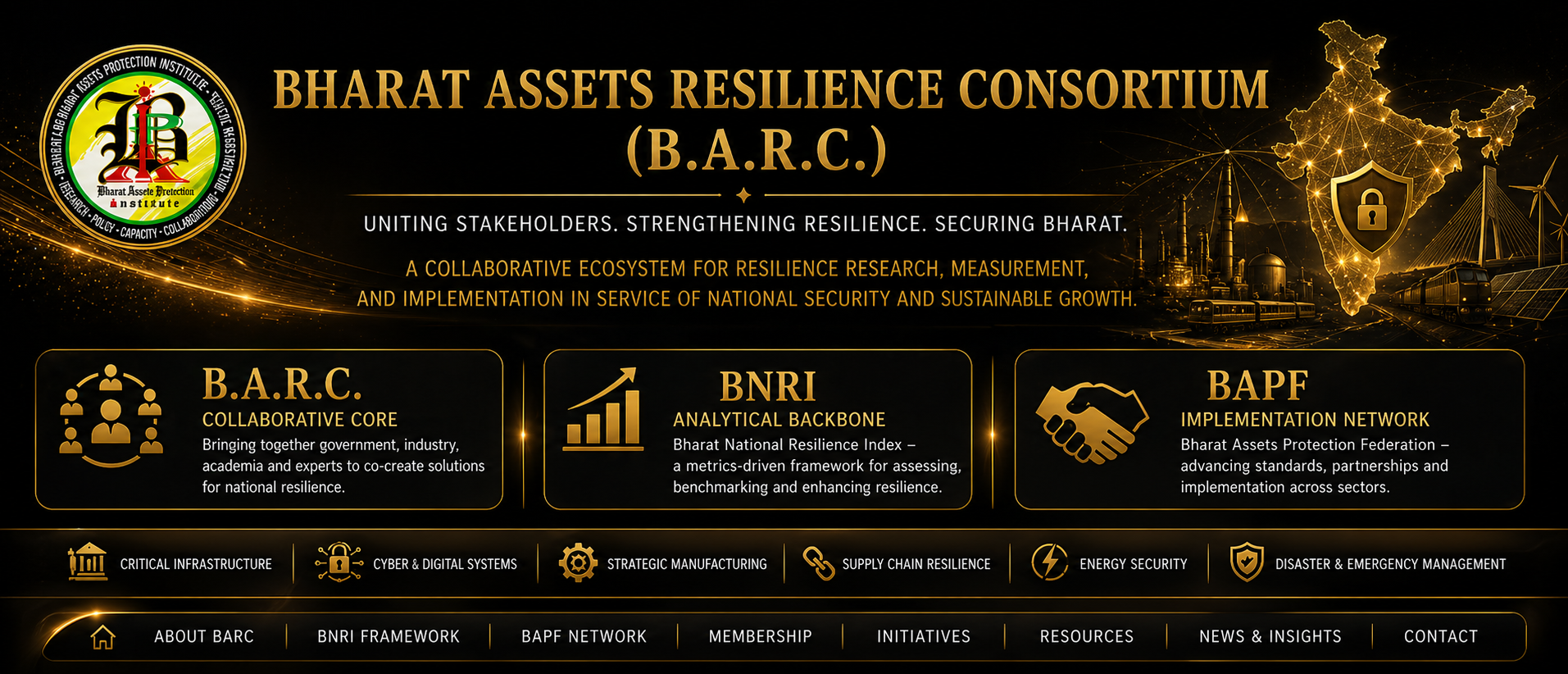
The Bharat Assets Resilience Consortium (B.A.R.C.) is the
integrated collaboration, measurement, and implementation framework of Bharat
Assets Protection Institute (B.A.P-I), designed to advance Bharat’s national
resilience across critical infrastructure, strategic manufacturing, and
supply chain ecosystems. Structured across three core pillars—B.A.R.C.
(collaborative core), the Bharat National Resilience Index (BNRI) (analytical
and measurement backbone), and the Bharat Assets Protection Federation (B.A.P-F)
(institutional and implementation network)—the framework operationalizes a
unified, multi-sectoral approach to resilience that is research-driven,
policy-aligned, and execution-oriented. |
|
|
|
|
|
1. Bharat Assets
Resilience Consortium (B.A.R.C.): Collaborative and
Strategic Core The Bharat Assets Resilience Consortium (B.A.R.C.) constitutes
the central collaborative architecture of B.A.P-I, designed to address the
full spectrum of risks affecting Bharat’s critical infrastructure and
strategic systems. It operates as a high-level convergence platform that
integrates stakeholders from government, industry, academia, research
institutions, and professional domains into a coordinated framework for
resilience-building. Aligned with the institute’s mandate of strengthening national
capacity across critical infrastructure protection, cyber-physical security,
economic resilience, disaster preparedness, and strategic risk governance,
B.A.R.C. facilitates:
*
Interdisciplinary research and integrated threat analysis across sectors * Policy design
and strategic advisory inputs aligned with national priorities * Development of
resilience frameworks for infrastructure, manufacturing, logistics, and
digital ecosystems * Pilot
initiatives and scenario-based modelling for risk mitigation and response
preparedness
The consortium addresses both conventional and emerging threat
landscapes, including hybrid threats, systemic disruptions, supply chain
vulnerabilities, technological risks, and climate-induced stressors. It
ensures that resilience is conceptualized not as a sectoral function, but as
an interconnected national capability. Within this architecture, the Bharat Assets Protection
Consortium (B.A.P-C) functions as the outreach and participation interface,
expanding engagement across institutions and professionals. It enables
structured collaboration, knowledge exchange, training, and capacity-building
initiatives, thereby operationalizing the institute’s broader ecosystem
approach.
2. Bharat National
Resilience Index (BNRI): Measurement, Benchmarking,
and Analytical Backbone The Bharat National Resilience Index (BNRI) serves as the
analytical core of the ecosystem, providing a structured and metrics-driven
framework for assessing and enhancing resilience across sectors. It is
designed to quantify resilience through defined indicators, enabling
benchmarking, comparative analysis, and evidence-based policy formulation. BNRI aligns directly with B.A.P-I’s mandate to develop
standardized resilience metrics and evaluation systems, ensuring that
institutional outputs are measurable, comparable, and strategically relevant.
Its core functions include:
* Sectoral and
cross-sectoral resilience assessment using defined indicators * Identification
of interdependencies and cascading risk pathways * Development of
resilience scoring models for infrastructure and systems * Support for
policy prioritization through data-driven insights * Alignment of
national resilience strategies with global benchmarks and best practices
By embedding BNRI within the consortium framework, B.A.R.C.
ensures that all research, collaboration, and policy engagement is grounded
in quantifiable analysis and structured evaluation, moving beyond theoretical
constructs to actionable intelligence.
3.
Bharat Assets Protection Federation (B.A.P-F) Institutional Network and Implementation
Layer The Bharat Assets Protection Federation (B.A.P-F) represents
the institutional and execution-oriented pillar of the ecosystem, designed to
translate research outputs and analytical frameworks into real-world
application. It enables structured participation from industry bodies,
infrastructure operators, compliance organizations, and sectoral
stakeholders. B.A.P-F aligns with the institute’s mandate to strengthen
implementation capacity, institutional coordination, and operational
readiness across critical sectors. Its role includes:
* Facilitating
industry participation in resilience planning and execution * Integrating
safety, security, compliance, and risk management practices * Supporting
adoption of resilience frameworks within operational environments * Enabling
public-private collaboration in infrastructure protection and risk governance * Bridging the gap
between policy design and field-level implementation
Through this federation model, the
ecosystem ensures that resilience strategies are not only conceptually robust
but also operationally viable and scalable across sectors.
Integrated Ecosystem
Architecture The combined functioning of B.A.R.C., BNRI, and B.A.P-F
creates a comprehensive national resilience ecosystem, where collaboration,
measurement, and implementation are structurally aligned. This tri-layered
architecture enables:
* Seamless
integration of research, policy, and execution * Development of
standardized resilience frameworks across sectors * Continuous
feedback loops between analytical assessment and field implementation * Strengthening of
institutional coordination and national preparedness * Contribution to
strategic national initiatives such as the Critical Infrastructure Protection
Programme (CIPP)
This integrated model reflects B.A.P-I’s broader vision of
building a Bharat-centric resilience architecture that is adaptive,
data-driven, and future-oriented.
Membership and
Collaboration The ecosystem welcomes participation from a diverse range of
stakeholders committed to advancing Bharat’s resilience objectives,
including:
* Universities,
research institutions, and academic associations * Corporate
entities, MSMEs, and technology and manufacturing firms * Safety,
security, compliance, and audit organizations * Government
bodies, regulatory agencies, and policy institutions * Independent
experts, scholars, and practitioners
Participants engage through joint research, policy dialogues,
advisory roles, pilot projects, training programmes, and knowledge
dissemination initiatives. All collaborations are governed by principles of professional
integrity, confidentiality, institutional alignment, and shared
responsibility, ensuring a credible and high-impact engagement environment.
|
|
Contact and Engagement |
|
For membership, institutional
collaboration, or partnership enquiries: |
|
|
|
Bharat Assets
Protection Institute (B.A.P-I) |