|
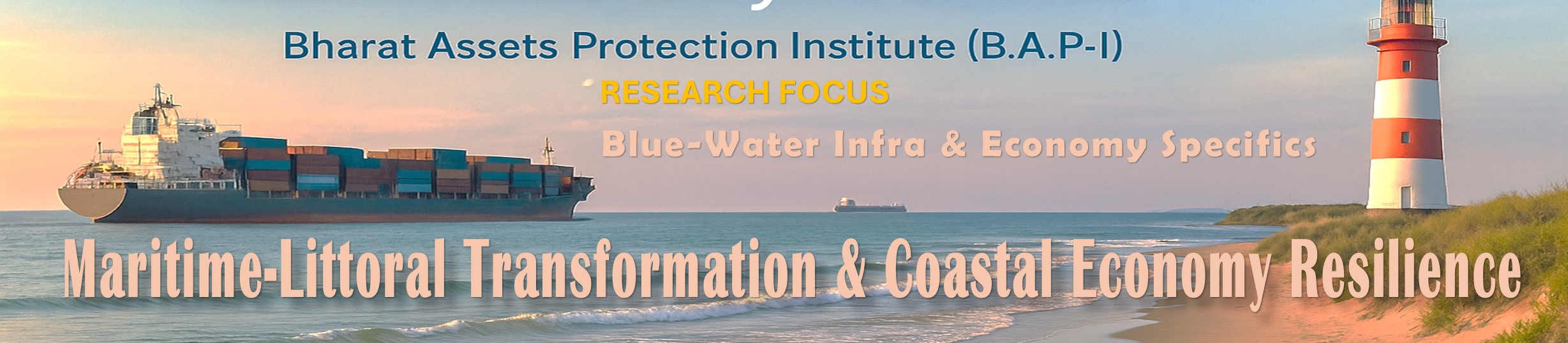
The Blue-Water Infrastructure & Economy plays an essential role in shaping both national and global
economic dynamics, with oceans serving as the lifeblood of international
trade, energy, and communication. In an increasingly interconnected world,
where maritime connectivity forms the backbone of global supply chains and
energy flows, understanding the infrastructure that enables such vast
movements is paramount. From ports and harbours to deep-water infrastructure,
offshore platforms, and maritime logistics, each element contributes to the resilience
and sustainability of the global economy.
The importance of
studying the Blue-Water Infra & Economy cannot be overstated,
particularly as oceans face mounting challenges, from climate change and
over-exploitation of marine resources to the growing geopolitical and
technological risks surrounding maritime security and undersea cables. The
evolving demands of blue economy practices, including sustainable fisheries
and eco-friendly shipping solutions, have made it essential to foster
innovative infrastructure and protective governance mechanisms for these
vital maritime domains.
By focusing on
Blue-Water Infrastructure, the Bharat Assets Protection Institute seeks to
develop comprehensive frameworks for coastal security, ocean-energy dynamics,
marine biodiversity protection, and maritime domain awareness. These
frameworks aim to balance economic growth with environmental stewardship,
ensuring that oceans remain functional and protected in the face of growing
threats. This research is essential to enhancing maritime safety, global
trade resilience, and the sustainable use of marine resources.
Overview of the Research Focus on Blue-Water
Infrastructure & Economy
At the core of the
Bharat Assets Protection Institute’s research is the exploration of
Blue-Water Infrastructure—critical maritime assets and their intersection
with global supply chains, energy networks, and ecosystems. The Institute’s
agenda examines both the tangible and intangible aspects of maritime
infrastructure, including ports, harbours, offshore platforms, and
infrastructure related to deep-water energy supply chains.
This research
investigates the entire life cycle of ships and their systems, from
construction to operation and eventual decommissioning, to ensure that their
environmental and security impacts are fully understood. An important facet
of the research includes developing more sustainable practices in coastal
security management, where local economies and fisheries value chains
intersect with broader national and regional security goals. The integration
of maritime domain awareness, especially in Coastal Economic Zones (CEZs), is
critical in ensuring resource security, economic resilience, and sustainable
fisheries in the face of ever-increasing maritime threats.
The research also
delves into ocean-energy dynamics, which are critical for understanding how
offshore platforms and deep-water infrastructure operate within the broader
maritime supply lines, contributing to global energy markets. The issue of
undersea cable infrastructure and data network security is another focus
area, given the growing reliance on subsea communication cables for global
connectivity and data flow.
Inland waterways
connectivity, exemplified by projects such as the National Inland Waterways
(NIW), also plays a key role in enhancing regional connectivity while
offering a sustainable alternative to land-based transportation. These
waterways, alongside the development of blue-water infrastructure
partnerships and linkages, are central to the blue economy concept, providing
new pathways for trade and regional cooperation.
Moreover, the
protection of marine biodiversity and the promotion of eco-blue technologies
are critical to safeguarding the long-term health of the oceans and coastal
environments. These areas of research are vital for ensuring that marine
resources are utilised in a way that does not compromise the ecological
balance, allowing for the sustainable management of ocean-based industries.
At the core of the
Bharat Assets Protection Institute’s research is the exploration of
Blue-Water Infrastructure—critical maritime assets and their intersection
with global supply chains, energy networks, and ecosystems. The Institute’s
agenda examines both the tangible and intangible aspects of maritime
infrastructure, including ports, harbours, offshore platforms, and
infrastructure related to deep-water energy supply chains.
This research
investigates the entire life cycle of ships and their systems, from
construction to operation and eventual decommissioning, to ensure that their
environmental and security impacts are fully understood. An important facet
of the research includes developing more sustainable practices in coastal
security management, where local economies and fisheries value chains
intersect with broader national and regional security goals. The integration
of maritime domain awareness, especially in Coastal Economic Zones (CEZs), is
critical in ensuring resource security, economic resilience, and sustainable
fisheries in the face of ever-increasing maritime threats.
The research also
delves into ocean-energy dynamics, which are critical for understanding how
offshore platforms and deep-water infrastructure operate within the broader
maritime supply lines, contributing to global energy markets. The issue of
undersea cable infrastructure and data network security is another focus
area, given the growing reliance on subsea communication cables for global
connectivity and data flow.
Inland waterways
connectivity, exemplified by projects such as the National Inland Waterways
(NIW), also plays a key role in enhancing regional connectivity while
offering a sustainable alternative to land-based transportation. These
waterways, alongside the development of blue-water infrastructure
partnerships and linkages, are central to the blue economy concept, providing
new pathways for trade and regional cooperation.
Moreover, the
protection of marine biodiversity and the promotion of eco-blue technologies
are critical to safeguarding the long-term health of the oceans and coastal
environments. These areas of research are vital for ensuring that marine
resources are utilised in a way that does not compromise the ecological
balance, allowing for the sustainable management of ocean-based industries.
Inviting Scholars, Policy Experts, and Stakeholders
The Blue-Water
Infrastructure & Economy Specifics research focus invites a broad
spectrum of scholars, policymakers, marine engineers, environmental
scientists, technologists, and international trade experts to contribute to
this vital research agenda. We encourage collaborative efforts that tackle
the challenges of maritime security, blue economy sustainability, maritime
domain awareness, and ocean-energy dynamics.
Researchers are
invited to explore areas such as sustainable maritime infrastructure, ports
and offshore platform resilience, and coastal security management. They are
encouraged to contribute advanced modelling techniques for marine
biodiversity protection, eco-blue technology integration, and traceability
systems within fisheries value chains. Ship life cycle management and
environmentally sustainable shipping technologies are other focal points for
innovative solutions.
The research
agenda also provides ample opportunities for studying multi-faceted maritime
security systems, with a specific focus on undersea cable infrastructure and
data security, areas that are critical to global digital infrastructure.
Contributions related to inland waterways connectivity and inter-modal
maritime logistics will also be welcomed, as will research focused on
maritime governance and regional economic linkages between ports, harbours,
and offshore platforms.
Scholars are
invited to contribute through quantitative risk analysis, systemic
vulnerability assessments, resilience benchmarking, and cyber-physical
systems modelling for maritime infrastructure. We also encourage
policy-oriented research and regulatory innovation, including the development
of frameworks for blue-water infrastructure partnerships and
multi-stakeholder engagement models that promote cooperation between
government, industry, and local communities.
Further, the
Institute invites contributions to the development of operational
whitepapers, blueprint frameworks, and sectoral playbooks that can help
inform national policy on blue-water security, trade resilience, and
sustainability. We are especially interested in real-time incident response
models, disaster management protocols, and governance mechanisms that can be
tested and implemented at the national and regional levels.
Encouraging Contributions Across Disciplines
Scholars are
encouraged to contribute through a variety of approaches, including empirical
research, case studies, modelling and simulation, and policy analysis.
Collaborative contributions from diverse fields such as engineering,
environmental science, economics, law, technology, and international
relations will be highly valued. The research platform offers opportunities
for scholars to publish their findings in influential policy briefs,
whitepapers, and sectoral playbooks, providing actionable insights for
governments, industries, and international bodies.
By engaging with
these research areas, scholars can play a crucial role in shaping the future
of blue-water infrastructure, maritime security, and ocean economy
governance, contributing to the sustainable and secure management of the
world's maritime resources.
|