Blue Water Infrastructure-Partnership & Linkages
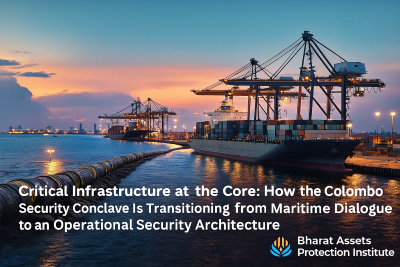
The Colombo Security
Conclave is gradually shifting from a maritime discussion forum to an
operational regional security framework. The momentum behind this transition is
shaped by geopolitical competition, growing external strategic presence in the
Indian Ocean, and emerging cyber and hybrid threats that now extend across
maritime, digital and infrastructure domains. The adoption of a five-pillar
mandate reflects this broader horizon, where maritime security sits alongside
counterterrorism, transnational crime, disaster response, cybersecurity and the
protection of critical infrastructure. The growing emphasis on critical
infrastructure protection in 2025 signals a clear recognition that resilience,
interoperability and preparedness are now central to regional security
thinking. CSC’s activities increasingly interface with other Indo-Pacific
mechanisms, including IORA, IONS, BIMSTEC and QUAD-linked initiatives,
suggesting a complementary role in a wider regional security ecosystem. Looking
ahead, cyber standards, coordinated operational protocols, intelligence fusion,
legal coherence and recurring preparedness exercises are likely to form the
backbone of its cooperative agenda. In this evolving environment, CSC is
positioning itself as a practical and operational mechanism in the
Indo-Pacific, with critical infrastructure protection emerging as a defining
priority for long-term regional stability.
Keywords : Colombo Security Conclave, Indian Ocean security, critical infrastructure protection, cyber physical resilience, maritime security cooperation, hybrid threats, Indo Pacific frameworks, geopolitical competition.
1.
Geopolitical Catalysts and the Rise of the Colombo Security Conclave
The
evolution of the Colombo Security Conclave (CSC) reflects an altered strategic
landscape in the Indian Ocean Region. Competition among major powers, along
with the growing relevance of maritime and digital domains, has influenced
security postures and cooperation patterns. China’s expanding footprint in dual
use port development, naval access, maritime surveillance, defence arrangements
and Belt and Road Initiative corridors has encouraged India and its maritime
partners to pursue more structured security cooperation (Pant and Shivamurthy,
December 26, 2023). As stated, “As China’s influence and presence in the Indian
Ocean grows, India has sought to enhance security cooperation with the Indian
Ocean Island and littoral nations, through a new ‘minilateral’ group called the
Colombo Security Conclave (CSC)” (Solanki, May 31, 2023).
Threats
in the region have also become more complex. Maritime terrorism, coastal
radicalisation, hybrid tactics, organised trafficking and cyber intrusions
targeting ports, subsea cables and administrative networks have broadened the
security spectrum. These pressures strengthened the relevance of compact and
action-oriented formats capable of quicker coordination. CSC reflects that
logic, functioning as a focused grouping grounded in shared vulnerabilities and
practical cooperation rather than broad political declarations.
The
Indian Ocean remains central to global supply chains and energy movement. Any
disruption, whether through a digital attack on port logistics or physical
interference with maritime infrastructure, carries consequences beyond regional
boundaries. This emerging reality aligns with the view that “strengthening
regional partnerships has gained immense significance today due to the rapidly
changing and challenging global security environment” (Padmanabhan, 2025,
November 20). CSC’s emergence can therefore be understood as a response to
geopolitical competition, shared systemic exposure and a shift toward
resilience-focused collective security planning.
2. Institutional Evolution: From Maritime Dialogue to Security Architecture
The
Colombo Security Conclave originated in 2011 as a trilateral National Security
Adviser level framework between India, Sri Lanka and the Maldives, with an
initial focus on maritime and coastal security cooperation (Solanki, May 31,
2023). Momentum slowed around 2014 as political environments shifted and
regional sensitivities influenced engagement patterns (Pant and Shivamurthy,
December 26, 2023). A changing Indo Pacific context after 2020, along with
growing exposure to cyber, technological and infrastructure vulnerabilities,
revived the need for a structured mechanism. India’s push to re-engage and
widen participation signalled a shift away from periodic dialogue toward a more
continuous and coordinated security format.
By
2021 the grouping began moving toward establishing a Secretariat in Colombo,
with formal founding documents signed by August 2024. Working groups, shared
exercises and targeted training followed, covering areas such as cybersecurity,
maritime governance, counterterrorism and humanitarian response. These
developments indicate movement from consultation to applied cooperation.
The
formalisation of a five-pillar mandate in March 2022 marked a clear turning
point. Maritime security was retained, but the mandate expanded to include
counterterrorism, trafficking and organised crime, cybersecurity and critical
infrastructure protection, and disaster response (Solanki, May 31, 2023). With
this shift, CSC began transitioning from a maritime-focused dialogue space into
a wider regional security framework with operational scope.
3. Membership Transformations and Regional Political Significance
Membership
evolution has influenced the strategic identity of the Colombo Security
Conclave. From its trilateral foundation, the grouping expanded to include
Mauritius as a full member, with Bangladesh and Seychelles joining in observer
roles. This reflected a widening security community shaped by shared exposure
rather than narrow regional boundaries (Pant and Shivamurthy, December 26,
2023). Recent engagements have also seen participation from additional regional
actors, suggesting increasing interest in the platform’s mandate and direction
(Solanki, 2025, November 20).
Engagement
dynamics continue to be shaped by domestic political developments across member
and observer states. The recent absence of the Maldives illustrates how
internal and external alignments can influence participation (Pant and
Shivamurthy, December 26, 2023). This context reinforces the need for more
institutionalised mechanisms to ensure continuity that is not dependent on
political shifts. As noted, “the group will be vulnerable to domestic political
changes unless it can better institutionalise itself within the participant’s
systems” (Solanki, May 31, 2023).
Despite
fluctuations, the Conclave remains a platform for smaller Indian Ocean states
to articulate national and collective security concerns while maintaining
policy autonomy. It supports cooperation on maritime risks, cyber
vulnerabilities, climate linked disruptions and broader systemic threats, while
enabling capacity development and shared operational preparedness.
4. Operational Pillars: The Five-Domain Security Mandate
CSC’s
operational framework is built around five core pillars: maritime safety and
security, countering terrorism and radicalisation, combating trafficking and
transnational organised crime, cybersecurity and critical infrastructure
protection, and humanitarian assistance and disaster relief (Solanki, May 31,
2023). Together, these areas capture the spectrum of both traditional threats
at sea and newer risks emerging from digital disruption, hybrid tactics and
vulnerabilities that span physical and cyber domains. The structure also
reflects an understanding that maritime security is now interconnected with
systems resilience, technology governance and coordinated law enforcement.
These
pillars guide exercises, training programmes and institutional cooperation.
They support flexible collaboration across shared priorities such as coastal
monitoring, protection of undersea systems, cyber incident coordination and
operational counterterror response. The sixth NSA meeting reviewed a roadmap
for 2024 with a continued focus on interoperability, preparedness and
institutional strengthening to support regional stability (Pant and
Shivamurthy, December 25, 2023). The seventh NSA meeting reaffirmed this
direction, noting that “member states were briefed on activities undertaken
across the Conclave’s five pillars” and agreed to expand practical cooperation
(Economic Times, 2025, November 20).
5. Critical Infrastructure Protection at Centrality: The Strategic Turn in CSC
Critical
infrastructure protection has moved to the centre of CSC’s evolving mandate.
Member states increasingly recognise that regional security is no longer
confined to maritime boundaries or territorial domains. It must also address
the digital and physical systems that support governance, economic activity and
essential services. This shift became visible in recent high-level engagements
where cybersecurity and critical infrastructure protection received dedicated
focus and were placed within a clear implementation and review framework (MEA,
19 November 2025).
This
focus represents an inflection point. Earlier phases emphasised maritime
threats, counterterrorism and crime. The newer orientation reflects the
vulnerability of energy networks, subsea communication cables, digital public
platforms, logistics corridors and transport infrastructure. Disruptions
affecting these systems could trigger cascading effects across borders. The
decision to develop a structured action plan for upcoming cycles indicates
movement toward operational outcomes such as shared incident reporting,
harmonised resilience standards and coordinated response mechanisms (MEA, 19
November 2025).
The
growing emphasis on CIP aligns with broader geopolitical dynamics in the Indian
Ocean. China’s naval presence, port development and infrastructure investments
continue to shape strategic calculations in the region (Pant and Shivamurthy,
December 26, 2023). India’s role in reviving the Conclave after 2020 and
expanding participation reflects an effort to build a cooperative governance
model grounded in resilience and preparedness (Pant and Shivamurthy, December
26, 2023). At the same time, the CSC has generally approached CIP in a neutral
and functional manner, reflecting member sensitivities and differing
geopolitical alignments.
Operational
developments reinforce this direction. Reviews led by the Secretariat, cyber
and security exercises, legal cooperation pathways and capability-building
programmes signal a move from conceptual alignment toward practical
implementation (News On Air, November 20, 2025). Ajit Doval described the
current landscape as “rapidly changing and challenging,” emphasising shared
preparedness, collaboration and interoperability (Padmanabhan, 2025, November
20).
The
institutionalisation of CIP is consistent with CSC’s broader journey.
Established in 2011 through maritime consultations among India, Sri Lanka and
the Maldives, the grouping paused around 2014 and later re-emerged in 2020 with
a permanent Secretariat in Colombo (Solanki, May 31, 2023). Since then,
exercises on cyber defence, search and rescue, counterterrorism and coastal and
digital security have demonstrated a shift toward scenario-based coordination
(Solanki, May 31, 2023).
Participation
has widened over time, and recent engagements indicate increasing external
interest in CIP as a cooperative domain (Solanki, 2025, November 20). However,
political variability remains a factor, with changing national priorities
influencing participation patterns (Pant and Shivamurthy, December 26, 2023).
These realities reinforce the need for stable mechanisms, long-term planning
and structured cooperation. Calls for a defined mandate and roadmap reflect
this requirement (Solanki, May 31, 2023).
Taken
together, these developments illustrate a clear strategic and operational
shift. Critical infrastructure protection is no longer peripheral. It now forms
a foundational element of how CSC conceptualises cooperation, resilience and
regional security. As noted in regional reporting, CSC has strengthened
cooperation across its five pillars and integrated technology and
infrastructure protection into its long-term agenda (Economic Times, 2025,
November 20). In an era shaped by digitised systems and contested maritime
environments, safeguarding interconnected infrastructure has become essential
to trust, stability and sustained security in the Indian Ocean Region.
6. Applied Cooperation: Exercises, Joint Working Groups, and Capacity Building
The
operational phase of CSC has strengthened through coordinated exercises,
structured training and practical cooperation formats. Since 2021, exercises
have covered maritime search and rescue, cybersecurity drills, cyber incident
simulations, coastal enforcement and terrorism-related investigation
procedures. These activities signal a shift from policy statements to
operational interoperability and shared practice (Solanki, May 31, 2023).
Working groups now support sustained cooperation across counterterrorism, cyber
policy harmonisation, law enforcement coordination and disaster response,
providing a stable framework for sector-specific collaboration (Pant and
Shivamurthy, December 26, 2023).
Capacity
development has become central to CSC’s approach. Training in cyber forensics,
policing standards, maritime domain awareness and port security protocols
addresses capability gaps faced by smaller island and littoral states. The
first structured progress review by the Secretary General during the seventh
NSA-level engagement reflects a stronger focus on measurable outcomes,
including shared standards, reporting cycles and jointly developed operational
frameworks (Solanki, 2025, November 20). A proposal to formalise coast guard
leadership consultations, raised earlier by Ajit Doval, suggests growing
recognition that operational actors, not only diplomatic representatives, must
shape interoperability and preparedness (Solanki, May 31, 2023).
7. Institutionalisation and Continuity Challenges
Progress
continues, but CSC still faces sensitivity to political shifts, external
influence and differing national priorities. Participation patterns have not
been uniform, and recent absences illustrate how domestic realignments can
affect continuity (Pant and Shivamurthy, December 26, 2023). Perception
dynamics also remain relevant. “Another challenge is India’s dominant role in
the grouping, which creates sensitivities among some members who do not want
the group to be viewed as anti-China” (Solanki, May 31, 2023). This context
requires a balanced approach that prioritises functional cooperation while
avoiding geopolitical signalling.
Long
term resilience will depend on institutional mechanisms that operate beyond
short political cycles. Permanent charters, standard operating procedures,
interagency training pathways and semi-autonomous joint working groups are
potential requirements for sustained cooperation. Recent statements noting that
the Conclave “reviewed regional security cooperation and agreed to deepen
collaboration across its five core pillars” point to growing momentum toward
more permanent governance models capable of maintaining continuity under
varying external and internal conditions (Economic Times, 2025, November 20).
8. Convergence with Broader Indo-Pacific Frameworks
CSC’s
future relevance will depend on how effectively it aligns with broader
Indo-Pacific security mechanisms rather than replicating their roles. The
framework already intersects with IORA, IONS, BIMSTEC, QUAD-linked initiatives
and emerging cooperation formats in digital and maritime governance. As noted,
“the CSC countries are all members of the two region-wide Indian Ocean
groupings, the Indian Ocean Rim Association (IORA), and the Indian Ocean Naval
Symposium (IONS)” (Solanki, May 31, 2023). Within this ecosystem, CSC operates
as an applied space for implementation, interoperability and joint exercises,
complementing more diplomatic or policy-oriented platforms.
Potential
alignment pathways include technical coordination on cyber standards with QUAD
initiatives, cooperation on digital public infrastructure with BIMSTEC, and
coordinated humanitarian and maritime activities with IORA and IONS. External
partnerships are also part of the evolving discussion. “Australia’s experience
and expertise on the CSC’s five pillars would likely be welcomed by the CSC
countries, including India” (Solanki, May 31, 2023). The grouping’s comparative
strength remains its operational proximity, its ability to act as a practical
mechanism and the trust built through shared littoral realities rather than
abstract regional strategies.
9. Future Imperatives for Regional Critical Infrastructure Protection
With
critical infrastructure protection now embedded within CSC’s mandate, the next
phase requires a forward-looking framework prioritising resilience,
coordination and regulatory coherence. The agenda ahead includes joint
mechanisms for cyber incident reporting, maritime infrastructure protection and
coordinated cross-border response. Intelligence fusion for cybercrime, hybrid
threats and digital espionage targeting governance systems will be essential.
Shared standards for cyber forensics, encryption governance and secure maritime
digital networks are also needed, alongside protection strategies for subsea
cables, port-linked ICT systems, satellite navigation and interconnected energy
grids. Institutional pathways for digital sovereignty, secure hardware supply
chains and indigenous cybersecurity capacity remain central. Progress is
visible through exercises, working group activities and political direction,
yet long-term value will depend on sustained implementation and enforceable
cooperation capable of scaling across jurisdictions and sectors.
Looking
forward, CSC can evolve beyond coordination into a structured governance
mechanism for regional resilience. A regional critical infrastructure risk map,
regularly updated, would help identify priority sites across ports,
communication nodes, energy terminals and transport corridors. Technical
interoperability, paired with national CERT integration and shared response
models, could support a real-time networked defence posture. This would
gradually shift CSC from a platform of aligned interests into a working system
of layered joint preparedness.
10. Policy Prescriptions: Toward a Resilient, Multi-Layered Indian Ocean Security System
Strengthening
CSC into a durable regional security mechanism will require phased and
deliberate policy direction. Interoperability should be deepened through shared
operating doctrines, cyber readiness baselines, resilience metrics and maritime
digital safety protocols. Legal harmonisation will play a critical role across
cybercrime, technology transfer, digital forensics and counterterror
frameworks. Simulation-based preparedness must become routine, testing
responses to cyber disruption, supply chain instability, port shutdowns and
hybrid maritime activity. Institutional depth is equally important. A formal
CSC charter, permanent staffing, shared training academies and protected budget
frameworks would help ensure continuity. External engagement may be appropriate
through a selective partnership model, involving capable Indo-Pacific actors
where useful, without altering CSC’s identity or strategic balance.
As
implementation strengthens, CSC has the potential to become the operational
spine of wider Indo-Pacific security cooperation. Its comparative advantage
lies in agility, proximity and trust networks built around littoral realities
rather than abstract regional policy structures. With critical infrastructure
protection at its core, CSC can help consolidate comprehensive security across
the Indian subcontinent and the Indian Ocean. Joint frameworks, common
resilience baselines and interoperable response systems would create a more
predictable environment for energy flows, trade, digital systems and maritime
access. For smaller island and coastal states, such structures provide
stability and capability reinforcement. For larger actors, they offer an avenue
to translate strategic intent into operational preparedness.
Conclusion
The Colombo Security
Conclave is entering a decisive stage in its evolution. It is no longer a
maritime discussion platform but an operational regional security structure in
which critical infrastructure protection has become central. Through
institutionalisation, functional cooperation and shared recognition of emerging
threats, CSC is shaping a resilient security ecosystem. One capable of
responding to the vulnerabilities of a connected Indian Ocean in an era defined
by cyber physical convergence, geopolitical competition and systemic
interdependence.
References
Economic Times.
(2025, November 20). India hosts 7th CSC NSA meeting, strengthens regional
security ties. The Economic Times. https://economictimes.indiatimes.com/news/defence/india-hosts-7th-csc-nsa-meeting-strengthens-regional-security-ties/articleshow/125464915.cms
Ministry of External
Affairs (MEA). (2025, November 19). 7th Meeting of the National Security
Advisers of the Colombo Security Conclave (November 20, 2025). Government
of India. https://www.mea.gov.in/press-releases.htm?dtl/40310/7th+Meeting+of+the+National+Security+Advisers++of+the+Colombo+Security+Conclave+November+20+2025
News On Air. (2025,
November 20). 7th Colombo Security Conclave NSAs Meeting Begins in New Delhi.
https://www.newsonair.gov.in/7th-colombo-security-conclave-nsas-meeting-begins-in-new-delhi/
Padmanabhan, K.
(2025, November 20). At 7th Colombo Security Conclave, NSA Doval bats for
safety, security & stability of Indian Ocean. ThePrint. https://theprint.in/diplomacy/at-7th-colombo-security-conclave-nsa-doval-bats-for-safety-security-stability-of-indian-ocean/2788404/?amp
Pant, H. V., &
Shivamurthy, A. G. (2023, December 25). The evolving role of the Colombo
Security Conclave. The Hindu. https://www.thehindu.com/opinion/op-ed/the-evolving-role-of-the-colombo-security-conclave/article67671968.ece
Pant, H. V., &
Shivamurthy, A. G. (2023, December 26). The evolving role of the Colombo
Security Conclave. Observer Research Foundation. https://www.orfonline.org/research/the-evolving-role-of-the-colombo-security-conclave/
Siddiqui, H. (2025,
November 20). Colombo Security Conclave: NSA Doval Warns Of Challenges,
Vulnerabilities. StratNews Global. https://stratnewsglobal.com/world-news/colombo-security-conclave-nsa-doval-warns-of-challenges-vulnerabilities/
Solanki, V. (2023,
May 31). The Colombo Security Conclave: What is it and what does it mean for
Australia? Australia India Institute. https://aii.unimelb.edu.au/the-colombo-security-conclave-what-is-it-and-what-does-it-mean-for-australia/
[This work has been funded by the Indian
Council of Social Science Research (ICSSR), Ministry of Education, New Delhi,
under the ―ICSSR Post-Doctoral Programme‖ 2019-20 on “Critical Infrastructure
Protection Programme for India”.]