

Critical Logistics Resilience & Continuity Planning
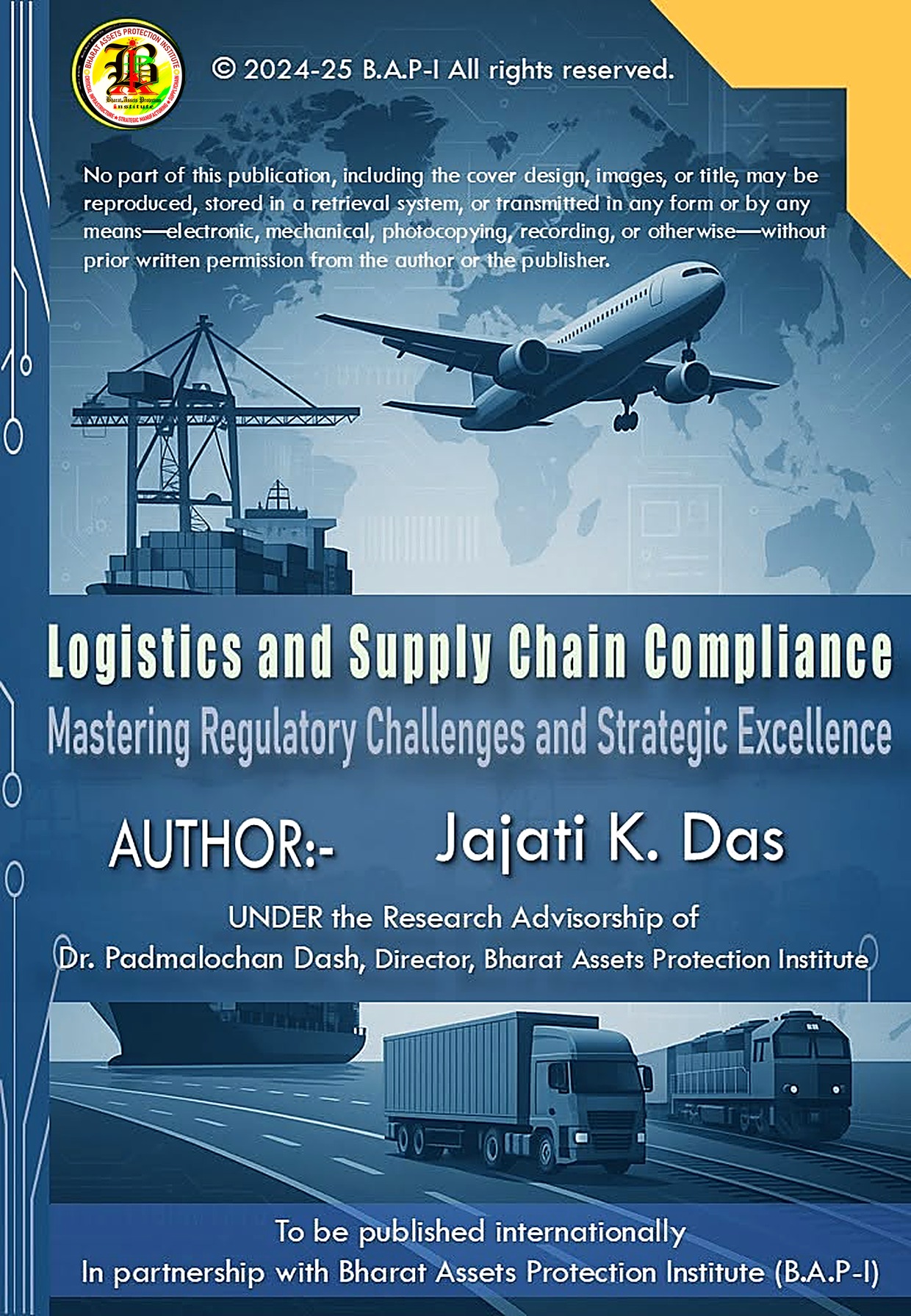
Compliance has moved from the back office to the centre of supply chain strategy. This review examines Logistics and Supply Chain Compliance: Mastering Regulatory Challenges and Strategic Excellence by Jajati K. Das, a forthcoming book prepared in partnership with the Bharat Assets Protection Institute™ under the Research Advisorship of Dr. Padmalochan Dash. Drawing on the manuscript overview and chapter plan, the review traces the book's twelve chapters across four movements: strategic foundations; the regulatory landscape of customs, sector rules and ESG; operational execution in warehousing, transport and digital governance; and governance maturity, culture and future regulation. It identifies the book's main strengths as a clear business case for compliance, an integrated treatment of functions usually covered separately, serious attention to leadership and culture, and a forward-looking outlook. It also sets out what readers will look for in the published text, including worked examples, links to Indian instruments and practical tools, and considers the book's relevance to supply chain resilience in India.
Focus areas
Keywords
- Logistics compliance
- supply chain compliance
- book review
- customs and trade regulation
- ESG and ethical sourcing
- data integrity
- compliance culture
- supply chain resilience
- Jajati K. Das
- Bharat Assets Publication
Book Review
Compliance as Strategy: A Review of Logistics and Supply Chain Compliance by Jajati K. Das
by Bharat Assets Protection Institute™
1. Introduction
For most of the last three decades, compliance sat at the edge of supply chain management. It was the paperwork that followed a shipment, the audit that arrived once a year, the department that said no. That position no longer holds. Market access now depends on documented traceability, buyers ask for proof of ethical sourcing before they ask for price, and a single gap in customs classification or data handling can stop goods at a border as effectively as a strike or a storm. Compliance has moved from the back office to the centre of how supply chains are designed and run.
Logistics and Supply Chain Compliance: Mastering Regulatory Challenges and Strategic Excellence by Jajati K. Das is written for exactly this moment. The book, now in preparation for international publication in partnership with the Bharat Assets Protection Institute™ (B.A.P-I), sets out to treat compliance not as a list of obligations but as a discipline that shapes strategy, operations and organisational culture. This review is based on the manuscript overview and chapter plan shared with Bharat Assets Publication ahead of release.
2. About the Book and Its Author
The book is organised in twelve chapters and is intended to work both as a strategic guide and as an operational reference. It will be published in English. At the time of writing, the edition details, page extent and ISBN have not been announced.
Jajati K. Das brings more than twenty-two years of experience in supply chain management to the subject. A Professional MBA from IIM Kolkata, he has advised senior leadership teams, supported organisations in building resilient supply chains, led systems work, supported business expansion and guided start-ups through capability development and execution readiness. That background is visible in the shape of the book: it is organised the way a practitioner meets compliance, starting with why it matters to the business and ending with what has to change in people and processes for it to last.
The manuscript was developed under the Research Advisorship of Dr. Padmalochan Dash, Director, Bharat Assets Protection Institute™. The stated aim of that engagement was to align scholarly rigour with industry practice, so that the frameworks in the book hold up both in a classroom and on a warehouse floor.
3. Structure and Scope
The twelve chapters follow a clear arc, which can be read in four movements.
Strategic foundations. The opening chapter, The Strategic Imperative of Compliance, establishes the book's central argument: compliance belongs in strategic planning because it protects continuity, sustains reputation and underwrites responsible participation in global trade.
The regulatory landscape. Global Trade and Customs Compliance deals with cross-border documentation, customs processes and regulatory structures. Sector-Specific Compliance Challenges then shows how pharmaceutical, food, aerospace, automotive and technology supply chains each face distinct regulatory pressure. Environmental and Ethical Compliance widens the frame to sustainability expectations, responsible sourcing and ESG-aligned reporting, which are now written into procurement and contracting across global markets.
Operational execution. Excellence in Warehouse and Inventory Management covers traceability, audit readiness, safety requirements and physical controls. Transportation Compliance and Strategic Management addresses road, rail, air and maritime modes, including hazardous materials handling and carrier certification. Digital Compliance and Data Integrity turns to cybersecurity, data protection and the technologies now being used to support compliance, among them AI-driven monitoring, automated reporting and blockchain-based verification.
Governance maturity and the future. Risk Management Frameworks for Compliance presents structured ways to identify, prioritise and mitigate compliance risk across a network. Leadership and Building a Compliance-Driven Culture addresses accountability, communication and capability building. The closing chapters, Strategic Compliance as a Competitive Advantage and Preparing for Future Regulatory Landscapes, look at how organisations turn compliance into differentiation and how trade policy, sustainability regulation, geopolitics and new technology are likely to reshape expectations. The final chapter centres on preparedness and the continuing development of compliance maturity.
4. Strengths of the Work
The first strength is the argument itself. Many compliance texts are organised by regulation, which makes them useful for lookup but weak at explaining why an organisation should invest in compliance before it is forced to. By opening with strategy and closing with competitive advantage, this book makes the business case explicitly and then shows how to deliver it.
The second is breadth with a clear thread. Customs, sector rules, ESG, warehousing, transport, data protection, risk and culture are usually covered in separate books written for separate audiences. Bringing them together under one framework reflects how compliance failures actually happen: rarely in one function alone, and usually where functions meet.
The third is the attention to people. The chapter on leadership and compliance culture addresses the point at which most programmes fail. Policies and systems can be bought; consistent behaviour across shifts, sites and partners has to be built. A book that treats culture as a compliance subject in its own right is taking the problem seriously.
The fourth is that the book looks ahead. Sustainability-driven regulation, data governance and technology-enabled verification are moving fast, and a reference that only described today's rules would date quickly. The forward-looking chapters give readers a way to think about rules that do not yet exist.
5. What Readers Will Look For
Because the book is still in preparation, a full assessment must wait for the published text. Three areas will matter most to readers when it appears.
The first is depth of worked examples. The manuscript plan promises real-world application alongside analytical models. The value of a compliance reference rises sharply when it shows how a framework was applied, what went wrong and what was changed, rather than describing the framework alone.
The second is jurisdictional detail. Readers in India will want to see how the global principles connect with domestic instruments such as the National Logistics Policy of 2022, the PM GatiShakti National Master Plan and the Digital Personal Data Protection Act, 2023, alongside the international regimes their export customers apply. Readers elsewhere will look for the same bridge to their own systems.
The third is usability as a working tool. Checklists, maturity models and audit templates would let practitioners take the book from the shelf to the operation. Given the author's practitioner background, this is a reasonable expectation.
6. Who Should Read It
The intended audience is wide, and the structure supports that. Supply chain and logistics managers will find frameworks they can apply in daily operations. Compliance officers and auditors will find a shared vocabulary that links their work to operational and strategic decisions. Senior executives will find a structured case for treating compliance as a governance and investment question. Policymakers and regulators will see how rules are experienced inside firms. Educators, researchers and students will gain an integrated reference that connects topics usually taught separately.
7. Relevance to Supply Chain Resilience in India
For the Bharat Assets Protection Institute™, whose work centres on critical infrastructure, strategic manufacturing and supply chain resilience, the book's argument carries particular weight. Resilience is often discussed in terms of physical capacity: ports, corridors, warehouses and alternative suppliers. Compliance is the less visible layer that decides whether that capacity can be used when it is needed. A shipment that cannot prove its origin, a carrier that cannot show its certification or a data flow that breaches protection rules can all halt a supply chain that is otherwise intact.
As Indian manufacturers move deeper into global value chains and export to markets with demanding sustainability and traceability requirements, compliance maturity becomes part of national economic security. A practitioner-led reference that treats compliance as strategic capability is a timely contribution to that effort.
8. Verdict
On the evidence of its plan and overview, Logistics and Supply Chain Compliance promises to be a well-structured and practically grounded reference that does what few books in the field attempt: it connects regulation, operations, technology and culture into a single argument for compliance as a source of strength. Its success will rest on the depth of its examples and tools when the full text is released. For professionals responsible for keeping goods moving lawfully, safely and credibly across borders, it is a book to watch for.
Disclosure: Bharat Assets Publication is associated with the publication of this book, and the Director of B.A.P-I served as Research Adviser to the manuscript. This review is published by the Bharat Assets Publication Editorial Desk.
References 4 sources
- Das, J. K. (forthcoming). Logistics and supply chain compliance: Mastering regulatory challenges and strategic excellence. In partnership with Bharat Assets Protection Institute™. Retrieved from https://bharatassetsprotection.org/test/bharatassetsprotection/Book/Logistics-and-Supply-Chain-Compliance
- Department for Promotion of Industry and Internal Trade, Ministry of Commerce and Industry, Government of India. (2022). National Logistics Policy. Retrieved from https://dpiit.gov.in
- Government of India. (2023). The Digital Personal Data Protection Act, 2023 (No. 22 of 2023). Retrieved from https://www.meity.gov.in
- Government of India. (2021). PM GatiShakti National Master Plan for Multi-modal Connectivity. Retrieved from https://pmgatishakti.gov.in
How to cite this article
Bharat Assets Protection Institute™ (2026). Compliance as Strategy: A Review of Logistics and Supply Chain Compliance by Jajati K. Das. Bharat Assets Online, Bharat Assets Protection Institute™. B.API-BOI-2026-10-WB-BR-O-00012-8. https://bharatassetsprotection.org/test/bharatassetsprotection/Article/Book-Review-Logistics-and-Supply-Chain-Compliance
© 2026 Bharat Assets Protection Institute™ (B.A.P-I). All rights reserved.
Reviewed by

Bharat Assets Protection Institute™
Editorial Desk
About the author of the book

Jajati K. Das
Supply Chain Management Professional; Professional MBA, IIM Kolkata