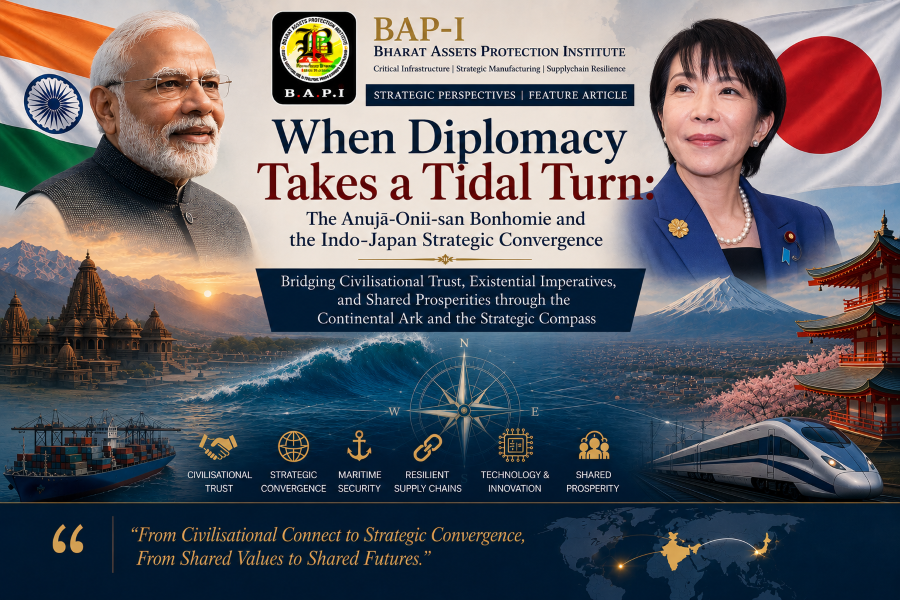
When Diplomacy Takes a Tidal Turn: The Anujā-Onii-san Bonhomie and the Indo-Japan Strategic Convergence
|
The Sixteenth
India-Japan Annual Summit of July 2026 introduced the imagery of
civilisational bonhomie into contemporary statecraft when Prime Minister
Narendra Modi addressed Japanese Prime Minister Sanae Takaichi as his
“younger sister” and the relationship was reciprocally framed through the
vocabulary of an elder brother. This article argues that the Anujā-Onii-san Bonhomie
Diplomacy is not a symbolic gesture alone but a strategic multiplier that
accelerates convergence across security, economic resilience, critical
infrastructure, technology, maritime cooperation, and Indo-Pacific
governance. It proposes that Japan’s deepening
engagement with India is driven by two existential imperatives that operate
beneath the surface of summit declarations: capital continuity, arising from
an ageing, demographically declining economy whose accumulated savings and
industrial capital require a safe, growing, and trusted continental
destination for long-term preservation; and geographic insurance, arising
from an archipelago situated on the Ring of Fire, seismically and
volcanically exposed, climatically vulnerable to intensifying typhoons,
rising sea levels, and the spectre of territorial contraction, for which
India’s vast continental landmass, demographic dividend, and resource base
represent a civilisational insurance partner without parallel in the
Indo-Pacific. It is argued that these two imperatives together explain why
the India-Japan partnership is evolving beyond conventional bilateral
cooperation into a structural programme through which Japan’s critical
infrastructure ecosystems, strategic manufacturing ecosystems, and supply
chain ecosystems are being gradually transferred, preserved, banked,
partnered, and maintained with India through a mixed approach that ensures
their survival and operational continuity regardless of what the future holds
for the Japanese archipelago. The article examines this convergence across
five strategic domains and concludes that the partnership constitutes the
construction of a continental ark for Japan’s civilisational, industrial, and
technological inheritance. It concludes that India must accept what the ark
carries because it serves Bharat’s own industrial transformation; but the
compass of strategic autonomy must remain in Indian hands, for the freedom to
define its own Indo-Pacific choices is the one civilisational inheritance
that India cannot afford to entrust to anyone else. |