National Resilience | Resource Security | Strategic Preparedness
The Sector at a Glance
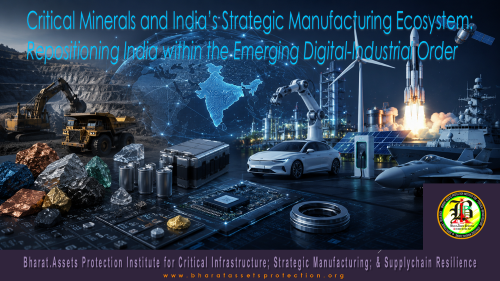
Mining, minerals and strategic raw materials constitute the physical foundation on which every other productive sector of a nation rests. Before a turbine can spin, a battery can store, a missile can fly or a semiconductor can switch, a mineral must be located, extracted, concentrated, refined and converted into a material of known purity and specification. The sector covered under this tab extends across bulk minerals such as iron ore, coal, bauxite and limestone; base metals such as copper, zinc and lead; and, with growing urgency, the critical and strategic minerals: lithium, cobalt, nickel, graphite, rare earth elements, gallium, germanium, tungsten, titanium, vanadium and the platinum group metals, alongside atomic minerals of relevance to the nuclear programme.
The scope of this tab is not limited to the mine. It covers the complete value chain from geological survey and exploration, through extraction, beneficiation and mineral processing, to smelting, refining, separation, metallisation and the production of advanced materials such as permanent magnets, battery-grade chemicals and high-purity metals. It equally covers overseas assets, stockpiling, recycling and the governance of mining regions. It is in the midstream, where ore becomes material, that strategic control is most often won or lost; and it is this complete chain that BAP-I treats as the true measure of resource security.
Why This Sector Is Critical
Strategic raw materials sit beneath every critical infrastructure and every strategic manufacturing ambition that Bharat has set for itself. Defence platforms depend on rare earth magnets, specialty alloys and tungsten; electric mobility and grid storage depend on lithium, nickel, cobalt and graphite; electronics and semiconductors depend on gallium, germanium, high-purity silicon and indium; and renewable energy depends on copper, silver and rare earths in quantities far larger than the systems they replace. A shortage at the mineral level does not remain a mineral problem; it travels upward and halts production lines, delays defence deliveries and stalls the energy transition itself.
The structural vulnerability of the sector lies in concentration. The reserves of several critical minerals, and even more so the processing and refining capacity for them, are concentrated in a small number of jurisdictions, and export restrictions on processed critical minerals and related technologies have already been used as instruments of statecraft. Supply continuity in such a market cannot be assumed. If this sector fails, Bharat's manufacturing missions in electronics, electric vehicles, defence and clean energy do not slow down gradually; they stop at the point where the last imported consignment is consumed.
The Bharat Context
Bharat is endowed with a substantial mineral base and a long mining tradition, yet its geological potential remains only partly explored, particularly for deep-seated and concealed deposits of critical minerals. The country continues to import a large proportion of the critical minerals and processed materials that its new industries require, and domestic capability in separation, refining and conversion into advanced materials has remained thin. The persistent gaps are visible at three levels: exploration depth and data quality; midstream processing technology at commercial scale; and the long gestation between discovery and production that discourages private investment.
The enabling environment has, however, moved decisively. Amendments to the Mines and Minerals (Development and Regulation) Act have opened critical and deep-seated minerals to auction and exploration licensing, and the National Critical Mineral Mission has set out a whole-of-chain approach covering exploration, processing, recycling and overseas acquisition. The Geological Survey of India, the Indian Bureau of Mines, the National Mineral Exploration Trust, Khanij Bidesh India Limited for overseas assets, IREL (India) Limited for rare earths, and CSIR laboratories engaged in mineral processing together form an institutional base that did not exist in this coherence a decade ago. Demand-side programmes such as the PLI schemes for advanced chemistry cell batteries and electronics, the National Green Hydrogen Mission and defence indigenisation under Aatmanirbhar Bharat confirm that the domestic market for these materials is real and growing. What remains absent is an integrated research-to-resilience architecture that links exploration data, processing technology, stockpiling policy and end-user demand into one national resource security strategy; and this is the gap that BAP-I seeks to address through this tab.
Modern Dynamics: The IKS and Civilisational Inheritance of Bharat
The modern dynamics of this sector cannot be read apart from its civilisational inheritance. Bharat’s standing among mineral nations does not begin with the National Critical Mineral Mission; it begins with the furnaces of the Deccan and the retorts of Zawar. For example, the wootz crucible steel of Telangana and Karnataka, exported for centuries as the raw material of the famed Damascus blades, was an ultra-high-carbon steel whose banded microstructure, as Srinivasan and Ranganathan have shown in their study of India’s legendary wootz, modern laboratories explained only in recent decades. At Zawar in Rajasthan, to take another instance, the excavations recorded by Craddock and his colleagues for the British Museum established industrial-scale zinc distillation from at least the twelfth century CE, some four hundred years before Europe mastered the process. The Delhi Iron Pillar, likewise, owes its sixteen hundred years of resistance to corrosion to a phosphorus-rich chemistry that Balasubramaniam’s work in corrosion science has since explained. These were not curiosities. They were complete production systems, covering ore selection, charge preparation, furnace design and quality grading, run by hereditary communities of smelters such as the Agarias, whose tacit process knowledge, as found recorded in Dharampal’s account of Indian science and technology in the eighteenth century, formed the sector’s original skill base.
That inheritance speaks directly to the Bharat dynamics of the present. Pre-colonial Indian metallurgy ran as a distributed network of small, low-capital, locally fuelled furnaces tied to artisan guilds and seasonal mining; in other words, a model of dispersed capacity and embedded employability, the exact inverse of the import-dependent, single-point supply chains the country now runs for lithium, cobalt and rare earths. Read critically, the record cuts both ways. Colonial deindustrialisation destroyed the smelting communities, yet the indigenous system also failed to make the transition to coke-based scale, and romanticising it will not refine a tonne of lithium. What remains usable is the institutional pattern rather than the furnace itself: localised beneficiation, community-held process skill, closed material loops, and metallurgical self-reliance as a civilisational norm. The Indian habit of near-total metal recycling and re-smithing, for example, anticipates the urban-mining and circular-economy imperatives of the present day. Even exploration follows this inheritance; the legacy workings at Zawar, Khetri and Hutti marked the very orebodies that modern mines now exploit.
Applied Aspects and the Apparatus
The applied task is to convert this inheritance into working apparatus for the sector. The sector’s growing demand for mineral-processing technicians, furnace operators, assayers and recyclers maps naturally onto regions with unbroken metal-working traditions; the foundry clusters of Rajkot, Coimbatore, Belgaum and Howrah, for example, are living descendants of this lineage, and schemes such as PM Vishwakarma accept in principle that hereditary skill is an asset to be formalised rather than displaced. An applied programme would go further. It would certify traditional smelting and refining knowledge through Recognition of Prior Learning; pair archaeometallurgy with materials-science curricula so that wootz-type steels and corrosion-resistant phosphoric irons become live research programmes rather than museum captions; route documentation of the Traditional Knowledge Digital Library kind into the sector so that process knowledge is protected before it is commercialised; and use the mapped legacy workings as exploration guides, as the Geological Survey of India already does in practice.
The apparatus for this work largely exists and needs joining rather than inventing. The National Critical Mineral Mission, the National Mineral Exploration Trust, Khanij Bidesh India Limited, IREL, the CSIR metallurgy laboratories, IIT (ISM) Dhanbad and the state directorates form the modern limb; the District Mineral Foundations, the skilling missions and the artisan schemes form the community limb. The caveats must stand beside the confidence: tacit knowledge dies in one untrained generation, laboratory validation of traditional processes remains thin, and employability claims must be tested against actual plant-floor absorption rather than sentiment. Managed with that discipline, the sector gains what no import-substitution policy can purchase, namely a workforce whose relationship with metal is measured in millennia, and a production culture in which resilience, recycling and self-reliance are not new targets but recovered habits.
Importance of the Sector
Economy
Mining and mineral processing generate value far beyond the pit head. Every tonne of ore that is beneficiated, refined and converted domestically retains within Bharat the margins, technologies and jobs that would otherwise be captured abroad, and every critical material produced at home reduces the import bill and the exposure of downstream manufacturers to price shocks. The sector supplies the steel, aluminium, cement and copper on which infrastructure growth depends, and it now underpins the newer value chains in batteries, magnets, electronics and clean energy equipment. Mineral-bearing states derive significant revenue through royalties, auction premiums and contributions to District Mineral Foundations, which, when governed well, can finance health, education and livelihood investment in some of the country's least developed districts. It is argued that midstream processing, rather than raw extraction, is where the largest untapped economic value of the sector lies.
Employment
The sector sustains employment across a wide spectrum of skills and geographies, much of it in regions where alternative formal employment is scarce. Exploration requires geologists, geophysicists, geochemists, drilling specialists and remote sensing analysts; mining operations require mining engineers, surveyors, blasting and safety personnel, heavy equipment operators and maintenance technicians; and processing calls for metallurgists, chemical engineers, hydrometallurgy and separation specialists, laboratory analysts and environmental professionals. Mechanised and digitised mining, recycling and urban mining add further demand for skills in automation, remote operations and material recovery. Workforce planning for this sector must therefore address both the scarcity of advanced processing expertise and the just transition of traditional mining communities.
Entrepreneurship
Although large-scale mining is capital intensive, the wider mineral value chain offers considerable space for start-ups and MSMEs. Enterprises can build value in exploration technology, drone-based and airborne surveys, geological data analytics, assay and testing services, beneficiation equipment, mine safety systems, tailings reprocessing, and the recycling of batteries, electronic waste and industrial scrap for critical metals. The opening of exploration licences for critical and deep-seated minerals creates a role for junior exploration companies, a segment that has been underdeveloped in Bharat. Access to geological data, pilot-scale facilities, patient capital and assured offtake can convert laboratory processes into commercial plants; provided that clearance timelines are made predictable.
Partnership
Resource security cannot be achieved through domestic action alone. The sector calls for partnership between the Geological Survey of India, state governments and private explorers for data sharing and exploration; between national laboratories, public sector undertakings and industry for processing technology development and transfer; between mineral producers and downstream manufacturers for long-term offtake; and between Bharat and resource-rich and technology-rich partner countries for overseas assets, joint ventures and diversified supply. Such partnerships must be designed so that they build indigenous processing capability and secure assured access rather than merely relocating dependence. BAP-I positions itself as the convening platform where these stakeholders can meet on shared research questions.
How the Researcher Must Approach This Sector
A researcher entering this sector should begin from the value chain. The first discipline is to locate the chosen question precisely: exploration, extraction, beneficiation, refining, advanced materials, recycling or governance, and to state at the outset which link of the chain the work strengthens and whose resilience it serves. The second discipline is triangulation in the manner the institute’s methodology prescribes: official data from the Geological Survey of India, the Indian Bureau of Mines yearbooks and the mission documents must be read against field evidence from mines, plants and mining districts, and against the practitioner’s account, before any conclusion is drawn. Where the work touches the civilisational inheritance, the sources must be handled with the same rigour; a claim about wootz or Zawar stands on the published archaeometallurgy, not on enthusiasm, and traditional knowledge must be documented with the consent and participation of the communities who hold it.
Every research piece in this sector, whether a book, a research paper, a policy piece or a technical report, must show how the Indian Knowledge Systems of this sector, joined with modern science, technology and institutions, can make the sector more resilient, more sustainable, more productive, more self-reliant and more just to the communities that sustain it. This is the standing test of relevance for the sector’s research.
The institute further requires every author to read the sector through its six strategic pillars and to state plainly which pillars the work serves: Critical Infrastructure, Strategic Manufacturing, Supply Chains, Technology Sovereignty, Comprehensive National Security and Global Engagement and Collective Resilience. A study of rare earth processing, for example, speaks at once to Strategic Manufacturing, Technology Sovereignty and Supply Chains, and the author is expected to draw those threads explicitly rather than leave them implied. In the same manner, findings should be placed where they will live within the institute’s four intelligence layers: parameters and thresholds belong to Critical Dynamics and Resilience Parameters, the mapping of actors, capacities and dependencies to Ecosystem Intelligence, datasets and indicators to the National Resilience Data Grid, and the assessed state of the sector’s health to Ecosystem Resilience. Work framed this way feeds the institute’s intelligence architecture naturally, instead of standing alone.
The researcher should write for decision, in the applied register this sector demands: every paper should end by stating what a ministry, a public sector undertaking, a laboratory or an investor should do differently because of it. Work may enter through any of the research streams listed below, and contributions that join the modern dynamics to the civilisational inheritance, for example a criticality assessment that includes secondary recovery from traditional recycling networks, or a workforce study that measures the absorption of hereditary skill into formal processing plants, are particularly invited. Every submission follows the institute’s publication guidelines and peer review process, and carries its B.API-BOI number on publication.
Research Focus Possibilities
BAP-I invites original research articles, policy papers, technical reports, diagnostic assessments, case studies and white papers across the following indicative research streams. The list is open-ended; contributions that connect a new question to the resilience objective of this tab are equally welcome.
A. Resource Mapping, Exploration and Supply Risk
- Criticality assessment of minerals for Bharat's defence, electronics, energy and mobility sectors, with supply risk scoring by source country, processing concentration and substitutability
- Gaps in geological data coverage for deep-seated and concealed critical mineral deposits, and the role of airborne geophysics, remote sensing and machine learning in prospectivity mapping
- Stockpiling strategy for strategic raw materials: which materials, what holding form, what governance and what release triggers in sanction or conflict scenarios
B. Processing, Refining and Advanced Materials
- Pathways to commercial-scale rare earth separation and permanent magnet manufacturing within Bharat, including technology, feedstock and cost barriers
- Domestic production of battery-grade lithium, nickel, cobalt and graphite chemicals: process options, pilot-to-plant scale-up and qualification by cell manufacturers
- Recovery of gallium, germanium, indium and other by-product metals from existing aluminium, zinc and copper processing streams
- Recycling and urban mining of end-of-life batteries, electronics and magnets as a secondary source of critical minerals
C. Policy, Regulation and Overseas Engagement
- Effectiveness of the auction regime for critical and deep-seated minerals and exploration licences, and the conditions that attract junior exploration investment
- Overseas asset acquisition through public sector vehicles and joint ventures: risk assessment, governance models and lessons from comparable national approaches
- Export restriction risk from processing-dominant jurisdictions and the design of plurilateral supply chain arrangements to mitigate it
D. Sustainability, Communities and Human Capital
- Environmental governance of mining and processing, including tailings management, water use and mine closure obligations, as a condition of social licence
- Utilisation and outcomes of District Mineral Foundation funds in mining-affected districts, and models for community benefit sharing
- Workforce readiness in hydrometallurgy, mineral processing and exploration geoscience, including curriculum gaps in mining and metallurgy education
- Mine safety technology, automation and digital mine monitoring as instruments of both productivity and resilience
Who Can Participate
This tab invites participation from the Geological Survey of India, the Indian Bureau of Mines, mining and mineral processing public sector undertakings, IREL and other atomic mineral entities, Khanij Bidesh India Limited, CSIR laboratories engaged in metallurgy and mineral processing, IIT (ISM) Dhanbad and other IITs and NITs with mining and metallurgy departments, state mining and geology directorates, private mining, refining and recycling companies, exploration and drilling firms, battery and magnet manufacturers, policy think tanks, international collaborators and individual researchers with domain expertise. Contributions from practitioners, policymakers and academics carry equal standing within the BAP-I research framework.
The Resilience Objective
Every contribution under this tab must serve one purpose: securing assured, diversified and sustainable access to the minerals and strategic raw materials on which Bharat's industry, defence and energy transition depend, from the ground through to the finished material. BAP-I treats mineral security as the first layer of national resilience, and research as the instrument through which that layer is mapped, measured and made sovereign.