Search

Focus area 5 of 6 · The Viswaguru Project

Comprehensive National Security

Internal and external security architecture: border management, counter-terrorism, cyber security and intelligence coordination.

23 publications tagged

Focus area 5 of 6

About this focus area

Comprehensive National Security is one of the six focus areas of the Viswaguru Project, the Bharat National Resilience Mission, and one of the lenses through which India's national resilience is understood, strengthened and advanced. It draws on several of the twelve Research Focus clusters and their 148 sectors, chiefly Internal Security Management and Critical Sectors, and brings their findings together into one resilience picture.

Internal and external security architecture: border management, counter-terrorism, cyber security and intelligence coordination. The project places comprehensive national security within the eight-stage resilience cycle of Understand, Map, Assess, Protect, Strengthen, Govern, Sustain and Advance, so that research, policy and institutional capacity building in this area stay aligned with the national mission.

Each publication tagged to comprehensive national security is read against the four resilience metrics: Critical Dynamics and Resilience Parameters (CDRP), Ecosystem Intelligence (EI), the National Resilience Data Grid (NRDG) and Ecosystem Resilience (ER). Together they will feed the Bharat National Resilience Index (BNRI) once its methodology is published, so that no dimension of resilience is studied in isolation.

Contributions are welcome from strategic studies, public policy, engineering, economics, international relations, law and management. The institute looks for work that connects research with operational policy, and builds a body of knowledge on comprehensive national security that is rigorous and usable by those who make and carry out decisions.

The Viswaguru Project

Four resilience metrics

B.A.P-I Publications

Publications on Comprehensive National Security

Book review bnri second edition

From Doctrine to Statute: A Legislative Review of the Bharat National Resilience Index (BNRI)

Bharat Assets Protection Institute™16 Oct 2026
Abstract Book Review

This review reads The Bharat National Resilience Index (BNRI), Second Edition (2026), by Dr. Padmalochan Dash, as a government drafting office would: as a possible reference for legislation. The book proposes BNRI as the measurement pillar of a Critical Infrastructure Protection Act (CIPA), scoring covered operators on four weighted pillars and linking their Class to audit cadence, sanctions and incentives. The review finds Chapter VI unusually strong on delegation, Seventh Schedule competence, due process and proportionality, and credits the book's candour that its bodies are proposals and its weights normative. It also sets out what legislators must resolve first: dependence on State consent for State List sectors, a heavy institutional design with uncosted public bodies, the litigation risk of penalties tied to uncalibrated scores, scarce audit capacity, disclosure limits and a legal basis for Prahari. It concludes that the book is the most complete Indian blueprint for a statutory regime, but a drafting brief rather than a Bill.

Read more
The prahari bharat assets protection institute

The Prahari: Proposing the National Continuity Command Framework with India’s Critical Infrastructure Protection at core.

Dr. Padmalochan DASH25 Dec 2025
Abstract Guideline / Framework Document

India’s critical infrastructure now functions as a tightly coupled cyber-physical organism where disruption in one node propagates across national systems within minutes. Conventional sector-bound protection models no longer address this operational reality. This strategic piece presents the Prahari as a consolidated national continuity architecture that converts Bharat National Resilience Index classification into defended operational control across power, transport, data, logistics, water, industrial, and urban service systems. It prescribes a permanent continuity force, unified command lattice, measurable recovery ceilings, enforceable redundancy depth, and endurance-based governance that reposition infrastructure continuity as a sovereign security function. The framework integrates physical security, cyber control, electromagnetic stability, industrial restart sequencing, disaster sustainment, intelligence correlation, and statutory audit discipline into a single national continuity enforcement system designed to preserve service depth, deny cascading collapse, and restore national performance under persistent disruption conditions.

Read more
Putin in india 1

Putin Has Landed: Reflection Points on the Multilateral, Multisectoral and Civilisational Logic of the India–Russia Super Strategic Partnership

Dr. Padmalochan DASH14 Dec 2025
Abstract Expert Perspective

India’s foreign policy practice is increasingly defined by continuity rather than reaction. Strategic decisions are no longer framed as responses to immediate crises or alliance expectations, but as calibrated choices shaped by long-term national interest, historical experience, and material capacity. In this setting, partnerships are evaluated less for declaratory alignment and more for their ability to preserve autonomy, absorb pressure, and sustain resilience across political, economic, and security domains. The India–Russia relationship occupies a distinct place within this evolving posture. It neither operates as a legacy arrangement nor as a tactical instrument within contemporary power rivalries. Instead, it reflects a structurally embedded partnership built over decades through defence co-creation, energy security, technological depth, and institutional familiarity. Recent high-level engagements, including President Vladimir Putin’s visit to India, have brought renewed attention to these foundations, highlighting patterns of convergence that extend beyond bilateral diplomacy and into the wider Eurasian landscape. This paper approaches the relationship from that perspective. It does not catalogue diplomatic outcomes or offer prescriptive commentary detached from operational realities. The analysis treats India–Russia engagement as a strategic system shaped by civilisational cardinals such as strategic autonomy, sovereign capability, demographic strength, resource continuity, technological resilience, and multipolar agency. These are examined as working principles that increasingly guide Indian state behaviour rather than as abstract or rhetorical constructs. The discussion situates this partnership within a broader Eurasian context marked by contested supply chains, fragmented financial systems, technological rivalry, and shifting centres of power. By tracing convergence vectors and identifying policy management challenges across these domains, the paper seeks to clarify how India is sustaining engagement, managing risk, and preserving decision-making space under conditions of sustained external pressure. The emphasis remains on strategic coherence and institutional continuity, consistent with India’s long-cycle national trajectory and diplomatic practice.

Read more
Bsf article photo bapi

Escalating Firepower and Mandated Authority: Assessing the Border Security Force’s Expanded Role in National Sovereignty Protection through Capacity Modernisation, Jurisdictional Empowerment, and Legal Sanctions Against

Bharat Assets Protection Institute™, Dr. Padmalochan DASH02 Dec 2025
Abstract Policy Commentary

Post-Operation Sindoor, India’s border security posture has shifted into a decisive phase characterised by offensive deterrence, heightened legal consequence, and multi-domain enforcement supported by technology. The evolving threat environment, defined by drone-assisted arms delivery, hybrid warfare, organised infiltration pipelines, and demographic manipulation, has accelerated the transformation of the Border Security Force into a more strategically empowered national-security institution with expanded jurisdictional reach, enhanced military capability, and sharper operational focus. This evolution reflects a structural recalibration rather than a short-lived reactive adjustment, positioning border protection as inseparable from safeguarding democratic continuity, territorial integrity, and sovereign identity. It is now treated as a strategic determinant of internal stability rather than an isolated law-and-order concern. The post-Sindoor environment signals the rise of a new enforcement paradigm in which real-time surveillance, strengthened interdiction capability, and coordinated response frameworks shape a doctrine of pre-emptive security. Within this shifting landscape, the Border Security Force is positioned as a central pillar of national security, tasked with preventing hybrid threats, sustaining territorial security, and upholding constitutional legitimacy in an increasingly volatile geostrategic context.

Read more
Colombo 2

Critical Infrastructure at the Core: How the Colombo Security Conclave Is Transitioning from Maritime Dialogue to an Operational Security Architecture

Bharat Assets Protection Institute™, Dr. Padmalochan DASH21 Nov 2025
Abstract Research Paper

The Colombo Security Conclave is gradually shifting from a maritime discussion forum to an operational regional security framework. The momentum behind this transition is shaped by geopolitical competition, growing external strategic presence in the Indian Ocean, and emerging cyber and hybrid threats that now extend across maritime, digital and infrastructure domains. The adoption of a five-pillar mandate reflects this broader horizon, where maritime security sits alongside counterterrorism, transnational crime, disaster response, cybersecurity and the protection of critical infrastructure. The growing emphasis on critical infrastructure protection in 2025 signals a clear recognition that resilience, interoperability and preparedness are now central to regional security thinking. CSC’s activities increasingly interface with other Indo-Pacific mechanisms, including IORA, IONS, BIMSTEC and QUAD-linked initiatives, suggesting a complementary role in a wider regional security ecosystem. Looking ahead, cyber standards, coordinated operational protocols, intelligence fusion, legal coherence and recurring preparedness exercises are likely to form the backbone of its cooperative agenda. In this evolving environment, CSC is positioning itself as a practical and operational mechanism in the Indo-Pacific, with critical infrastructure protection emerging as a defining priority for long-term regional stability.

Read more
Street optics

From Street Optics to System Failure: Resilience by Design and Deterrence Strategy for Critical Infrastructure Sovereignty

Dr. Padmalochan DASH12 Nov 2025
Abstract Research Paper

India’s critical infrastructure has emerged as a primary arena where street mobilisation can be converted into systems failure. Adversarial coalitions utilise a hybrid sequence: legitimacy is cultivated through student wings, NGOs and influencer ecosystems; crowds are synchronised at pressure points across the urban landscape; and low-footprint sabotage or cyber intrusion is directed at power, telecom or transport systems to produce visible governance collapse. The objective is not protest, but institutional delegitimisation by generating outrage that forces political intervention or concessions. This paper proposes an immediate national response grounded in two instruments: the Bharat National Resilience Index, a measurable readiness and recovery mechanism that assesses redundancy, digital-twin stress testing and continuity heatmaps; and the Critical Infrastructure Protection Act, which provides statutory authority to integrate cyber and physical resilience, interdependency assessments and crisis-transparent accountability. The policy message is direct: deterrence now depends on resilience by design. India has the capability to harden critical nodes, reduce recovery time and apply attribution discipline, preventing adversarial coalitions from converting public discontent into engineered infrastructure failure or political instability.

Read more
Comprehensive National Security

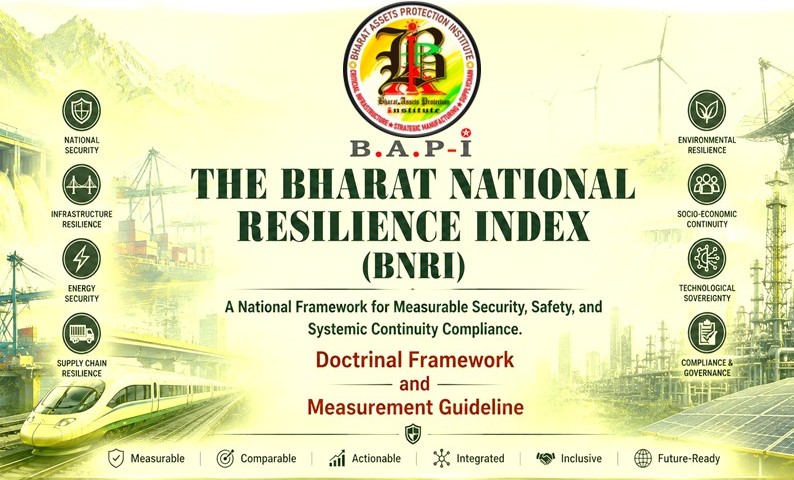
The Bharat National Resilience Index (BNRI): A Doctrinal Framework for Measurable Security, Safety, And Systemic Continuity Compliance

Dr. Padmalochan DASH28 Oct 2025
Abstract B.A.P-I National Resilience Series (BNRS)

India's critical infrastructure operates today as an interdependent cyber-physical ecosystem. Power grids, ports, logistics corridors, data networks, defence manufacturing corridors, and governance platforms are interlinked through algorithms, control systems, and human oversight. A disruption at any single node can cascade across sectors within minutes. Yet India possesses no unified metric to measure, audit, or enforce resilience across this interconnected architecture. Governance remains fragmented across ministries; recovery benchmarks remain advisory; and compliance operates without statutory consequence.

The Bharat National Resilience Index (BNRI) is proposed as India's first statutory instrument to quantify resilience as a measurable systems property. It converts resilience from a policy aspiration into a graded, penalised, and incentivised obligation of governance. BNRI integrates threat assessment, zero-tolerance compliance, adaptive governance, defence-in-depth engineering, and all-hazards consequence mapping within a single national framework anchored in the proposed Critical Infrastructure Protection Act (CIPA).

Read more
Cipa new act

Legislating Resilience: Why India Needs a Critical Infrastructure Protection Act for the Cyber-Physical Age

Dr. Padmalochan DASH16 Oct 2025
Abstract Editorial

India’s expanding digital and physical interdependence has transformed its Critical Information Infrastructure (CII) into both an engine of growth and a domain of vulnerability. The surge in hybrid threats, state-sponsored intrusions, ransomware, and supply-chain disruptions, demands a unified statutory framework that transcends fragmented governance. This article calls for the enactment of a Critical Infrastructure Protection Act (CIPA) to institutionalise cyber-physical resilience through structured vulnerability assessments, coordinated response mechanisms, and measurable performance indices such as the Bharat National Resilience Index (BNRI). By aligning technology, policy, and accountability, CIPA can redefine national security as the sustained continuity of India’s essential systems, ensuring that resilience becomes both a legal mandate and a strategic instrument of comprehensive national power.

Read more
Bnri bapi

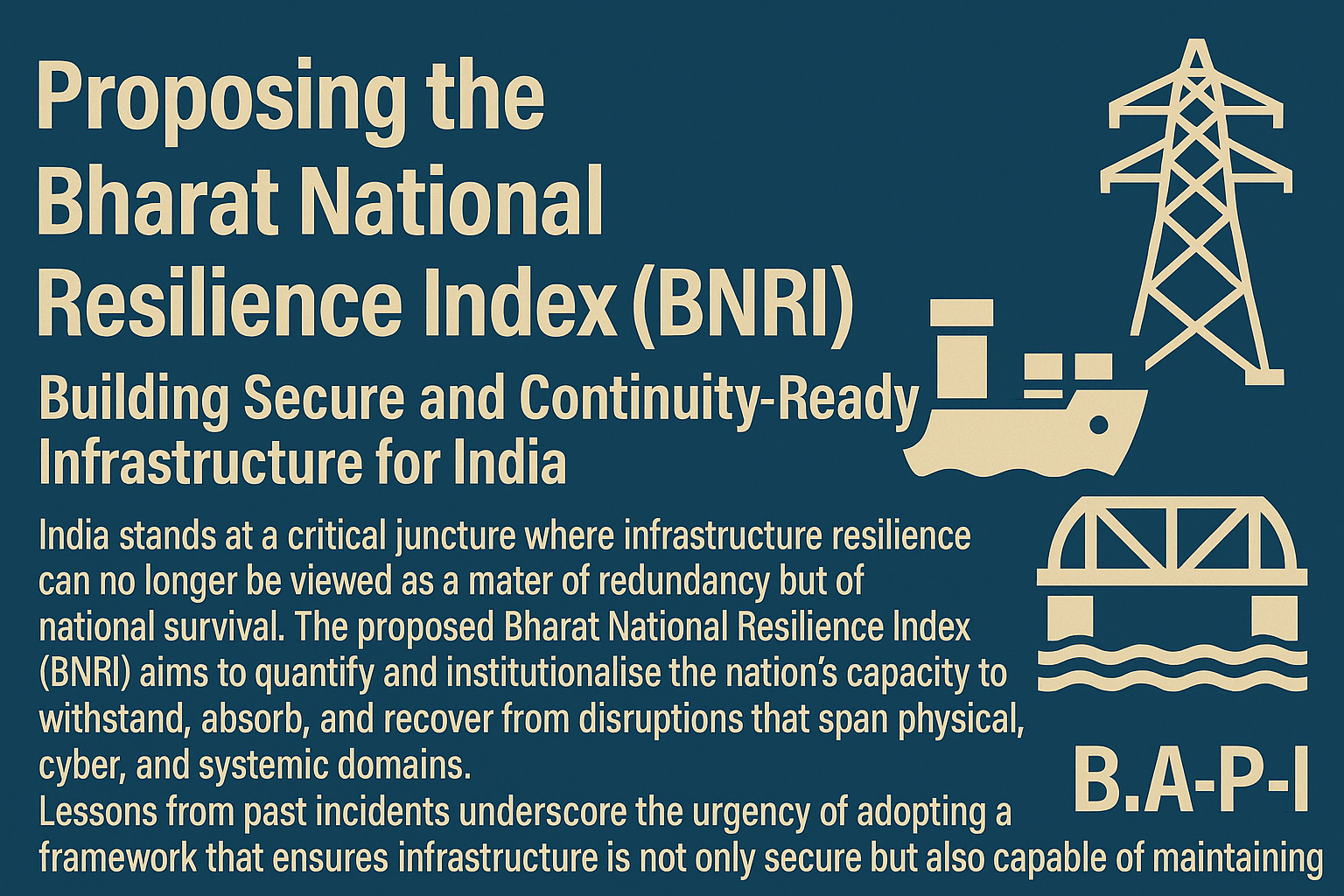
Proposing the Bharat National Resilience Index (BNRI): Building Secure and Continuity-Ready Infrastructure for India

Dr. Padmalochan DASH15 Oct 2025
Abstract Technical Brief / Concept Note

India’s critical infrastructure has evolved into an interdependent cyber-physical ecosystem where disruptions cascade across sectors with unprecedented speed. The absence of a unified resilience metric has left governance fragmented and recovery uneven. The proposed Bharat National Resilience Index (BNRI) seeks to quantify resilience as a measurable systems property, integrating threat assessment, zero-tolerance compliance, adaptive governance, and defence-in-depth engineering into a cohesive national framework. By combining all-hazards consequence mapping with public–private coordination, BNRI transforms resilience from reactive crisis management into anticipatory continuity planning. It establishes a technical and policy foundation for harmonised regulation, transparent accountability, and sustained service integrity across India’s critical sectors.

Read more
Comprehensive National Security

The Strategic Necessity of a Critical Infrastructure Protection Act (CIPA): A National Imperative for India’s Security and Resilience

Dr. Padmalochan DASH12 Oct 2025
Abstract Editorial

India’s expanding geopolitical footprint and accelerating economic integration have exposed its critical infrastructure (CI) systems to unprecedented risks from terrorism, cyber-espionage, hybrid warfare, and transnational extremism. This paper argues for the urgent enactment of a Critical Infrastructure Protection Act (CIPA) to establish a unified legal and institutional framework for national resilience. Drawing on regional security dynamics, global best practices, and the Bharat Assets Protection Institute™’s (B.A.P-I) proposed Bharat National Resilience Index (BNRI), the article outlines how legislative codification can transform fragmented protection mechanisms into an integrated national doctrine. By linking technological fortification, statutory governance, and inter-agency coordination, CIPA would position India to deter asymmetric threats, secure supply-chain continuity, and ensure socio-economic stability across a volatile Indo-Pacific environment.

Read more
Comprehensive National Security

Proposal for the Creation of an Inter-Border Security Force (IBSF): Securing India’s Federal Seams and Internal Sovereignty

Dr. Padmalochan DASH12 Oct 2025
Abstract Technical Brief / Concept Note

India’s inter-state borders have transformed from administrative demarcations into volatile seams where internal disorder, external interference, and hybrid threats intersect. These corridors, once intended for governance, now function as operational sanctuaries for insurgents, smugglers, narco-terror syndicates, and demographic manipulators. The absence of a neutral federal mechanism has repeatedly produced jurisdictional paralysis and political confrontation, as evident in the Assam–Mizoram firefight of 2021, Red Corridor insurgencies, and the pandemic-induced collapse of inter-state logistics. This article proposes the creation of an Inter-Border Security Force (IBSF), a neutral, technology-driven, and intelligence-fused federal entity mandated to stabilise disputed corridors, dismantle illicit economies, secure supply chains, and ensure humanitarian mobility during crises. Functioning under a dedicated Act of Parliament and aligned with the Bharat National Resilience Index (BNRI), the IBSF would bridge centre–state coordination, embed cyber-physical surveillance within governance corridors, and convert India’s internal fault lines into resilient arteries of national unity.

Read more
Bharat assets publications bip 22

India’s National Resilience Doctrine: Foundation, Architecture, and Institutional Design for Critical Infrastructure Protection and Critical Sectoral Resilience

Dr. Padmalochan DASH30 Jan 2025
Abstract B.A.P-I National Resilience Series (BNRS)

India’s national security architecture has operated through two established pillars. External security is governed by the Ministry of Defence, the armed forces, and the external intelligence apparatus; while internal security is governed by the Ministry of Home Affairs, state home ministries, central police organisations, state police forces, and the domestic intelligence system. Between these two pillars lies a domain that has grown in strategic consequence faster than any institution has been built to govern it.

That domain is critical infrastructure and strategic sectoral clusters. India’s economy, security, and survival rest upon twelve strategic sectoral clusters encompassing more than 150 stand-alone sectors whose continuous functioning keeps the country operational and whose disruption would constitute a national function failure. These sectors encompass energy grids, communications networks, financial systems, transport corridors, health facilities, water supply systems, digital platforms, logistics chains, strategic manufacturing, satellite systems, maritime assets, and the commercial-industrial base; they constitute the material foundation upon which both external defence and internal governance depend. Without functioning infrastructure, external deterrence loses its industrial base; internal governance loses its delivery mechanisms; and the state’s capacity to function as a sovereign entity comes under direct threat. Yet this domain has had no dedicated doctrine, no statutory authority with cross-sectoral jurisdiction, no operational force, no independent audit mechanism, and no quantitative measurement framework. It has remained, in institutional terms, the unguarded centre of India’s national security.

This paper proposes the Bharat National Resilience Ecosystem (BNRE) as a national doctrine that positions critical infrastructure protection and critical sectoral resilience as the third pillar of India’s comprehensive national security. The doctrine is operationalised through an integrated institutional architecture comprising seven components: a unified legislative instrument (BIP-CARE, the Bharat Infrastructure Protection and Critical Assets Resilience Enactment); a national programme (BIP-CARP, the Bharat Infrastructure Protection and Critical Assets Resilience Programme); an apex governance directorate placed under the National Security Council (BIPCARD, the Bharat Infrastructures Protection and Critical Assets Resilience Directorate); a multi-stakeholder coordination platform bringing together sectoral operators, managers, and authorities (SOMA); an independent audit and assessment bureau for resilience measurement and synchronisation (RAS); a dedicated operational force trained for compound cyber-physical scenarios (Prahari); and a composite quantitative measurement index linking resilience performance to statutory consequences (BNRI, the Bharat National Resilience Index). Three doctrinal principles; Convergence, Distributed Resilience, and Measured Accountability; govern the ecosystem. A closed governance loop ensures that standards, implementation, assessment, and policy revision function as a continuous self-correcting cycle. The paper draws on comparative analysis of CIP regimes across the United States, European Union, Japan, Australia, Israel, and Singapore, and on the twelve-cluster BAP-I (Bharat Assets Protection Institute™) securitisation framework developed through the author’s doctoral and post-doctoral research programme (Dash, 2024; Dash, 2025, Jul. 1; B.A.P-I, (1)). The paper argues that no existing Indian institutional arrangement and no single international model combines all seven functions within one architecture; making the BNRE the first integrated national resilience doctrine designed for the full spectrum of cyber, physical, hybrid, environmental, economic, and geopolitical threats to critical infrastructure.

Read more
Bapi retro 17

From District Forecast to Slope Warning: The Wayanad Landslides of 2024 and the Next Step for Landslide Early Warning in India's Hill Districts

Dr. Padmalochan DASH06 Jul 2024
Abstract Case Studies

In the early hours of 30 July 2024 a debris flow that began high above Mundakkai in Kerala's Wayanad district ran for about seven kilometres through Mundakkai and Chooralmala, taking more than two hundred lives and destroying the only bridge into the upper valley. This retrospective paper reviews what the meteorological, geological and attribution sources reported about the rainfall, the warnings and the losses, and what India has done since. It finds that the India Meteorological Department forecast the extreme rain, that central forces had been pre-positioned, and that the armed forces restored access within days, while the remaining task was to translate district-scale alerts into slope-level evacuation. It records the Geological Survey of India's expanding landslide forecasting system and national susceptibility mapping as substantial national assets. The paper argues that landslide early warning should be treated as critical infrastructure in its own right, built down to the slope and the settlement, tied to clear evacuation protocols, and supported by exposure reduction and redundant access in hill districts.

Read more
Bapi retro 13

Custody Before Consent: The Digital Personal Data Protection Act, 2023 and the Data Held by India's Critical-Sector Operators

Dr. Padmalochan DASH25 May 2023
Abstract Policy Commentary

The Digital Personal Data Protection Act, 2023 gave India its first general data protection law after a long wait. This retrospective reads the Act from the standpoint of critical infrastructure protection rather than privacy alone. It sets out what the Act asks of data fiduciaries, including reasonable security safeguards, breach intimation, erasure of data no longer needed and the heavier duties of Significant Data Fiduciaries, and notes that the largest penalty in the statute is reserved for security failure. It then places the Act beside the existing regimes of CERT-In and the National Critical Information Infrastructure Protection Centre, showing how a single incident at a hospital or utility can now trigger three separate reporting duties. The paper traces the notification of the Rules in November 2025 and their staggered commencement through 2027, and assesses what the regime means for power, banking, health and transport operators. It recommends a single incident intake and the deliberate designation of critical information infrastructure operators as Significant Data Fiduciaries.

Read more
Bapi retro 14

Two Hours on the Teesta: The South Lhonak Outburst, the Loss of Teesta-III and the Case for Coupling Early Warning to Dam Safety

Dr. Padmalochan DASH14 Jan 2023
Abstract Case Studies

On the night of 3 to 4 October 2023 an outburst from South Lhonak Lake in North Sikkim sent a flood down the Teesta valley that washed away the dam of the 1,200 MW Teesta-III project at Chungthang. Drawing on the 2025 scientific reconstruction, parliamentary replies and official records, this retrospective sets out what has been established: a frozen moraine collapse into the lake, a wave that breached the moraine, and roughly two hours between trigger and impact at the dam. It records the long Indian effort to monitor the lake, from the 2016 Sikkim expedition to the NDMA weather stations installed weeks before the flood, and the rescue mounted by the Army, the Indian Air Force and the NDRF. It argues that the Dam Safety Act, 2021, a landmark built around hazards that dams pose downstream, should now be extended to threats arriving from upstream. It reviews the national response since 2023 and recommends binding upstream lake monitoring to dam operations through GLOF-specific emergency action plans and pre-authorised gate operations.

Read more
Bapi retro 08

Six Hours to Report: The CERT-In Directions of 2022 and the Making of India's Incident Governance

Dr. Padmalochan DASH21 Dec 2022
Abstract Policy Commentary

On 28 April 2022 CERT-In issued directions under Section 70B of the Information Technology Act requiring entities to report listed cyber incidents within six hours, keep system logs for 180 days, synchronise clocks with national time servers and, for data centre, cloud and VPN providers, retain subscriber records for five years. This policy commentary revisits the government's rationale, the response of industry bodies, and the FAQs and extension through which CERT-In clarified that individuals and corporate VPNs were outside scope, that logs could be held abroad if producible and that initial reports could be partial. It argues that the directions established India's first economy-wide discipline of incident governance and were, in their essentials, vindicated, and that the next step is to harmonise the reporting duties that have since emerged in sectoral and data protection rules. It recommends a single harmonised notification portal, severity-tiered reporting categories and a statutory footing for critical sectors through a Critical Infrastructure Protection Act.

Read more
Bapi retro 11

Keeping the Lights On Under Fire: Ukraine's Power Grid After October 2022 and the Lessons for Protecting India's Energy Infrastructure

Dr. Padmalochan DASH17 Dec 2022
Abstract Case Studies

From October 2022 Russia turned its missiles and drones systematically on Ukraine's electricity system, destroying, by the Ukrainian president's account, nearly a third of the country's power stations within a week and, over the following winters, damaging about half of its large network substations. Ukraine's response combined emergency repair, international supply of spare equipment, synchronisation with the continental European grid, layered physical protection of substations and a civil defence network of heated shelters for citizens without power. This research paper revisits 2022 as the year in which deliberate, sustained attack on a national grid became a practical rather than theoretical threat. Drawing on reports from the International Energy Agency, operators and established news sources, it reconstructs the pattern of attack and response and then draws lessons for India in three domains: physical protection of critical nodes, redundancy through spares, interconnection and decentralised generation, and civil defence planning that assumes prolonged outage. It argues that India, having put in place a strong cyber security framework for the power sector, is well placed to extend it to physical hardening.

Read more
Bapi retro 07

Five Servers and a National Hospital: The AIIMS Ransomware Attack of 2022 and Health as Critical Infrastructure

Dr. Padmalochan DASH10 Feb 2022
Abstract Case Studies

In November 2022 a cyber attack on the All India Institute of Medical Sciences, New Delhi, encrypted about 1.3 terabytes of data on five servers hosting the e-Hospital application, and the hospital ran registration, admissions, laboratories and records manually for about two weeks while continuing to treat patients. This case study first sets out the official account placed before Parliament, which traced the compromise to improper network segmentation, confirmed that no specific ransom had been demanded and recorded that all e-Hospital data was restored from an unaffected backup. It then describes the government response: investigation under the cyber terrorism provision of the IT Act, CERT-In remedial measures and a health sector advisory, system hardening at AIIMS and the hospital's successful blocking of a further malware attack in 2023. Building on these steps, the paper argues that apex hospitals and national health data platforms should be designated as critical information infrastructure, and recommends protected system status, mandatory segmentation with tested backups and rehearsed manual operations plans.

Read more
Bapi retro 06

Ransom at the Valve: Colonial Pipeline, RedEcho and the Defence of India's Energy Chain

Dr. Padmalochan DASH28 Dec 2021
Abstract Case Studies

In 2021 the energy sector received two warnings. In May a ransomware attack on Colonial Pipeline, which entered through a single virtual private network account without multi-factor authentication, led the operator to halt fuel supply to much of the American East Coast. In February, when a threat intelligence firm reported that a China-linked group had targeted Indian power organisations, the Ministry of Power stated that CERT-In and NCIIPC had already detected the threat, issued alerts and contained it with no data loss. This retrospective examines both episodes, the regulatory response in the United States, and what followed in India, including further intrusions into state load despatch centres, a ransomware attack on Oil India and new cyber security rules for the power sector. It argues that India's early warning success should now be extended from the grid to the whole energy chain, and recommends binding cyber obligations for the oil and gas midstream, chain-wide exercises across sectors, and a standing energy-chain threat intelligence cell.

Read more
Bapi retro 05

When the Mountain Fell on the Powerhouse: Chamoli 2021 and the Unfinished Protection of Himalayan Hydropower

Dr. Padmalochan DASH01 Oct 2021
Abstract Case Studies

On 7 February 2021 a rock and ice avalanche from Ronti Peak in Chamoli, Uttarakhand, turned into a debris flow that destroyed the Rishiganga small hydro project, struck the Tapovan-Vishnugad project and left more than 200 people dead or missing, most of them project workers. This retrospective revisits the scientific reconstruction, which showed a slope failure with visible precursors and a clear seismic signature rather than a glacial lake outburst, and sets it against the national response and the official record of damage assessment and restoration at Tapovan-Vishnugad. It then credits what has changed since: a firmer position on new hydropower in the upper Ganga basin, a national programme for glacial lake hazards and a Chamoli warning pilot. The paper argues that the next stage of reform is to widen this effort from lakes to all mountain hazards, and recommends basin-scale multi-hazard assessment as a condition of approval, warning chains that reach tunnels and riverbed works, and an independent resilience audit for every high Himalayan dam.

Read more
Bapi 16 bharat assets protection institute article cip b.a.p i

The Convergence of Critical Infrastructure Protection and Internal Security Management in India: Institutional Deficits and the Imperative of an Integrated Architecture

Dr. Padmalochan DASH22 Jan 2021
Abstract Research Paper

India's critical infrastructure protection, when it comes to cyber-physical things including from the hybrid nature of threats, has remained without a dedicated statutory authority, a unified governance architecture, or an institutional mechanism where threat assessment, interdependency mapping and enforcement can integrate at the national level. This article examines the convergence of critical infrastructure vulnerabilities with the country's prevailing internal security management deficits, taking the events of 2025 including the coordinated cyber-physical assaults during Operation Sindoor as the empirical ground. By the means of comparative assessment of seven measured jurisdictions and diagnostic evaluation of the twelve-cluster BAP-I securitisation model against the existing NCIIPC framework, it is argued that sector-specific regulations and ad-hoc institutional arrangements are no longer tenable for the protection of India's critical sectors. The article traces the institutional failure to the same structural weakness that has characterised India's security reform trajectory since the post-1998 Kargil Review Committee process; and proposes the BIPCARD institutional architecture, the Critical Infrastructure Protection Act and the associated elements of SOMA, RAS, Prahari and the Bharat National Resilience Index as the integrated governance framework that the prevailing and emerging threat environment demands.

Read more
Bapi retro 03

Trusted Sources and Blocked Apps: How 2020 Turned India's Telecom Security Toward the Supply Chain of Digital Infrastructure

Dr. Padmalochan DASH16 Aug 2020
Abstract Policy Commentary

In 2020 India took two sets of decisions that changed how the state secures its digital infrastructure. Between June and November the Ministry of Electronics and Information Technology blocked a large number of mobile applications under Section 69A of the Information Technology Act, 2000, to protect sovereignty, defence, state security, public order and the data of Indian citizens. In December the Union Cabinet approved the National Security Directive on the Telecommunication Sector, under which operators would buy new network equipment only from trusted sources. This commentary looks back at both measures as the foundation of an Indian supply-chain doctrine for digital infrastructure. It traces how the directive was written into licence conditions from June 2021, shaped India's 5G trials, entered the Telecommunications Act, 2023 and is being considered for other critical sectors. It credits the clarity and resolve of these decisions and sets out a reform agenda to carry them forward: published general criteria for trust, a review mechanism, and a cross-sector regime within a Critical Infrastructure Protection Act.

Read more
Bapi retro 01

The Mumbai Grid Disturbance of October 2020: India's Findings, the RedEcho Claims and the Cyber-Physical Reform Agenda for Grid Protection

Dr. Padmalochan DASH27 Jan 2020
Abstract Case Studies

On 12 October 2020 Mumbai lost power for between two and fifteen hours after a cascade of transmission trippings exceeded the capacity of the city's islanding scheme. In early 2021 a foreign threat intelligence report on a China-linked group called RedEcho, and a preliminary report of the Maharashtra cyber police, prompted claims of cyber sabotage. This retrospective places India's official record at the centre. The Union Government's investigation attributed the outage to human error and found that the attempted intrusions it detected were not linked to the Mumbai failure; CERT-In and NCIIPC had alerted the power system operator months earlier, the malicious addresses were blocked, and no data loss was found. The paper credits that early warning, traces the reform path from the 2021 CEA guidelines to the binding Cyber Security in Power Sector Regulations, 2026, and proposes the next step: a joint cyber-physical investigation protocol under which every major grid disturbance yields one early and authoritative Indian finding.

Read more