National Resilience | Critical Infrastructure Protection | Strategic Preparedness
The Sector at a Glance
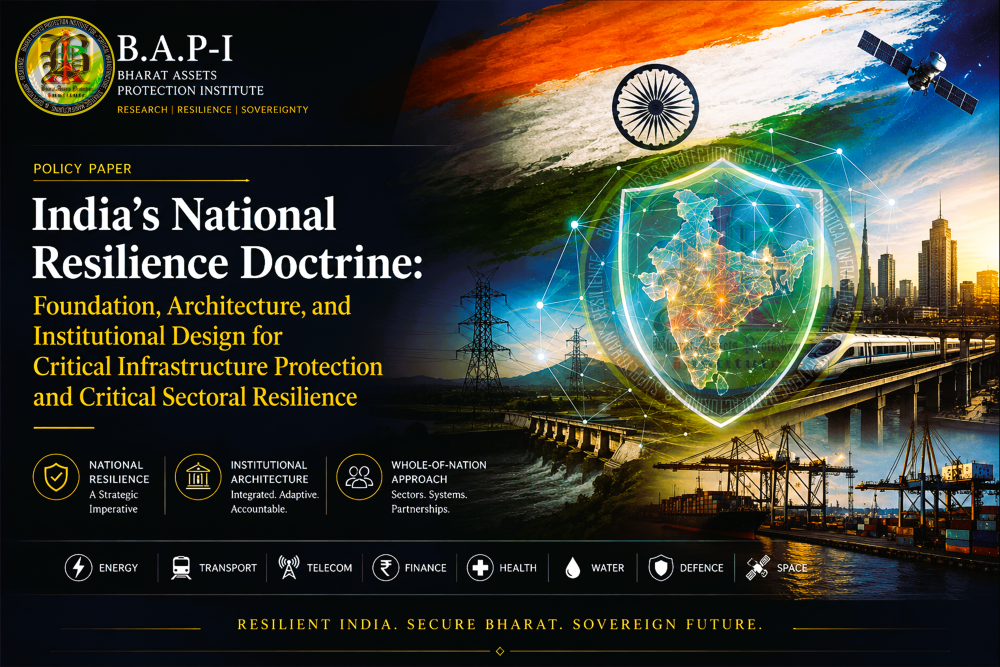
Critical infrastructure comprises the assets, systems and networks whose incapacity or destruction would have a debilitating impact on national security, the economy, public health or safety. The sector covered under this tab concerns the systems through which these assets are protected, and extends across energy and power grids, oil and gas, water supply and dams, transport networks including rail, ports, airports and highways, telecommunications and data centres, banking and financial systems, health care, government services, nuclear and space installations, and strategic manufacturing. Critical Infrastructure Protection Systems, or CIPS, bring together physical security, cybersecurity, operational resilience and emergency management for these assets.
The scope of this tab is not limited to guarding individual installations. It covers the full protection architecture: identification and classification of critical assets, mapping of interdependencies, threat and vulnerability assessment, physical and cyber protection measures, monitoring and early warning, incident response and recovery, business continuity, regulation and standards, information sharing, and the institutions that coordinate all of these across sectors and levels of government. It is this complete architecture, and not isolated protective measures, that determines whether Bharat's lifelines can withstand and recover from disruption.
Why This Sector Is Critical
Every function of modern national life runs on critical infrastructure. Defence mobilisation needs power, fuel, transport and communications; the economy needs payment systems, ports and logistics; citizens need water, electricity, health care and connectivity. These systems are increasingly interconnected and digitally controlled, which improves efficiency but also allows a disruption in one system to cascade into others. A failure of the power grid affects water pumping, telecommunications, hospitals and payments within hours.
It is argued that critical infrastructure is now the primary terrain of strategic competition below the threshold of war. Threats include cyber attacks on control systems, sabotage, terrorism, insider threats, supply chain compromise of components and software, extreme weather and natural disasters, and pandemics. Many protective arrangements remain organised sector by sector, while threats move across sectors. This is a structural vulnerability; and when critical infrastructure protection fails, the result is not a local incident but a national emergency affecting security, economic continuity and public confidence.
The Bharat Context
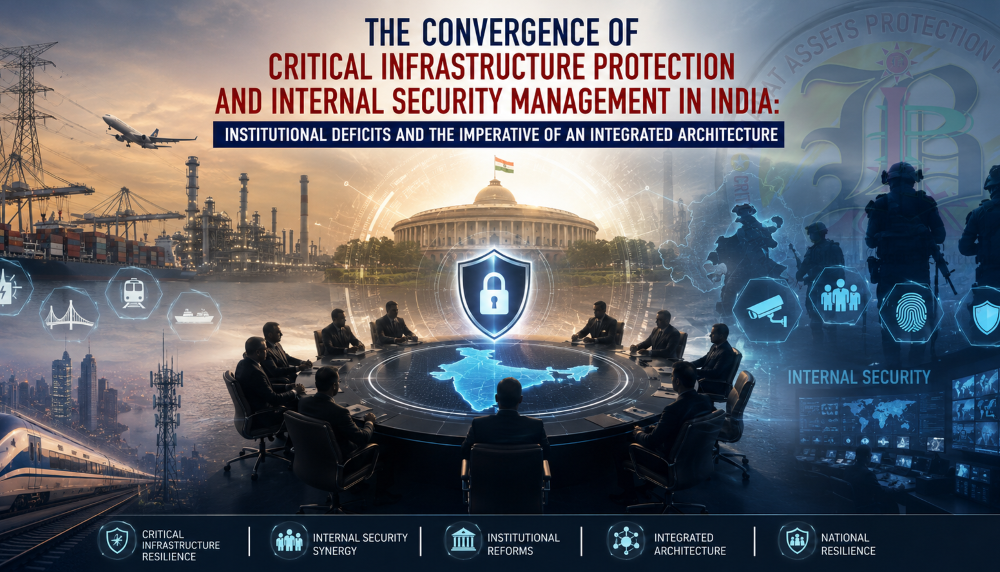
Bharat has established important foundations for critical infrastructure protection. The National Critical Information Infrastructure Protection Centre, under the National Technical Research Organisation, is the designated national nodal agency for the protection of critical information infrastructure, and the Information Technology Act provides for the declaration of protected systems. CERT-In serves as the national agency for cyber incident response, supported by sectoral CERTs. Physical protection of many critical installations is provided by the Central Industrial Security Force, and sector regulators and laws, such as the Dam Safety Act and nuclear regulation through the Atomic Energy Regulatory Board, address specific asset classes. The gaps lie in integration: physical and cyber protection are often governed separately, interdependency mapping across sectors is limited, private operators of critical assets vary widely in capability, and supply chain security of imported operational technology needs closer attention.
The enabling environment is substantial. The National Disaster Management Authority provides the disaster resilience framework, PM Gati Shakti offers a national geospatial platform for infrastructure planning, and Digital India, the India Semiconductor Mission and trusted source requirements in telecommunications support the indigenisation of critical technology. DRDO, ISRO, public sector operators of power, oil, rail and ports, and sectoral regulators each contribute expertise. Make in India and Aatmanirbhar Bharat create the policy basis for indigenous protection technologies. What remains missing is a unified national framework that connects cyber, physical and operational resilience across all critical sectors, and that brings public and private operators into a common system of standards, exercises and information sharing; and this is the gap that BAP-I seeks to address through this tab.
Importance of the Sector
Economy
The protection of critical infrastructure safeguards national capital of the highest value and underwrites the continuity of the entire economy. Disruption of power, ports, payments or telecommunications imposes losses that spread across every sector within hours. Investment in protection also builds a domestic industry in cybersecurity for operational technology, secure industrial control systems, surveillance and perimeter protection, resilience engineering and risk analytics. Indigenous capability in these fields reduces exposure to supply chain compromise and creates exportable expertise for partner nations seeking to protect their own infrastructure.
Employment
The sector requires a wide and specialised workforce: cybersecurity professionals with knowledge of industrial control systems, security engineers, infrastructure and systems engineers, risk analysts, intelligence analysts, emergency managers, physical security personnel and business continuity planners. Operators of power plants, grids, pipelines and transport systems also need security awareness built into their daily work. The scarcity of professionals who understand both engineering operations and security is a known constraint, which makes education and training in this field both an employment opportunity and a resilience necessity.
Entrepreneurship
Critical infrastructure protection offers deep-tech opportunities for start-ups and MSMEs. Enterprises can develop operational technology security tools, anomaly detection for control systems, secure communication modules, digital twins for resilience testing, drone and sensor-based perimeter monitoring, structural health monitoring, and risk modelling platforms for interdependent infrastructure. It is argued that indigenous solutions are especially valuable here, because operators of critical assets must be able to trust the provenance and integrity of every component in their protective systems; provided that testing, certification and procurement routes are open to qualified domestic enterprises.
Partnership
Critical infrastructure is owned and operated by a mix of central and state governments, public sector undertakings and private companies, which makes partnership indispensable. The sector calls for structured information sharing between operators and national agencies, joint exercises across sectors, collaboration between regulators on common standards, academic research on interdependencies and resilience, and industry participation in developing protective technologies. Cooperation with trusted international partners on threat intelligence and standards can add value, provided that sensitive information remains protected. BAP-I positions itself as the convening platform where these stakeholders can meet on shared research questions.
Research Focus Possibilities
BAP-I invites original research articles, policy papers, technical reports, diagnostic assessments, case studies and white papers across the following indicative research streams. The list is open-ended; contributions that connect a new question to the resilience objective of this tab are equally welcome.
A. Identification, Interdependency and Risk
- Methods for identifying and classifying critical infrastructure assets across sectors and levels of government
- Mapping of interdependencies between power, water, telecommunications, transport and finance, and modelling of cascading failures
- Combined threat assessment covering cyber attack, sabotage, natural hazards and pandemic scenarios
B. Cyber and Physical Protection
- Security of industrial control systems and operational technology in power, oil and gas, water and transport
- Supply chain security of imported components and software in critical infrastructure, and trusted source frameworks
- Integration of physical security, surveillance and cybersecurity into unified protection systems
- Insider threat management and personnel security in critical installations
C. Governance, Standards and Information Sharing
- Institutional architecture for critical infrastructure protection, and the coordination between national, sectoral and state agencies
- Standards, audits and compliance obligations for private operators of critical assets
- Information sharing mechanisms, sectoral CERTs and joint exercises between public and private operators
D. Resilience, Recovery and Human Capital
- Business continuity and recovery planning for critical infrastructure after major disruption
- Resilience of critical infrastructure to climate change and extreme weather
- Workforce development in operational technology security and critical infrastructure resilience
- Indigenous technology development for critical infrastructure protection and pathways from research to deployment
Who Can Participate
This tab invites participation from national cybersecurity and critical infrastructure agencies, sectoral regulators, public and private operators of power, oil and gas, water, transport, telecommunications and financial systems, the Central Industrial Security Force and state police, disaster management authorities, DRDO and ISRO units, cybersecurity and industrial automation companies, start-ups in operational technology security, IITs, NITs, IIITs and engineering research institutions, insurers and risk professionals, legal and policy scholars, and individual researchers with domain expertise. Contributions from practitioners, policymakers and academics carry equal standing within the BAP-I research framework.
The Resilience Objective
Every contribution under this tab must serve one purpose: ensuring that Bharat's critical infrastructure is protected by an integrated, sovereign and resilient system capable of preventing, withstanding and recovering from any disruption. BAP-I treats research as the instrument through which the nation's lifelines are mapped, secured and kept running.