Search

Focus area 2 of 6 · The Viswaguru Project

Strategic Manufacturing

India’s defence-industrial base, the Make in India ecosystem, and the manufacturing capabilities essential to strategic autonomy and self-reliance.

5 publications tagged

Focus area 2 of 6

About this focus area

Strategic Manufacturing is one of the six focus areas of the Viswaguru Project, the Bharat National Resilience Mission, and one of the lenses through which India's national resilience is understood, strengthened and advanced. It draws on several of the twelve Research Focus clusters and their 148 sectors, chiefly Commercial-Industrial Complex, Indigenisation & Technology Sovereignty and Business Innovation & Products Commercialisation, and brings their findings together into one resilience picture.

India's defence-industrial base, the Make in India ecosystem, and the manufacturing capabilities essential to strategic autonomy and self-reliance. The project places strategic manufacturing within the eight-stage resilience cycle of Understand, Map, Assess, Protect, Strengthen, Govern, Sustain and Advance, so that research, policy and institutional capacity building in this area stay aligned with the national mission.

Each publication tagged to strategic manufacturing is read against the four resilience metrics: Critical Dynamics and Resilience Parameters (CDRP), Ecosystem Intelligence (EI), the National Resilience Data Grid (NRDG) and Ecosystem Resilience (ER). Together they will feed the Bharat National Resilience Index (BNRI) once its methodology is published, so that no dimension of resilience is studied in isolation.

Contributions are welcome from strategic studies, public policy, engineering, economics, international relations, law and management. The institute looks for work that connects research with operational policy, and builds a body of knowledge on strategic manufacturing that is rigorous and usable by those who make and carry out decisions.

The Viswaguru Project

Four resilience metrics

B.A.P-I Publications

Publications on Strategic Manufacturing

Critical minerals and india&

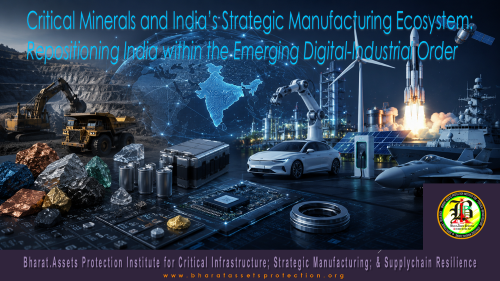
Critical Minerals and India's Strategic Manufacturing Ecosystem: Repositioning India within the Emerging Digital-Industrial Order

Dr. Padmalochan DASH26 May 2026
Abstract Research Paper

The transition of critical minerals from peripheral industrial inputs to foundational strategic assets marks one of the defining shifts within the contemporary digital-industrial order. These resources now underpin the full breadth of advanced manufacturing spanning semiconductor fabrication, renewable-energy infrastructure, defence-industrial production, artificial intelligence computing ecosystems, and the overarching architecture of technological sovereignty. Intensifying geopolitical competition over mineral access, downstream refining capability, and manufacturing integration has accompanied the global acceleration toward electrification, clean-energy deployment, and digitally integrated industrial systems. Against this backdrop, the present paper examines the strategic significance of critical minerals within a wider framework encompassing industrial resilience, national security imperatives, supply-chain vulnerability, and techno-economic rivalry. India's structural predicament characterised by deep import dependence, insufficient refining infrastructure, binding technological constraints, and limited downstream integration despite substantial rare earth potential is evaluated in detail. The paper further analyses the strategic relevance of lithium, cobalt, nickel, copper, graphite, rare earth elements, gallium, germanium, silicon, titanium, and other technologically indispensable minerals across defence, energy, semiconductor, and strategic manufacturing domains. Adopting a B.A.P-I analytical perspective, the study advances the argument that critical minerals must be embedded within India's long-term strategic resilience architecture specifically the Bharat National Resilience Index (BNRI), where mineral security intersects with Critical Infrastructure Protection, industrial sovereignty, supply-chain resilience, and comprehensive national security planning.
Read more
Critical minerals

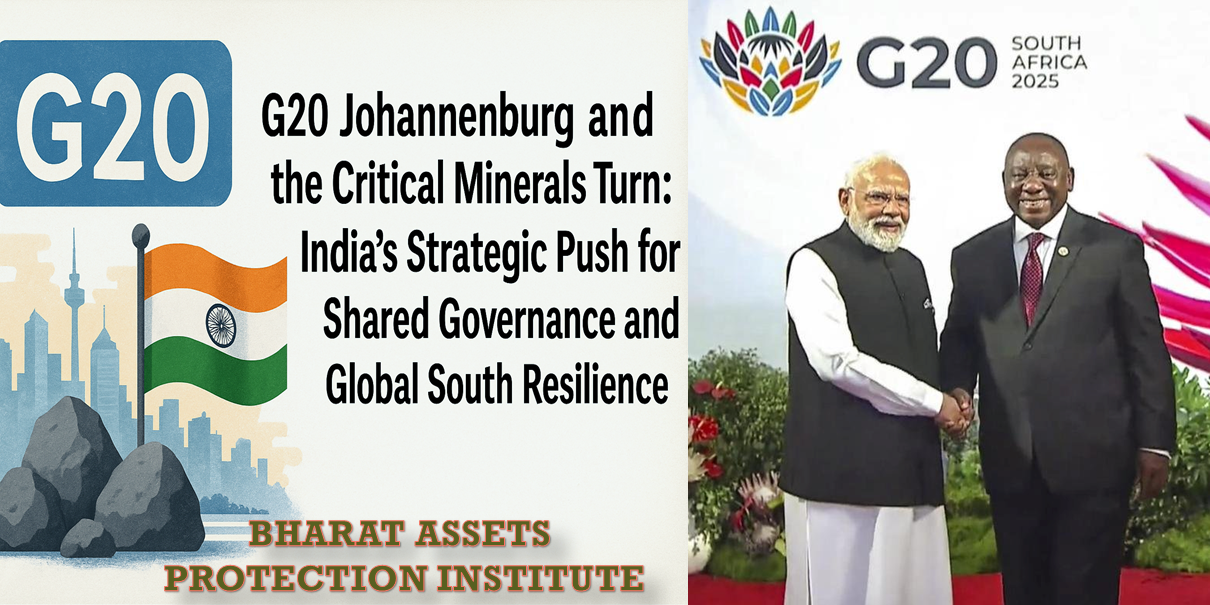
G20 Johannesburg and the Critical Minerals Turn: India’s Strategic Push for Shared Governance and Global South Resilience

Bharat Assets Protection Institute™, Dr. Padmalochan DASH23 Nov 2025
Abstract Policy Commentary

Critical minerals emerged as a central governance priority in the Johannesburg G20 deliberations, positioned alongside energy transition, digital governance and climate resilience. The Leaders’ Declaration affirmed the creation of a “G20 Critical Minerals Framework… for sustainable development, inclusive economic growth, and resilience” (ANI, Nov. 23, 2025). India advanced a norm-shaping role by proposing a “G20 critical minerals circularity initiative to promote recycling, urban mining, second-life batteries and related innovations” (PTI News, Nov. 22, 2025) and calling for a “G20 Open Satellite Data Partnership” to make shared space-based analytics accessible to the Global South (MEA, Nov. 22, 2025). The discussions acknowledged structural inequities, including supply concentration and the reality that China is “leverag[es] its chokehold over rare and critical minerals” (TOI, Nov. 23, 2025), while recognising that many producer states face “under investment, limited value addition and beneficiation, [and] lack of technologies” (ANI, Nov. 23, 2025). India’s framing that “critical minerals… should be seen as a shared resource for humanity” (MEA, Nov. 22, 2025) encapsulated an emerging shift toward equity-based governance, circular value chains and Global South leadership in minerals policy.

Read more
One nation one chemical policy

One Nation, One Chemical Policy: The Case for a Unified, Risk-Aligned Chemical Governance Framework in India

Dr. Padmalochan DASH22 Nov 2025
Abstract Research Paper

India’s chemical sector has entered a phase where industrial expansion, global compliance pressures, and national security obligations intersect, exposing the limitations of a fragmented, multi-rule regulatory inheritance that evolved after industrial disasters and incremental policy responses rather than through a unified governance doctrine (MSIHC-Rules, 1989; CA-EPPR, 1996; NDMA, 2019). The sector contributes to pharmaceuticals, petrochemicals, specialty chemicals, defence manufacturing, and export-driven industrial value chains, yet operates without a central statute, integrated licensing regime, or traceability-backed oversight system aligned to international regulatory models such as EU REACH, TSCA reforms, K-REACH, or AICIS frameworks (IBEF, 2023; REACH, 2006; TSCA-EPA, 1976; K-REACH, n.d.; AICIS, n.d.). The proposed policy establishes a unified national governance architecture integrating statutory mandates under a consolidated framework, a national digital chemical registry, BNRI-linked resilience scoring, lifecycle compliance controls, single-window licensing, and a CIPA-aligned enforcement hierarchy capable of addressing dual-use risks, cyber-physical manipulation, hazardous logistics chains, and disaster vulnerability within chemical infrastructure systems (CMSR, n.d.; CERT-IN, n.d.; CISA-CFATS, 2007; BAPI-CIPA, 2025; BAPI-BNRI, 2025). Hazard oversight, industrial safety, precursor tracking, storage verification, and high-risk transport are reframed as regulated national continuity functions rather than procedural compliance obligations, ensuring traceability, control, accountability, and interoperability across federal and state authorities through the proposed National Chemical Centre acting as an apex statutory institution (DCPC, n.d.; NACWC, n.d.; NDMA, 2019). The implementation roadmap adopts a phased transition approach where policy notification, registry activation, licensing convergence, enforcement tiering, and global harmonisation evolve into a unified national operating model supported by IoT-based monitoring, QR-enabled movement governance, SCADA cybersecurity, and AI-powered anomaly detection for high-hazard installations (ICRH-CMSR, n.d.; REACHLaw, n.d.; OPCW, 2021). Compliance is measured through a BNRI-based scoring framework that determines facility status, inspection cadence, export eligibility, and enforcement escalation under a national penalty and shutdown ladder linked to CIPA oversight jurisdiction and dual-use monitoring protocols (PCPIR-Policy, 2007; CMP, n.d.; BAPI-CIPA-Legis, 2025). The framework positions chemical regulation as a core national security, economic competitiveness, and public safety mandate, establishing India’s chemical ecosystem as a digitally governed, resilience-aligned, legally enforceable, internationally interoperable system capable of safeguarding industrial growth, community safety, and sovereign control of high-risk chemical assets.

Read more
Bapi retro 20

From Challenge to Contract: iDEX, India's Deep-Tech Support Architecture in 2024, and How Start-ups Can Serve Critical Infrastructure Protection

Dr. Padmalochan DASH20 Jun 2024
Abstract Industry Strategy

By 2024 India had assembled a recognisable architecture for supporting deep-technology start-ups. Its most mature defence component, Innovations for Defence Excellence (iDEX), launched in 2018, had moved from grants to procurement, and in March 2024 it was extended through the ADITI scheme, which offers larger grants for critical and strategic technologies. Around it stood the Startup India programme, the Fund of Funds for Startups, a draft national deep-tech start-up policy and, in 2025, a research, development and innovation fund of Rs 1 lakh crore. This retrospective paper reviews what the iDEX model achieved by 2024, the reforms that would strengthen it further, and what its design offers to a field it was not built for: the protection of civilian critical infrastructure. It argues that the decisive feature of iDEX is not the grant but the identified user with a problem statement and a route to purchase, and it proposes a comparable challenge-to-contract mechanism for power, telecommunications, water, transport and port operators under a national resilience mandate.

Read more
Bapi retro 09

Chips as Strategic Infrastructure: The India Semiconductor Mission of 2022 and What a Resilient Electronics Supply Chain Requires

Dr. Padmalochan DASH09 Sep 2022
Abstract Research Paper

The global semiconductor shortage of 2020 to 2022 showed that a component few citizens ever see could halt factories, delay vehicles and expose the dependence of an entire economy on a handful of foreign fabrication sites. India answered with the Programme for Development of Semiconductors and Display Manufacturing Ecosystem, approved in December 2021 and modified in September 2022 to offer uniform fiscal support of fifty per cent for fabs across all technology nodes, with the India Semiconductor Mission as its nodal agency. This retrospective revisits 2022 as the year in which chips moved from industrial policy into the vocabulary of national security. It traces the shock that prompted the programme, reads the 2022 modifications closely, and follows what happened afterwards, from approved fabs and packaging plants to the inauguration of a large memory assembly and test plant in 2026. It credits the programme with building, within a few years, a semiconductor base where none existed, and argues that the next stage should add trusted sourcing, stockholding, measurement and a governance home within the wider architecture of critical infrastructure protection.

Read more