


Hybrid Threats Monitoring & Risk Response Systems
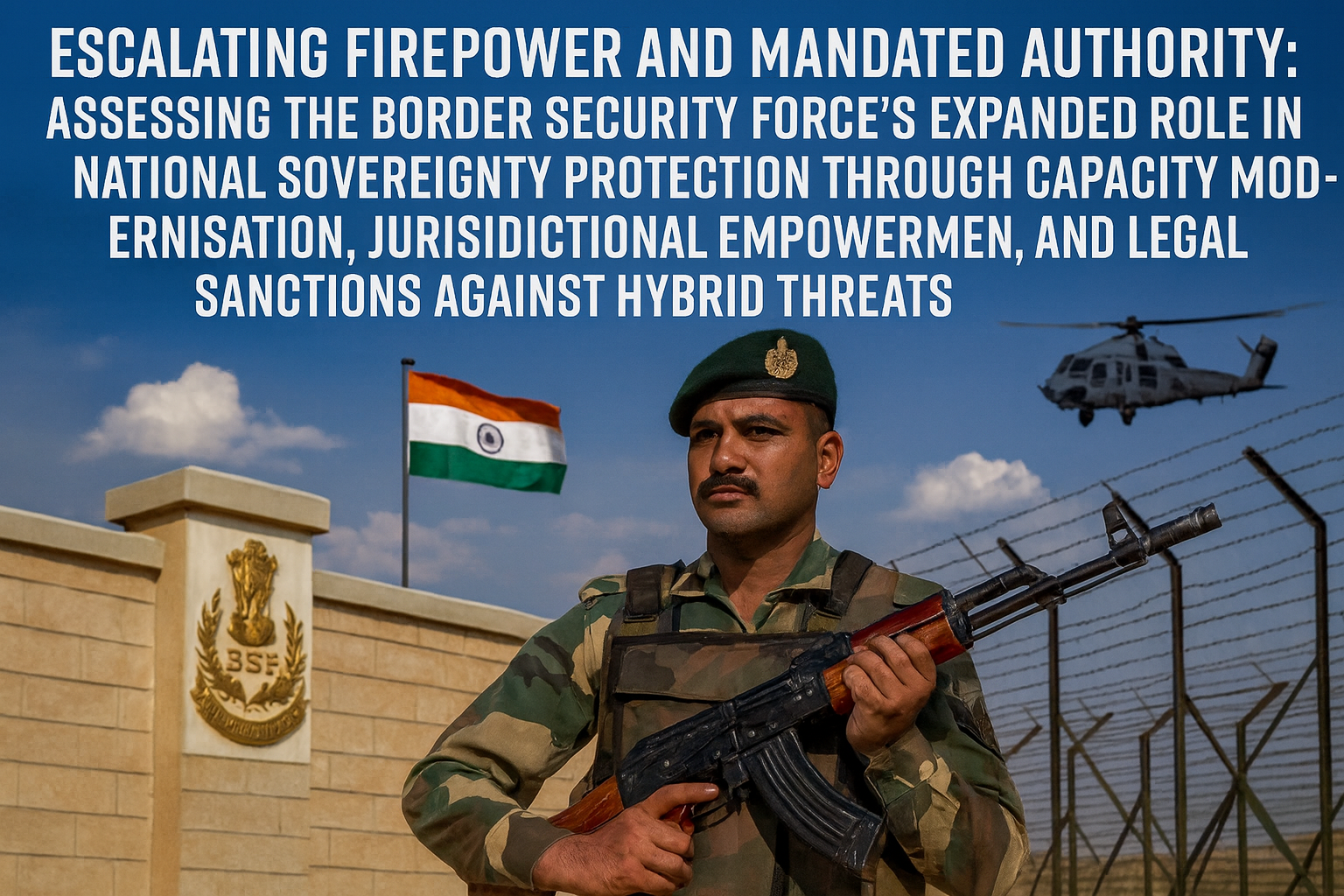
Post-Operation Sindoor,
India’s border security posture has shifted into a decisive phase characterised
by offensive deterrence, heightened legal consequence, and multi-domain
enforcement supported by technology. The evolving threat environment, defined by
drone-assisted arms delivery, hybrid warfare, organised infiltration pipelines,
and demographic manipulation, has accelerated the transformation of the Border
Security Force into a more strategically empowered national-security
institution with expanded jurisdictional reach, enhanced military capability,
and sharper operational focus. This evolution reflects a structural
recalibration rather than a short-lived reactive adjustment, positioning border
protection as inseparable from safeguarding democratic continuity, territorial
integrity, and sovereign identity. It is now treated as a strategic determinant
of internal stability rather than an isolated law-and-order concern. The
post-Sindoor environment signals the rise of a new enforcement paradigm in which
real-time surveillance, strengthened interdiction capability, and coordinated
response frameworks shape a doctrine of pre-emptive security. Within this
shifting landscape, the Border Security Force is positioned as a central pillar
of national security, tasked with preventing hybrid threats, sustaining
territorial security, and upholding constitutional legitimacy in an
increasingly volatile geostrategic context.
Keywords : Hybrid Warfare, Infiltration, Weapon-Dropping Drones, Cross-Border Terrorism, Demographic Subversion, National Sovereignty, Counter-Infiltration, Jurisdictional Enforcement, Deterrence Doctrine, Democratic Integrity. Op. Sindoor , Border Security Force (BSF), Heavy Weapons Capability, Smart Fencing, AI-Driven Surveillance, Modernisation, Arrest-Search-Seizure Authority, Multi-Domain Security, Interdiction, Launchpad Neutralisation.
1. Introduction
India’s border security
landscape is undergoing a decisive transformation driven by hybrid, adaptive
and technology-enabled threat vectors. The threat perimeter is no longer
confined to physical incursions. It now includes terrorism logistics, organised
illegal migration, narcotics supply chains, drone-assisted weapons delivery and
digitally facilitated radicalisation pipelines operating with increasing
precision. Recent operational patterns reflect this shift, with intelligence
assessments post-Op. Sindoor confirming a rise in Pakistan-supported
drone-based weapon drops and the recovery of drones, arms and explosives along
the Punjab frontier, indicating both adversarial escalation and strengthened
Indian interdiction capability (ET, February 2025).
Within this evolving
security environment, the Border Security Force (BSF) functions as the primary
instrument of sovereign protection. Structurally, it remains one of the world’s
largest border forces where “with an organisation of 193 battalions and personnel
of more than 2.76 lakh, the BSF protects the 2,279 km long border with Pakistan
and the 4,096 km long border with Bangladesh with complete vigilance” (PIB,
Nov. 21, 2025). Its mandate is multidomain, and it stands as the only force
responsible for defending India across land, water and air while operating
under highly variable geographic and threat conditions (PIB, Nov. 21, 2025). In
effect, the BSF is no longer a static boundary guard, but a frontline sovereign
defence institution positioned against cross-border crime, proxy terrorism and
demographic disruption.
This operational shift has
progressed in parallel with legal reinforcement. The Ministry of Home Affairs
expanded BSF authority to search, seize and arrest up to 50 km from the
international border in Assam, West Bengal and Punjab, replacing fragmented jurisdiction
with uniform enforcement continuity (Singh, Oct. 16, 2021). This expansion
rests on the statutory mandate under the BSF Act, which defines the force as an
Armed Force of the Union empowered to secure national borders, authorise use of
force including lethal force where required and act without warrant when
national security is implicated (BSF Act, 1968).
Operational outcomes
validate this enhanced mandate. Arms-linked interdiction has risen sharply,
with firearm recoveries increasing by approximately 2,568 percent and explosive
seizures by over 7,363 percent since 2021, signalling unprecedented disruption
of hostile logistical networks (Ranjan, Aug. 18, 2025). Narcotics seizures
exceeding 18,000 kilograms in 2025 demonstrate parallel disruption of
transnational crime routes and radicalisation-financing infrastructure (PIB,
Nov. 21, 2025). Battlefield validation further confirms capability progression.
During Op. Sindoor, modern platforms including the Vidhwansak anti-material
rifle, automatic grenade launchers and anti-aircraft systems successfully
destroyed bunkers, pillboxes, armoured platforms and active terror launchpads,
compelling adversary withdrawal from fortified positions (NDTV, May 27, 2025;
CNBCTV18.com, May 27, 2025). This marks a shift from reactive defence to
calibrated deterrence aligned with the national position that any misadventure
will receive an appropriate response (TOI, Dec. 2025).
Border defence is now
framed as inseparable from democratic continuity. Infiltration and hybrid
destabilisation are treated not merely as security violations but as threats to
constitutional legitimacy, demographic stability and electoral sovereignty. National
statements affirm that preventing infiltration is necessary to preserve the
integrity of the democratic system and that BSF deployment constitutes a
constitutional requirement rather than a discretionary administrative action
(PIB, Nov. 21, 2025).
Against this backdrop, this
paper examines the escalation of firepower, expansion of legal jurisdiction,
transformation of enforcement capability and doctrinal evolution of the BSF in
response to rising hybrid threats and sovereign defence imperatives, with
specific focus on national security preservation and democratic stability.
|
2.
Executive Summary |
|
India’s border security environment has entered a defining and
increasingly complex phase shaped by hybrid warfare, drone-enabled weapons
movement, cross-border terrorism, organised criminal networks, demographic
infiltration and shifting insurgent logistics corridors. In this emerging
landscape, the expansion of the Border Security Force’s firepower, legal
authority and jurisdictional reach now stands at the core of sovereignty
protection and democratic stability. The BSF today operates as a technologically
adaptive, operationally expanded and doctrinally aligned force, securing
6,375 km of international borders through 193 battalions and more than 2.76
lakh personnel, remaining the only institution defending India across land,
water and air (PIB, Nov. 21, 2025). Interdiction results reinforce this
institutional shift, with the seizure of more than 18,000 kilograms of
narcotics in 2025 marking significant disruption of radicalisation financing
and transnational criminal pipelines (PIB, Nov. 21, 2025). |
|
Jurisdictional clarity has further strengthened enforcement
reach. The standardised authority to arrest, search and seize up to 50 km
inside notified border states (Singh, Oct. 16, 2021) now removes the earlier
fragmentation that constrained operational depth. This expansion is firmly
rooted in statutory provisions under the BSF Act and Rules (Mar. 2004),
enabling warrantless arrest, application of calibrated force when required
and seizure of material linked to national-security offences. Under this framework,
the BSF evolves from a conventional border-policing function into a frontline
security architecture countering infiltration chains, terror logistics,
narcotics corridors, unlawful migration patterns and hybrid demographic
disruptions. |
|
Modernisation continues to demonstrate strategic and battlefield
value. During Op. Sindoor, platforms including the Vidhwansak anti-materiel
rifle, automatic grenade launchers and high-rate anti-aircraft systems
neutralised fortified positions and Pakistan-based launchpads, compelling
adversarial withdrawal (NDTV, May 27, 2025; CNBCTV18.com, May 27, 2025). The
integration of drone-warfare doctrine and the rise of indigenous
counter-autonomous innovation (Srivastava, Sept. 22, 2025) signal a shift
toward intelligent border architecture where technology reinforces
deterrence, precision and response velocity. |
|
Operational patterns continue to validate this trajectory.
Firearm recoveries increasing 2,568 percent and explosive recoveries rising
7,363 percent since 2021 indicate a dual phenomenon: increased adversarial
activity and a significantly strengthened interception posture (Ranjan, Aug.
18, 2025). The decline in successful transnational infiltration attempts
reflects a growing relationship between enhanced BSF capability and the
disruption of terror-linked logistics networks. |
|
The cumulative outcome signals a structural transition toward a
deterrence-driven border security regime. Advanced weapon systems,
standardised legal mandate, expanded aerial and electronic surveillance, and
maturing anti-drone capability now position the BSF as a critical
institutional firewall against hybrid threats, external subversion and
organised cross-border exploitation ecosystems. National policy articulation
repeatedly affirms that strengthening the BSF is not a tactical adjustment,
but a constitutional imperative essential to safeguarding sovereign integrity
and ensuring democratic continuity. |
3. Problem Statement
The border security
challenge India confronts is no longer defined by conventional territorial
incursions. It has evolved into a multidimensional threat environment driven by
hybrid infiltration through terrorism, illegal migration, drone-facilitated weapon
drops, narcotics trafficking, ideological influence networks, and organised
transnational crime. Post-Op. Sindoor reporting confirms this shift, as
intelligence assessments indicate rising drone-delivered weapons from Pakistan,
changing infiltration routes, and the growing requirement for precision
counter-drone capability and improved technological deterrence (ET., February
2025). Parallel evidence indicates an escalation in logistics hostility, with
firearm recoveries rising 2,568 percent and explosive seizures increasing 7,363
percent since 2021, reflecting both increased adversarial effort and
strengthened supply lines (Ranjan, August 18, 2025).
Attacks across high-risk
sectors persist despite operational pushback. Surveillance reports document
restructured launchpads and continued militant movement along the Line of
Control, reaffirming the presence of state-linked militant preparation and long-term
strategic intent (TOI, Dec. 2025). Combined with narcotics corridors and
radicalisation networks, this pattern confirms a deliberate hybrid strategy
designed to weaken India’s sovereign borders and degrade internal security
capacity.
These threats were
compounded by past institutional limitations. Jurisdictional fragmentation and
restricted operational powers diluted BSF deterrence across border states. This
gap remained until the Ministry of Home Affairs issued the notification standardising
BSF powers to arrest, search, and seize up to 50 km inside identified border
states, resolving fragmented enforcement boundaries (Singh, Oct. 16, 2021).
Before this alignment, BSF response capability remained diluted, delaying
interdiction and reducing pursuit viability.
Despite the legal
foundation under the BSF Act and Rules enabling warrantless arrest, seizure of
contraband and arms, and prevention of unauthorised border movement (BSF Act
and Rules, Mar. 2004), earlier deployment structures, ageing equipment, and
procedural rigidity exposed porous terrain. These vulnerabilities allowed
adversaries to exploit legal ambiguity, complex geography, and technological
asymmetry.
The present threat
environment cannot be managed through incremental adaptation. It requires
continuous adoption of modern weapons systems, cyber-physical surveillance
networks, multidomain deployment models, and unified enforcement frameworks.
Infiltration today is not merely territorial. It is demographic, psychological,
and asymmetrically structured with the objective of weakening social stability,
national identity, and democratic processes.
3.1 Methodology and Analytical Mapping:
The qualitative analytical
approach used in this paper is structured and based exclusively on primary
government releases, legislative instruments, operational reporting, verified
statistical disclosures, and authoritative news sources cited in the study. The
analysis framework follows triangulated explication rather than theoretical
extrapolation, ensuring that all interpretations remain grounded in documented
actions, statutory texts, and official discourse.
The methodology progresses through three interconnected layers:
First, the current threat
environment is mapped against confirmed reporting on hybrid infiltration,
drone-assisted weapons movement, narcotics flow, and terror-linked mobilisation
networks. This step establishes the operational context within which the BSF
mandate has expanded.
Second, the paper conducts
an institutional response assessment by correlating legal empowerment,
jurisdictional extension, force structure, technological upgrades, weapons
modernisation, and operational results. Examples include the expanded authority
permitting BSF action up to 50 km from the international boundary in Assam,
West Bengal, and Punjab (Singh, Oct. 16, 2021), and statutory powers allowing
arrest and seizure without warrant (BSF Act and Rules, Mar. 2004), weighed
against operational outcomes such as narcotics seizures exceeding 18,000 kg.
Third, a
normative-evaluative layer is applied to test whether increased firepower,
interdiction capacity, and expanded jurisdiction are adequate to counter
emerging hybrid vectors including drone-distributed weapons (ET., February
2025), demographic infiltration strategies, and transnational logistics
pipelines. This layer also considers governance demands involving oversight,
doctrinal alignment, democratic protection, technological dependency, and the
need for integrated future frameworks.
|
Analytical
Dimension |
Source Type Mapped |
Purpose |
|
Threat Environment |
Verified operational reports and intelligence-linked public data |
Establish risk spectrum and escalation patterns |
|
Capacity and
Jurisdiction |
Legal instruments,
official notifications, force structure disclosures |
Identify
transformation in authority and enforcement reach |
|
Firepower and
Technology |
Deployment records, field validation accounts, operational
showcases |
Locate kinetic and surveillance capability shifts |
|
Enforcement
Outcomes |
Data disclosures,
seizure figures, counter-infiltration reporting |
Measure practical
impact against declared doctrine |
|
Doctrinal and
Future Requirements |
Policy statements, operational rhetoric, national security
framing |
Assess alignment with long-term sovereignty protection |
The analytical mapping
aligns findings with real institutional domains to ensure evidence-based
interpretation rather than speculative inference. This creates a direct trace
from threat evolution to policy change, institutional strengthening,
operational output, and the central evaluative question: whether the BSF’s
expanded firepower, jurisdiction, and legal authority now form a sustainable
sovereignty-protection framework capable of confronting present and evolving
hybrid threats.
4. Strategic Context
(Historical and Contemporary Triggers)
The border security system
in India has shifted from a random and reactive structure to a national
security framework aligned with changing threat patterns and operational needs.
Earlier border control models were marked by limited state capability, restricted
surveillance, and decentralised command arrangements, which created porous
borders vulnerable to infiltration, smuggling, and organised hostile activity.
Without a coherent national enforcement framework, security responses remained
tactical and local rather than strategic or preventive. This earlier framework
now stands in contrast to the evolved threat environment marked by hybrid
infiltration, drone-supported warfare, state-backed terror logistics, and
organised crime networks requiring a force capable of sovereign enforcement,
technological superiority, and multi-domain operations across land, water, and
air. In this present environment, the role of the Border Security Force
reflects a deliberate and necessary response to decades of accumulated vulnerabilities
and emerging operational imperatives.
4.1 Historical Limitations (Pre-Modernisation Period)
The earlier period of
border governance in India was defined by institutional limits, fragmented
operations, and insufficient legal authority, creating border regions that
functioned more as observation zones than controlled sovereign lines. Before a
national border force existed, the responsibility rested with state police
units lacking unified command, advanced surveillance systems, or doctrinal
preparedness suited to militarised threats. This environment allowed
infiltration routes, smuggling corridors, and hostile movement chains to
operate with limited resistance. The transition to a specialised force was
driven by the realisation that passive control could not address threats that
were becoming more coordinated and technologically flexible. This contrast is
evident today, reflected in the current force size of 193 battalions and more
than 2.76 lakh personnel securing the borders of Pakistan and Bangladesh (PIB,
Nov. 21, 2025).
The statutory mandate
declaring the BSF as the only force across all CAPFs responsible for securing
India across land, water, and air (PIB, Nov. 21, 2025) demonstrates a
capability beyond the narrow policing-based models of past decades. Enforcement
outcomes such as the confiscation of over 18,000 kilograms of narcotics in 2025
(PIB, Nov. 21, 2025) indicate the scale of threat that could not be countered
earlier due to gaps in legal authority, equipment, and surveillance. The
consequences of these historical limitations justify the national transition
from passive monitoring to a statutory security force with structured command,
jurisdictional consistency, modern weapon systems, and multidomain operational
capability.
4.1.1 State Police–Led Border Protection Pre-1965:
Before a national border
protection system was established, nearly all of India’s land borders were
policed by state police forces. This fragmented security model meant that the
defence of borders depended on state-level capacity rather than a unified national
doctrine. With no integrated command, continuity of response, or ability to
escalate operations, security assumed a policing posture that could not deter
organised infiltration, proxy warfare, or hybrid cross-border aggression. These
formations lacked specialised training, doctrine, and operational preparedness.
Border regions functioned as administrative margins rather than strategic
defence lines, which enabled demographic manipulation, arms movement,
smuggling, and state-backed infiltration. There was no institutional capability
to defend borders or engage in border warfare, reinforcing the reality that the
present-day BSF has evolved into a constitutional and national security
institution rather than a policing extension.
The difference between
present capacity and earlier structures is substantial. Today, the BSF’s
structure of 193 battalions and more than 2.76 lakh personnel maintains full
operational vigilance across 2,279 km of the Pakistan border and 4,096 km along
Bangladesh, representing a level of standardisation absent in state-policing
frameworks. Earlier, infiltration and illegal migration were not recognised as
threats to national security. The present position asserts that infiltration
and their tactical cross-migration must be prevented to protect India’s
democratic system from being destabilised and that deploying BSF capability is
a constitutional mandate rather than a discretionary act (PIB, Nov. 21, 2025).
This shift reflects a recognition that fragmented and inconsistent law
enforcement cannot counter state-backed mobilisation or hybrid threat models.
Before 1965, state police
lacked specialised weaponry, integrated intelligence, technological
surveillance, or operational interoperability. The present posture demonstrates
a determined shift toward deterrence, reflected in the stance that no adversary
should dare attempt to occupy even a single inch of Indian territory while the
BSF remains deployed under full vigilance (PIB, Nov. 21, 2025). Earlier
limitations in legal authority were overturned through statutory command
frameworks such as the BSF Act (1968), which authorised personnel to arrest
without warrant in cases involving threats to border security, smuggling,
infiltration, illegal entry, and activities detrimental to national safety
(BSF, 1968). This replaced fragmented state-based authority with a national
enforcement directive.
Modernisation has now
become an integral component of border defence. Previous models did not include
sustained capability development or technological progress. The current vision
asserts a forward trajectory with the objective that in the next five years,
the BSF will become the most technologically advanced border security force in
the world, combining operational lethality with advanced technological
capability (PIB, Nov. 21, 2025). This transition reflects a complete shift from
reactive border policing to proactive defence of national sovereignty.
4.1.2 Weak Weapons, Limited Technology, and Restrictive
Legal Authority
Pre-1965 border protection
under state police operated with limited weaponry, basic technology, and narrow
legal jurisdiction, which severely weakened India’s ability to safeguard its
frontiers. It functioned as an administrative policing system rather than a
strategic defence mechanism and could not counter infiltration attempts,
organised smuggling, radical mobilisation, or transnational crime networks. The
response remained reactive and static, leaving the system unable to deter or
respond to hostile state-backed actors or structured infiltration ecosystems.
In contrast, the current environment recognises the scale of threats and
assigns national defence responsibilities to a single institution. The BSF is
the only agency mandated to defend India across land, water, and air, adapting
to terrain hostility and operational unpredictability (PIB, Nov. 21, 2025).
Earlier border policing methods had no equivalent to modern frameworks such as
e-security fencing and AI-enabled border systems, which represent a transformation
from manpower-heavy tactics to intelligent network-based sovereignty
enforcement (PIB, Nov. 21, 2025). The doctrinal shift is also significant.
Previously, border violations were treated as isolated criminal incidents
rather than national threats. The current position identifies the BSF as the
first defensive layer along international boundaries tasked with preventing
infiltration, narcotics smuggling, terrorism, and destabilisation activities
(PIB, Nov. 21, 2025).
Earlier border systems
lacked advanced weaponry and tactical superiority, which limited operational
impact. The contrast became unambiguous during Op. Sindoor where the deployment
of the Vidhwansak anti-material rifle, automatic grenade launcher systems, and
other heavy platforms successfully destroyed bunkers, forward posts and
armoured structures (NDTV, May 27, 2025). The present force integrates
high-order surveillance, counter-drone capability, and rapid-response doctrine,
demonstrated when drones, arms, and explosives were recovered along the Punjab
frontier, reflecting improved counter-drone surveillance and fast-response
posture (ET., February 2025). These capacities were absent during earlier
decades, when large territorial gaps remained unmonitored. The BSF Act authorised personnel to employ
force, including lethal force when necessary, and to arrest without warrant
when actions relate to border security threats, smuggling, infiltration,
illegal entry, or activities affecting national safety (BSF, 1968). Procedural
clarity strengthened this mandate, as the Act permits any force member to seize
property suspected to be stolen or unlawfully possessed (BSF Act and Rules,
Mar. 2004).
4.2 Present Threat Landscape
The border environment in
India has become a dynamic operational space defined by hybrid, asymmetric, and
state-supported destabilisation strategies that integrate organised crime
networks, terror supply chains, and technology-enabled infiltration into a
coordinated threat structure. Borders are no longer passive geographic lines,
but active strategic zones where demographic manipulation, narco-terror
financing, arms trafficking, cyber-enabled coordination, and radicalisation
pipelines converge. Threats are adaptive, and the force must maintain constant
readiness and decisive interdiction capability. Most seriously, these threats
exceed physical intrusion and intersect with ideological and demographic
destabilisation, reinforcing the need for a proactive strategic posture rather
than routine frontier policing.
4.2.1 Organised Crimes: Arms, Narcotics, Wildlife, Human Smuggling and
Terror Pipelines
Current border threats
consist of coordinated networks involving arms trafficking, narcotics chains,
demographic penetration, wildlife crime, human smuggling, and terror-linked
movement pipelines designed to destabilise internal security and sustain extremist
ecosystems. Enforcement evidence demonstrates rising sophistication, as
reflected in 2025 seizures exceeding 18,000 kilograms of narcotics,
representing a significant disruption of transnational crime networks (PIB,
Nov. 21, 2025). The scale of hostile logistics is further demonstrated in
weapons data, where firearm recoveries increased by 2,568 percent and explosive
seizures by more than 7,363 percent since 2021, indicating both escalation of
adversarial capability and improved interdiction response (Ranjan, August 18,
2025).
These threats are not
isolated occurrences but elements of a coordinated ecosystem designed to
undermine sovereign stability. Within this operational reality, the BSF must
function as a national security institution rather than a conventional policing
body. Its mandate establishes that India’s first responder along international
borders must operate beyond defensive posture and prevent infiltration,
narcotics smuggling, terrorism and destabilisation networks (PIB, Nov. 21,
2025). Infiltration must therefore be understood not merely as unlawful entry
but as a deliberate attempt to influence or distort democratic stability. This
is reflected in the principle that preventing infiltration, narcotics
trafficking and terror mobility is inseparable from protecting electoral
integrity, demographic balance and national sovereignty (PIB, Nov. 21, 2025).
This threat architecture is
now being countered through modernisation, reflected in the shift where
e-security fencing and AI-based border systems replace manpower-heavy
strategies with intelligent, network-based enforcement (PIB, Nov. 21, 2025).
The move toward AI surveillance, digital fencing and automated detection marks
a definitive transition toward deterrence-based border control. This reinforces
why border security now functions as a constitutional obligation rather than a
policing task. The national position remains explicit: no adversary should be
capable of even contemplating intrusion as long as the BSF is deployed with
readiness and vigilance (PIB, Nov. 21, 2025). The current landscape therefore
represents a strategic paradigm in which hybrid infiltration is countered by an
assertive, legally empowered and technologically advanced force securing
sovereignty against national and transnational threats.
4.2.2 Drone Warfare as a New-Age Threat Vector
The border battlefield in
India has expanded into low-altitude airspace where unmanned aerial vehicles
are being used to transport weapons, narcotics, and explosives, creating an
operational environment where fences and ground patrols alone are no longer
sufficient. Operational intelligence confirms a sharp rise in drone-based
weapon drops from Pakistan, showing both an escalation of threat vectors and an
improvement in BSF interception and firepower countermeasures (ET., February
2025). Recoveries of drones, weapons, and explosives along the Punjab frontier
demonstrate enhanced counter-drone monitoring and rapid-response deployment
posture (ET., February 2025). These incursions represent systematic efforts to
continue financing extremism, maintain weapon supply lines, and enable militant
mobility without physically crossing the border.
As the force consolidates
its multidomain identity and remains the only organisation responsible for
defending India across land, water and air, drone warfare now falls directly
within the BSF mandate and operational responsibility (PIB, Nov. 21, 2025). In
this expanded role, the force is adapting to hostile terrain and unpredictable
operational environments with increasing structural precision. This evolution
demands layered surveillance, electronic disruption capability, kinetic
neutralisation platforms and agile ground interdiction teams capable of rapid
deployment across shifting threat vectors. These requirements are reinforced as
the BSF’s operational footprint not only remains wider, protecting 2,279 km of
the India–Pakistan border and 4,096 km of the India–Bangladesh border, but
extends deeper into operational depth as well (PIB, Nov. 21, 2025). The scale
of deployment is now a serious operational consideration, as it must support
distributed response nodes, uninterrupted monitoring frameworks and an escalation-ready
posture capable of countering unpredictable UAV incursions with speed, accuracy
and operational correctness.
Drone threats are no longer
treated as isolated events. They have been absorbed into doctrine, training,
and operational culture by the adversaries so the Indian security requirements.
The BSF now has formally integrated drone warfare into its training syllabus
and has established an innovation centre to sustain technological preparedness
against emerging hybrid threats (Srivastava, Sept. 22, 2025). This transition
standardises reconnaissance drills, payload identification, electronic
disruption procedures, and recovery operations across formations. The
innovation centre accelerates adaptation by converting field observations from
Punjab and LoC sectors into practical counter-drone strategies and deployment
methods.
This doctrinal shift is
reinforced by modernisation planning. The stated vision that within the next
five years the BSF will become the world’s most advanced border security force
combining technological superiority with operational lethality (PIB, Nov. 21,
2025) places drone warfare at the centre of planning rather than as a
supplementary skillset. AI-linked border solutions such as e-security fencing
and network-based detection signify the transition from manpower-centric
tactics to intelligence-driven, network-based sovereign enforcement (PIB, Nov.
21, 2025). AI-enabled analytics and autonomous sensors are essential to
detecting low-signature aerial platforms navigating terrain-adaptive flight
paths.
Weapons and contraband
transported by drones fall under the same enforcement regime as physical
smuggling. The Act authorises the BSF to search and seize arms, ammunition, and
other materials linked to smuggling, infiltration, terrorism, or hostile action
near the international border and grants any member of the Force the authority
to seize property suspected to be stolen or illegally possessed (BSF Act and
Rules, Mar. 2004). Such provisions ensure drone-based logistics are treated as
organised cross-border aggression rather than isolated criminal acts.
4.2.3 Transnational Terror Launchpads and Escalatory Cross-LoC Threats
The threat environment
along the Line of Control is shaped by long-standing, state-supported terror
cells positioned across the frontier, with intelligence confirming ongoing
mobilisation rather than isolated activity, including recent observations of approximately
120 terrorists stationed at 69 launchpads under continuous surveillance (TOI,
Dec. 2025). These launchpads function as forward operational platforms designed
to exploit terrain, ceasefire ambiguity, and surveillance gaps, making the role
of the BSF as India’s first responder along international borders (PIB, Nov.
21, 2025) decisive in ensuring early interdiction, disruption of launch
readiness, and maintenance of escalation advantage in hostile sectors.
Recent engagements during
Op. Sindoor reflect a shift toward proactive and retaliatory firepower, marking
a movement away from static defence toward a coordinated counter-force
strategy. In May, a Pakistani assault was repelled following heavy artillery fire
and precision salvos by BSF and Army formations, resulting in the destruction
of Pakistani posts and multiple terror launchpads across the LoC (TOI, Dec.
2025). The national security posture reinforces this deterrence, stating that
“no enemy will even look at a single inch of Indian territory as long as the
BSF stands guard (PIB, Nov. 21, 2025).”
This operation demonstrated
a defining material and doctrinal shift, with the BSF deploying modern weapons
including the Vidhwansak anti-material rifle with an 1800 metre and 1300 metre
operational range capable of destroying fortified structures, pillboxes, and
armoured vehicles (NDTV, May 27, 2025). The automatic grenade launcher with a
1,700 to 2,100 metre range and a killing radius of around 10 metres
(CNBCTV18.com, May 27, 2025; NDTV, May 27, 2025) enabled precision destruction
of hardened targets. Heavy-rate systems such as the 12.7 mm anti-aircraft gun
with a two-kilometre range and firing capability of 600 to 1000 rounds per
minute (NDTV, May 27, 2025; CNBCTV18.com, May 27, 2025) further forced
adversary withdrawal and asserted fire dominance as a mechanism of escalation
control. These responses were intelligence-driven, with surveillance detecting
movement of 40 to 50 individuals near the border on May 8, prompting
pre-emptive strikes. Follow-on engagements targeted the Looni launchpad and
destroyed another operational hub at Mastpur used for infiltration missions
(CNBCTV18.com, May 27, 2025).
Launchpads have since
become primary operational threats rather than secondary staging areas under a
modern doctrine where enhanced firepower, improved surveillance, and refined
tactics enable successful interception of major infiltration attempts (CNBCTV18.com,
May 27, 2025). This trajectory aligns with the stated vision that within five
years the BSF will become the most modern border security force combining
technological advantage with lethal capability (PIB, Nov. 21, 2025).
Sustaining this posture
relies on organisational strength and statutory authority, with the BSF
safeguarding approximately 6,375 kilometres of borders along Pakistan and
Bangladesh under a legal mandate that transforms the force into an armed entity
of the Union empowered to protect Indian borders and territorial interests,
including the authorised use of lethal force where necessary (BSF, 1968).
Enforcement provisions remain explicit, permitting personnel to arrest without
warrant when a cognizable offence is committed or suspected and to seize
unlawful property (BSF Act and Rules, Mar. 2004).
In this evolving
configuration, surveillance-led operations, expanded firepower, multidomain
readiness, and legal certainty position the BSF as a decisive deterrent against
escalatory cross-LoC threats. Launchpads, infiltration campaigns, and hostile
networks are now treated as persistent strategic threats rather than episodic
disturbances, reinforcing the BSF as a central institution for territorial
security and democratic resilience.
4.3 Capacity and Strategic Strength
The BSF’s capacity reflects
a definitive transition from traditional linear guarding to a sovereign defence
layer positioned across infiltration corridors, contested migration routes and
transnational crime pathways. Its deployment across 6,375 kilometres of the
Pakistan and Bangladesh borders, supported by 193 battalions and more than 2.76
lakh personnel (PIB, Nov. 21, 2025), enables uninterrupted vigilance across
diverse terrain while sustaining deterrence, interdiction and stabilisation
operations. As the only CAPF mandated to defend India across land, water and
air domains (PIB, Nov. 21, 2025), the BSF is structurally aligned to counter
drone-assisted smuggling, maritime infiltration and asymmetric hybrid threats
through surveillance-led dominance and multidomain operational readiness.
Capability maturity is reflected in measurable outcomes such as more than
18,000 kilograms of narcotics seized in 2025 (PIB, Nov. 21, 2025),
demonstrating disruption of narco-terror pipelines and translation of scale into
operational effect. Collectively, the convergence of manpower, mandate and
demonstrable interdiction success positions the BSF as a decisive stabilising
force in India’s national security architecture.
5. Evidence of Increased
Firepower and Capability Expansion
The evolving operational
character of the Border Security Force demonstrates how a conventional
border-policing posture has transitioned into a deterrence-oriented,
technology-reinforced national-security institution capable of countering
hybrid, asymmetric and state-supported threats. This shift is visible in
upgraded weapons platforms, expanded legal authority, advanced surveillance
systems and a cultural transition from passive border presence to active
sovereignty enforcement.
5.1 Increase in Firepower and Technological Capability
Recent engagements confirm
a marked rise in battlefield lethality, tactical precision and rapid-response
capacity across high-risk sectors. Anti-materiel rifles, automatic grenade
launchers and heavy-calibre systems are now employed to neutralise fortified
positions and disrupt cross-border launchpads. These capabilities are
underpinned by scale, with the BSF safeguarding the 2,279 km Pakistan border
and 4,096 km Bangladesh border through a structure of 193 battalions and more
than 2.76 lakh personnel, sustaining layered surveillance, reinforcement speed
and long-range engagement potential (PIB, Nov. 21, 2025).
This strengthening aligns
with the mandate assigning the BSF responsibility for securing India across
land, water and air domains and requiring adaptability to terrain volatility
and operational unpredictability (PIB, Nov. 21, 2025). Capability requirements
now extend into counter-drone warfare, aerial surveillance, riverine operations
and precision ground fire. Modernisation efforts correspond with the national
objective to transform the BSF into India’s most technologically advanced
border-security institution within five years, integrating intelligent fencing,
anticipatory surveillance, automated border systems and machine-assisted
monitoring into an information-driven interdiction architecture (PIB, Nov. 21,
2025).
Validated enforcement
results reinforce this trajectory. The seizure of more than 18,000 kilograms of
narcotics in 2025 represents one of the most significant disruptions of
transnational criminal and radicalisation financing networks in recent
operational history (PIB, Nov. 21, 2025). These outcomes demonstrate that the
shift is structural rather than symbolic, with the force capable of blocking
infiltration, dismantling smuggling corridors and pre-empting hybrid threats
before penetration into internal territory.
5.1.2 Battlefield Platforms and Operational Validation
Firepower expansion is
reflected through battlefield-tested deployment rather than inventory
accumulation. During Op. Sindoor, the BSF successfully fielded the Vidhwansak
anti-materiel rifle, automatic grenade launchers and high-rate firing systems,
neutralising bunkers, pillboxes, armoured vehicles and Pakistan-based
launchpads with precision (NDTV, May 27, 2025; CNBCTV18.com, May 27, 2025). The
Vidhwansak demonstrated operational ranges of 1800 and 1300 metres, meeting
target objectives as an indigenous platform (NDTV, May 27, 2025). Automatic
grenade launchers provided a 1,700–2,100 metre effective range with a ten-metre
killing radius, reinforcing suppression capability (CNBCTV18.com, May 27, 2025;
NDTV, May 27, 2025). Armour-neutralisation capacity increased with the
introduction of a 12.7 mm anti-aircraft system operated by a three-person crew,
offering up to a two-kilometre effective range and high-volume fire of 600–1000
rounds per minute (NDTV, May 27, 2025; CNBCTV18.com, May 27, 2025).
These kinetic upgrades are
matched by technological adaptation, including counters to drone-borne weapon
delivery and the formal integration of drone warfare doctrine supported by a
dedicated innovation centre for hybrid-threat preparedness (ET, Feb. 2025;
Srivastava, Sept. 22, 2025). The expansion remains anchored in statutory
mandate, with the BSF Act providing unrestricted operational mobility and
recognising all personnel in active border roles as on duty regardless of
location (BSF Act and Rules, Mar. 2004).
5.2 Expansion of Jurisdictional Mandate
The expansion of BSF
jurisdiction represents a deliberate shift from checkpoint-based border
policing to broader sovereign enforcement across infiltration corridors,
trafficking networks, and migration pressure zones. The policy authorising
search, seizure, and arrest authority up to 50 km beyond the international
boundary in Assam, West Bengal, and Punjab replaces earlier fragmented rules
and establishes a single operational boundary, eliminating jurisdictional
ambiguity and ensuring enforcement continuity (Singh, Oct. 16, 2021). This
mandate is rooted in statutory authority rather than administrative extension,
with the BSF Act and Rules clarifying that the force operates under the
superintendence and control of the Central Government and holds legal power to
arrest without warrant where a cognizable offence has occurred or is
anticipated, and to seize unlawfully obtained property (BSF Act and Rules, Mar.
2004). The revised notification supersedes the 2014 order, extending
operational scope across northeastern States including Tripura, Nagaland,
Mizoram, Meghalaya, and Manipur, alongside clarified deployment in Jammu and
Kashmir and Ladakh (Singh, Oct. 16, 2021). This restructuring elevates the BSF
from a border-adjacent force to an internal security buffer capable of
countering hybrid networks exploiting gaps between border belts and hinterland
zones. The result is faster interdiction, reduced operational friction, and a
coherent alignment of authority, geography, and mission that strengthens
deterrence and reinforces the BSF as the first-line executor of national
security across border-linked regions.
5.3 Strengthened Enforcement and Sanctions
The enforcement posture of
the BSF has transitioned to a zero-tolerance framework grounded in
constitutional responsibility to protect demographic balance, electoral
integrity, and sovereign decision-making. This stance affirms that infiltration
will be prevented irrespective of political objection, reinforcing border
control as a democratic safeguard rather than a routine security task.
Mechanisms such as the Special Intensive Revision (SIR) initiative
institutionalise this logic by ensuring that only Indian citizens influence
electoral legitimacy (PIB, Nov. 21, 2025). The national position asserts that
“democratic leadership, whether Chief Minister or Prime Minister, will be
determined exclusively by Indian citizens”, establishing sovereignty as an
enforceable mandate (PIB, Nov. 21, 2025). Statutory authority under the BSF Act
enables personnel to arrest without warrant when a cognizable offence has
occurred or is suspected and to seize unlawfully obtained property, enabling
disruption of infiltration chains, arms trafficking, narcotics-terror
financing, and demographic manipulation networks (BSF Act and Rules, Mar.
2004). Government framing situates enforcement within a constitutional
narrative, confirming that preventing infiltration, illicit mobility, and
narco-terror pipelines is inseparable from protecting national sovereignty and
democratic stability (PIB, Nov. 21, 2025). The combined effect of deportation
authority, expanded jurisdiction, and strengthened legal sanctions creates a
unified enforcement regime in which the BSF operates not only as a border
protection entity but as a constitutional buffer sustaining internal stability
and democratic continuity.
6. Operational Outcomes
(Post-Modernisation Indicators)
Post-modernisation outcomes
demonstrate a measurable doctrinal shift in the BSF’s operational conduct and
strategic effect, marked by increased interdictions, reduced successful
infiltration attempts, expanded counter-drone recoveries along the Punjab frontier,
and the dismantling of hybrid logistics pipelines. These patterns reflect
structural transformation driven by jurisdictional expansion, weapon system
modernisation, counter-drone adaptation, and battlefield learning from
engagements such as Op. Sindoor.
The foundation of this
shift remains mandate and scale, with 193 battalions and over 2.76 lakh
personnel protecting India’s 2,279 km border with Pakistan and 4,096 km with
Bangladesh under continuous vigilance (PIB, Nov. 21, 2025). As the only force
within the CAPF structure responsible for tri-domain defence across land,
water, and air (PIB, Nov. 21, 2025), the BSF’s operational scope has evolved
into a layered security architecture capable of managing infiltration vectors,
narcotics pipelines, and proxy warfare. Enforcement results reinforce this
transition, including the seizure of over 18,000 kg of narcotics in 2025,
signalling the disruption of transnational crime-terror convergence (PIB, Nov.
21, 2025).
Operational ethos now
aligns with a first-responder doctrine where BSF deployment is framed as a
constitutional obligation to prevent infiltration, narco-terror funding,
destabilisation attempts, and attempts to manipulate demographic or electoral
outcomes (PIB, Nov. 21, 2025). Modernisation has extended into maritime and
digital domains through e-Border Security integration and the establishment of
the National Academy for Coastal Policing, positioning the force for future
operational spaces including cyber-enabled trafficking and autonomous aerial
threats (PIB, Nov. 21, 2025).
The BSF continues to
operate in internal security theatres, contributing to counter-Naxal
operations, counter-terror actions, and infiltration disruption campaigns,
supported by recorded operational sacrifice of 2,013 personnel (PIB, Nov. 21,
2025). Arrests, surrenders, and dismantling of Maoist logistics structures
support the national objective of eliminating Naxalism by March 31, 2026 (PIB,
Nov. 21, 2025).
National direction
maintains an unequivocal enforcement stance: infiltrators will be identified
and removed irrespective of objection, supported by initiatives such as the
Special Intensive Revision (SIR), ensuring that only Indian citizens influence
democratic processes (PIB, Nov. 21, 2025). Statements affirm that as long as
the BSF stands guard, no adversary may threaten territorial sovereignty (PIB,
Nov. 21, 2025), and the institutional vision affirms a trajectory toward
becoming the world’s most modern border security service within five years,
integrating AI-enabled fencing, autonomous monitoring, and lethal precision
platforms (PIB, Nov. 21, 2025).
These indicators affirm a
doctrinal evolution from border guarding to national firewalling, where
safeguarding land, airspace, and digital perimeters is inseparable from
preserving sovereignty, demographic integrity, and democratic continuity.
7. Strategic Interpretation of the Post-Op. Sindoor 1.0 Security
Posture
The trajectory emerging
after Op. Sindoor signifies more than operational escalation; it reflects a
doctrinal transition in which the BSF now functions as a calibrated deterrent
aligned with sovereign defence logic and democratic protection. The shift is
visible in posture, capability, legal authority, and operational assertiveness,
with continuous surveillance pressure preventing infiltration before physical
breach points and preparedness to escalate force against hostile mobilisation
or proxy aggression. Post-operation patterns indicate that deterrence has moved
from symbolic signalling to consequence-based enforcement. The ongoing tracking
of approximately 120 terrorists across 69 launch pads along the LoC (TOI, Dec.
2025) demonstrates a real-time intelligence posture rather than episodic
patrolling, and the declaration that any misadventure will receive an
appropriate response reflects a doctrinal move from restraint-based defence to
active disruption (TOI, Dec. 2025). This recalibration is underwritten by legal
certainty. The expanded mandate enabling search, seizure, and arrest authority
within 50 km of the border (Singh, Oct. 16, 2021) replaces fragmented
jurisdiction with seamless enforcement depth. Statutory authority permitting
action without warrant when infiltration, smuggling, or terror-linked activity
is suspected (BSF Act and Rules, Mar. 2004) transforms law into an operational
instrument rather than a procedural barrier. Firepower now serves as an element
of deterrence signalling. Platforms such as the Vidhwansak anti-material rifle
and the 12.7 mm anti-aircraft system (NDTV, May 27, 2025) reinforce a
precision-response doctrine where lethality communicates strategic consequence.
Operational validation, including instances where “Op. Sindoor made enemy
personnel leave their border outpost” (NDTV, May 27, 2025), confirms that
weapon modernisation now shapes adversary behaviour.
Adaptation has extended to
hybrid threats, with increased Pakistan-backed drone drops (ET, Feb. 2025)
triggering counter-drone interception capability, retrieval of weapons-bearing
drones, and formal integration of drone warfare doctrine supported by an innovation
hub (Srivastava, Sept. 22, 2025). This reflects institutional learning rather
than reactive adjustment. These developments now align operational practice
with democratic mandate. The national position that only Indian citizens will
determine democratic leadership (PIB, Nov. 21, 2025) elevates infiltration
control from enforcement to constitutional protection. Border security,
narcotics disruption, and prevention of terror mobility are framed as integral
to safeguarding electoral legitimacy, demographic stability, and sovereign
identity (PIB, Nov. 21, 2025). Collectively, the Post-Op. Sindoor security
posture positions the BSF as a national firewall where capability, authority,
and democratic purpose converge. Sovereignty enforcement is now continuous,
deterrence is credible, and border defence functions as a core component of
national stability rather than a traditional paramilitary role.
8. Policy Gaps, Future Requirements, and Strategic Recommendations
Despite clear
post-modernisation gains following Op. Sindoor, India’s border security
architecture requires further refinement to remain resilient against an
evolving hybrid threat environment defined by drones, encrypted networks,
demographic manipulation, narcotics-linked radicalisation and cyber-enabled
infiltration. The BSF’s expanded mandate, enhanced firepower, interdiction
results and statutory enforcement capability place it at the centre of a
sovereignty-protection framework, yet doctrinal standardisation, capability
integration and predictive security mechanisms remain necessary for long-term
strategic advantage.
A primary gap lies in the
absence of a unified counter-drone doctrine. Post-Sindoor reporting confirms a
steep rise in Pakistan-supported drone deliveries carrying weapons and
explosives (ET, Feb. 2025). While interception capability has improved and recoveries
along the Punjab frontier demonstrate growing technical proficiency (ET, Feb.
2025), the next phase requires legal strike authorisation, automated response
triggers and standardised chain-of-custody procedures. This requirement aligns
with the national transition from manpower-dominant guarding to autonomous,
network-based sovereignty enforcement where autonomous technologies operate as
the primary layer and human deployment functions as reinforcement (PIB, Nov.
21, 2025).
A second structural
requirement concerns the emerging digital threat layer, reinforcing the need
for a cyber-border intelligence fusion system. Post-Sindoor assessments confirm
that silent recruitment structures and radicalisation networks remain under monitoring
(TOI, Dec. 2025). Their reliance on encrypted channels demonstrates that
territorial sovereignty and digital sovereignty must now be governed as a
single security continuum. The Special Intensive Revision initiative reinforces
that only lawful Indian citizens may determine democratic outcomes (PIB, Nov.
21, 2025). This principle, including the national assertion that only Indian
citizens will decide who becomes Chief Minister or Prime Minister (PIB, Nov.
21, 2025), requires institutional mechanisms beyond tactical enforcement.
A demographic early-warning
system is also required. Infiltration patterns and narcotics-linked settlement
shifts are designed to influence demographic composition, operational space and
electoral dynamics near borders (PIB, Nov. 21, 2025). A modern warning
architecture must integrate census anomalies, cross-border financial trails,
migration spikes, narcotics consumption indicators and settlement mapping to
enable anticipatory disruption rather than reactive response.
Strategic recommendations
align across doctrinal, technological, legal, operational and diplomatic
layers. Doctrinally, reactive enforcement must evolve into pre-emptive
deterrence guided by the posture that any misadventure will be met with a
decisive response (TOI, Dec. 2025). As India’s first responder along
international borders (PIB, Nov. 21, 2025), the BSF now requires a National
Border Security Doctrine grounded in hybrid-threat suppression and sovereignty
protection. Technologically, accelerated deployment of autonomous surveillance,
AI-enabled detection, counter-drone capability and continued heavy-platform
investment remains essential. Operational validation during Op. Sindoor,
including destruction of fortified structures and launchpads (NDTV, May 27,
2025; CNBCTV18.com, May 27, 2025), confirms the value of such systems. This
aligns with the declared objective of transforming the BSF into the most modern
border security force globally within five years combining technological
superiority with operational lethality (PIB, Nov. 21, 2025).
Legally, the standardised
50 km jurisdiction across Assam, West Bengal and Punjab (Singh, Oct. 16, 2021)
must now extend into cyber infiltration routes and encrypted logistics
pathways. The BSF Act already authorises arrest without warrant for cognizable
offences and seizure of illegal material (BSF Act and Rules, Mar. 2004). The
next step requires legal recognition for AI-assisted interceptions, autonomous
drone neutralisation and cyber-border search authority. Operationally,
interoperability must become permanent. The integrated deployment model in
which BSF, Army and state police units function in coordinated structure during
Op. Sindoor (TOI, Dec. 2025) provides a foundation for a permanent tri-service
border command anchored in escalation dominance and rapid response capability.
Diplomatically, the shifting of launchpads deeper inside Pakistan (TOI, Dec.
2025) demonstrates that escalatory pressure has strategic consequence and
should be leveraged in bilateral and multilateral platforms.
The governing principles
must now harden, particularly across the most disturbed, porous and
infiltration-prone border states, and this logic must extend to states with
maritime international boundaries that have historically remained outside
land-based enforcement purview. So long as the BSF stands at the frontier, no
adversary should be able to look at even one inch of Indian soil (PIB, Nov. 21,
2025). Collectively, these developments must transform the BSF into a
sovereignty-defence institution responsible not only for territorial protection
but also for safeguarding demographic balance, constitutional legitimacy and
national identity against multidomain and hybrid aggression.
9. Critical Analysis: Forward-Looking Considerations for Oversight,
Safeguards, and Doctrinal Consolidation
The modernisation
trajectory and expanded jurisdiction of the BSF signal a transition toward a
deterrence-based enforcement posture anchored in sovereignty protection and
hybrid threat suppression. The emerging posture is reflected in enhanced
firepower, intelligence-linked interdictions, tri-domain capability,
doctrine-aligned escalation response and measurable enforcement outcomes. As
the BSF’s national-security role deepens, however, long-term legitimacy and
credibility will depend on clear doctrinal articulation, supervisory
safeguards, legally precise frameworks and accountable command systems that
balance operational assertiveness with constitutional discipline. Comparative
lessons from conflict theatres reinforce this requirement. The breach of the highly
fortified Israel-Gaza boundary, despite layered surveillance and automated
defence, demonstrated that technology without institutional integration and
human judgment produces strategic vulnerability. The Indian approach now
emphasises that technology should strengthen command clarity and decision
precision rather than replace them.
Jurisdictional expansion
granting authority to arrest, search and seize up to 50 km inside Assam, West
Bengal and Punjab (Singh, Oct. 16, 2021) corrects earlier inconsistencies and
offers strategic enforcement depth. The statutory basis, granting personnel
authority to act without warrant if a cognizable offence is suspected (BSF Act
and Rules, Mar. 2004), provides legal clarity and response continuity. The
future requirement lies in harmonising operational standards across diverse
demographic and geographic environments to ensure calibrated, proportionate and
consistent enforcement.
Hybrid infiltration through
unmanned aerial systems remains one of the most adaptive threat vectors. After
Op. Sindoor, Pakistan-backed drone drops escalated and BSF units successfully
recovered drones, weapons and explosives along the Punjab corridor (ET, Feb.
2025). Drone warfare has now entered formal doctrine, and an innovation centre
supports capability evolution (Srivastava, Sept. 22, 2025). Yet the rapidly
evolving aerial threat landscape requires a nationally standardised
counter-drone architecture supported by authorised engagement rules, automated
neutralisation capability and interoperable command-and-control frameworks
capable of real-time, multi-domain response.
The enforcement philosophy
now reflects explicit national intent where infiltration interdiction,
deportation and mobility disruption operate as constitutional imperatives
rather than routine policing. National statements affirm that BSF deployment is
a constitutional necessity and no infiltrator will be permitted to influence
democratic processes (PIB, Nov. 21, 2025). With increased enforcement
authority, safeguards including evidence integrity systems, independent audit
mechanisms and structured population-verification protocols will be necessary
to ensure alignment with constitutional limits and judicial scrutiny.
Technology-enabled
sovereignty introduces future governance demands. With e-security fencing and
AI-assisted border systems marking the shift from manpower-centric guarding to
network-based intelligent enforcement (PIB, Nov. 21, 2025), autonomous surveillance,
AI-targeting platforms and smart-sensor ecosystems require cyber resilience,
redundancy engineering and structured operational oversight, supported by a
force trained to operate high-precision systems without dependence or misuse.
Operational outcomes
already establish the foundation for measuring institutional change. Seizures
exceeding 18,000 kg of narcotics in 2025 (PIB, Nov. 21, 2025), a 2,568 percent
rise in recovered firearms and a 7,363 percent increase in explosive recoveries
since 2021 (Ranjan, Aug. 18, 2025), alongside decreasing successful
infiltration attempts, reflect a structural shift rather than episodic
performance.
The BSF now stands at an
inflection point where modernised firepower, enhanced legal authority and
doctrinal recalibration represent a transformative evolution in India’s border
defence paradigm. Post-Op. Sindoor outcomes demonstrate that deterrence credibility,
preparedness and technological precision now define operational identity. The
forward path requires consolidation, technology oversight
mechanisms, interoperable national-security architecture and
performance-benchmarked supervision aligned with sovereign protection
objectives. The enduring strategic intent remains clear: no infiltrator, hybrid
network or adversarial actor must ever be permitted to weaken India’s
territorial integrity, sovereign identity or democratic stability.
|
References |
|
Singh, V. (2021, Oct. 16).
Explained | Enhanced powers of Border Security Force. The Hindu. https://www.thehindu.com/news/national/explained-enhanced-powers-of-border-security-force/article37006209.ece |
|
Government of India. (1968). The
BSF Act, 1968 (Act No. 47 of 1968). Ministry of Law and Justice. https://www.indiacode.nic.in/bitstream/123456789/1561/1/a1968-47.pdf |
|
Ministry of Home Affairs. (2004,
Mar.). BSF Act and Rules. Government of India. https://www.mha.gov.in/sites/default/files/bsfAct%26Rules_2.pdf |
|
CNBCTV18.com. (2025, May 27). Watch:
Modern weapons used by BSF to secure borders during Op. Sindoor . |
|
Economic Times (ET). (2025,
February). After Op. Sindoor , increase in trend of weapon-dropping from
Pakistan: BSF IG Punjab Frontier. |
|
Hindudayashankar.com. (2025, Nov.
21). Union Home Minister and Minister of Cooperation Amit Shah addresses
the Diamond Jubilee celebrations of the Border Security Force (BSF) in Bhuj,
Gujarat. |
|
JudicateMe (Non-primary source).
Sharma, I. (2020, August 29). Power of Border Security Force of India. |
|
NDTV. (2025, May 27). Border
Force demonstrates anti-material rifle ‘Vidhwansak’ used in Op Sindoor. |
|
PIB (PIB). (2025, Nov. 21). Union
Home Minister Shri Amit Shah addresses the Diamond Jubilee celebrations of
the Border Security Force (BSF). |
|
Ranjan, M. (2025, August 18). Surge
in seizures of arms, explosives on India’s borders may hit 10-year high in
2025. The New Indian Express. |
|
Sharma, R. C. (Secondary
commentary source). (n.d.). Valuable asset. FORCE Magazine. |
|
Srivastava, N. (2025, Sept. 22).
BSF adds drone warfare to its training syllabus, commissions innovation
centre. The Hans India. |
|
The Hindu (TH). (2021, Oct. 15).
Explained | Enhanced powers of Border Security Force: What is MHA’s role
here? |
|
TOI (TOI). (2025, Dec.). BSF
warns of 120 terrorists on LoC launch pads. Dr. Dash is a defense and security expert with a strong focus on India’s evolving security architecture. He writes extensively on politics, diplomacy, and international affairs, while specialising in internal security and critical infrastructure protection. His work bridges policy, strategy, and practice, offering insights that connect ground realities with national resilience imperatives. |