Multilateral Frameworks & Standards Alignment
India’s foreign
policy practice is increasingly defined by continuity rather than reaction.
Strategic decisions are no longer framed as responses to immediate crises or
alliance expectations, but as calibrated choices shaped by long-term national
interest, historical experience, and material capacity. In this setting,
partnerships are evaluated less for declaratory alignment and more for their
ability to preserve autonomy, absorb pressure, and sustain resilience across
political, economic, and security domains. The India–Russia relationship
occupies a distinct place within this evolving posture. It neither operates as
a legacy arrangement nor as a tactical instrument within contemporary power
rivalries. Instead, it reflects a structurally embedded partnership built over
decades through defence co-creation, energy security, technological depth, and
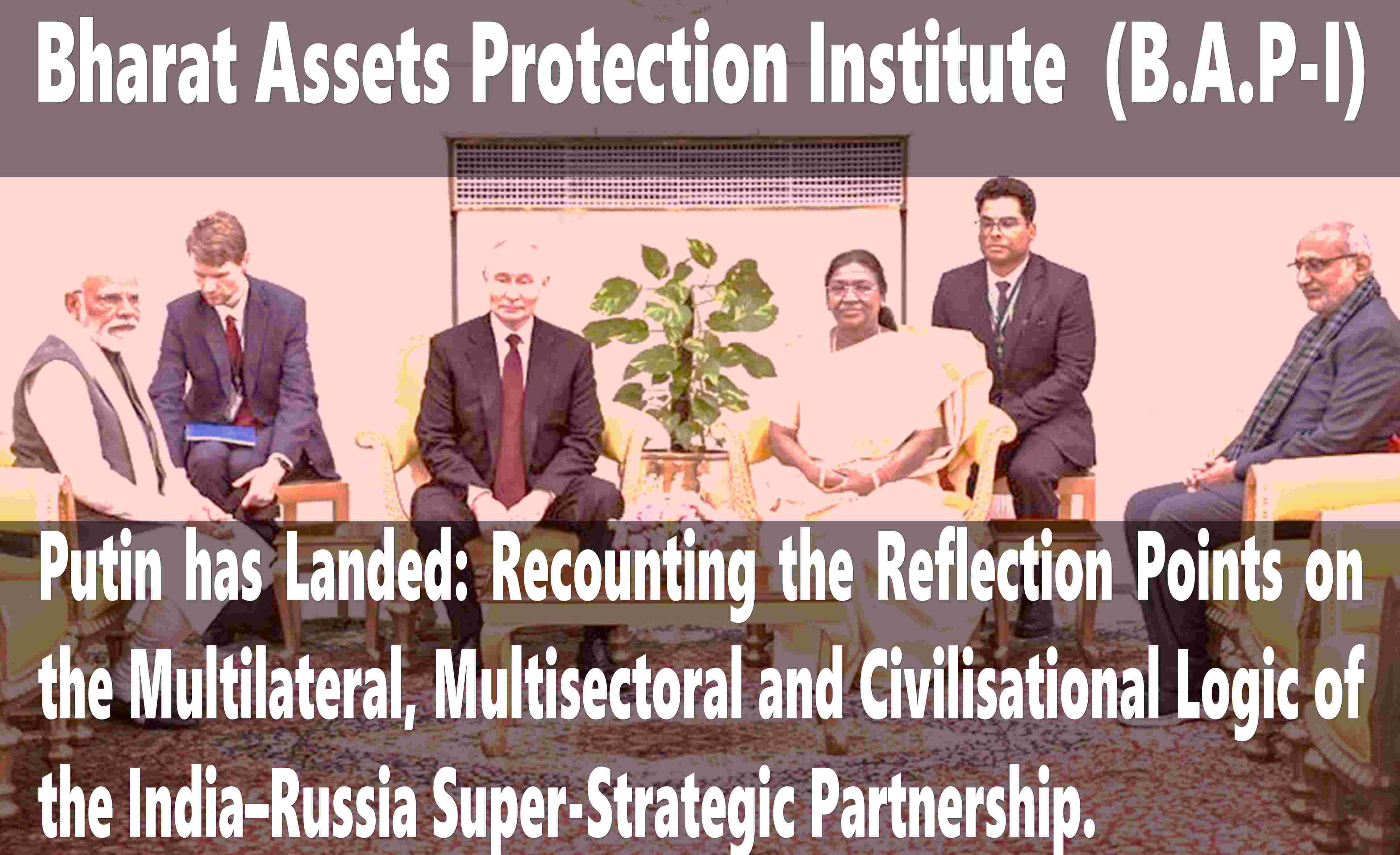
institutional familiarity. Recent high-level engagements, including President
Vladimir Putin’s visit to India, have brought renewed attention to these
foundations, highlighting patterns of convergence that extend beyond bilateral
diplomacy and into the wider Eurasian landscape. This paper approaches the
relationship from that perspective. It does not catalogue diplomatic outcomes
or offer prescriptive commentary detached from operational realities. The
analysis treats India–Russia engagement as a strategic system shaped by civilisational
cardinals such as strategic autonomy, sovereign capability, demographic
strength, resource continuity, technological resilience, and multipolar agency.
These are examined as working principles that increasingly guide Indian state
behaviour rather than as abstract or rhetorical constructs. The discussion
situates this partnership within a broader Eurasian context marked by contested
supply chains, fragmented financial systems, technological rivalry, and
shifting centres of power. By tracing convergence vectors and identifying
policy management challenges across these domains, the paper seeks to clarify
how India is sustaining engagement, managing risk, and preserving
decision-making space under conditions of sustained external pressure. The
emphasis remains on strategic coherence and institutional continuity,
consistent with India’s long-cycle national trajectory and diplomatic practice.
Keywords : ndia–Russia strategic partnership, strategic autonomy, civilisational statecraft, defence co-creation, energy security, Eurasian geopolitics, multipolar world order, demographic convergence, technological sovereignty, financial resilience, long-cycle diplomacy, sovereign decision-making
1. Strategic
Autonomy as Practice, Not Posture
India’s contemporary
foreign policy reflects a decisive shift from declaratory autonomy to exercised
sovereignty. Strategic autonomy today is not articulated through doctrine
alone. It is tested and demonstrated under real world pressure such as conflict
environments, energy disruptions, sanctions regimes and intensifying great
power competition. India’s conduct across these arenas signals a foreign policy
shaped by national interest, civilisational memory and geopolitical calibration
rather than inherited alliance expectations or transient global narratives.
This
operationalisation of autonomy is visible in India’s refusal to compress
complex geopolitical realities into binary moral alignments. New Delhi’s
diplomatic behaviour reflects an understanding that long-term national
resilience requires flexibility, balance and policy independence, particularly
in a world marked by fractured multilateralism and competing power centres.
1.1 Interpreting the
Ukraine Conflict Through India’s Strategic Lens
India’s position on
the Russia–Ukraine conflict has demonstrated a deliberate refusal to
internalise externally imposed framing. New Delhi declined to align with a
Western-centred narrative that sought uniformity of response and instead
emphasised dialogue, restraint and the protection of national priorities. This
approach has been widely noted as a product of strategic judgement rooted in
India’s interests and its assessment of global balance rather than ideological
conformity (India Today Video Desk, 2025, December 4).
The posture adopted
is neither ambiguous nor evasive. It reflects an assertion that India’s foreign
policy choices cannot be scripted by external pressures, irrespective of source
or scale. Diplomatic statements and voting behaviour have consistently reinforced
that India’s calculations are tied to long-term considerations affecting
economic stability, energy access, regional equilibrium and systemic global
order rather than episodic moral signalling (Kumar, 2025, December 5).
By sustaining this
position, India has demonstrated that neutrality, when exercised, can be
active, reasoned and interest-driven. It also reflects a broader recalibration
in Indian diplomacy where sovereign judgement takes precedence over
reputational management within dominant geopolitical blocs.
1.2 Energy Security
and the Sovereign Logic of Russian Crude Imports
India’s continued
procurement of Russian crude oil despite sustained diplomatic pressure
illustrates the material dimension of strategic autonomy. As domestic fuel
demand rose to a six-month peak, Indian refineries continued sourcing
discounted Russian shipments even as sanctions regimes tightened and political
signalling intensified (Reuters, 2025, December 8).
This decision
reflects an energy security calculus grounded in affordability, supply
stability and macroeconomic management. Russian crude has played a role in
cushioning domestic inflationary pressures and supporting industrial continuity
during a period of volatile global energy markets. The choice has been
acknowledged by the Kremlin as a sovereign act aligned with India’s national
economic interests, reinforcing the principle that energy policy remains a
domestic prerogative rather than an externally arbitrated domain (Reuters,
2025, December 8).
External attempts to
influence India’s energy decisions have taken multiple forms, including tariff
threats and diplomatic exhortations from the United States urging a reduction
or cessation of Russian oil imports. Such measures illustrate the coercive dimensions
of contemporary economic statecraft and the pressures that accompany it (Desai,
2025, October 27).
India’s response has
been neither reactive nor performative. The continuation of Russian oil imports
has been embedded within a broader strategy aimed at ensuring affordable energy
access, safeguarding industrial competitiveness and maintaining fiscal balance.
Even as New Delhi engages alternative suppliers and expands long-term energy
partnerships across regions, it has consistently maintained that
diversification does not imply submission to external preference hierarchies
(Kumar, 2025, December 5).
In this context,
President Vladimir Putin’s visit assumes significance beyond symbolism. It
reinforces a bilateral understanding that the India–Russia relationship
operates within a framework of mutual respect for sovereign decision-making,
particularly under conditions of sanctions pressure and geopolitical
contestation (Press TV, 2025, December 13).
2.
Military–Technological Consolidation: The India–Russia Defence Compact
India’s
military–technological engagement with Russia occupies a position distinct from
conventional defence partnerships. It does not operate through episodic
contracts or vendor dependency. It functions through embedded capability
convergence. The relationship is defined by sustained technological
familiarity, institutional memory, and a shared understanding of long-cycle
security requirements rather than by market-driven procurement cycles.
At its core, the
defence compact reflects a structural division of labour shaped by comparative
strength. India brings scale, precision manufacturing capacity, systems
integration expertise, software engineering depth, and an expanding industrial
base. Russia contributes long-established proficiency in missile science,
propulsion engineering, aerospace architecture, radar systems, and strategic
platforms developed under high-threat environments (Reuters, 2023, April 28).
The resulting configuration produces deterrence capabilities that are difficult
to replicate through short-term alliances or platform shopping.
This model of
cooperation converts civilisational alignment into deployable military power.
It reinforces strategic autonomy by insulating critical defence capabilities
from supply disruptions, political conditionalities, and technology denial
regimes. It also sustains technological depth across decades, enabling
iterative upgrades rather than obsolescence-driven replacement cycles (Bhowmick
& Stauder, 2025, April 8).
2.1 BrahMos and the
Architecture of Joint Capability Creation
The BrahMos missile
programme stands as the most advanced expression of India–Russia defence
integration. Unlike licensed production or technology transfer arrangements,
BrahMos represents joint development, co-production, and shared intellectual
ownership. It remains one of the few global defence systems where intellectual
property, operational evolution, and export logic are collectively governed
rather than asymmetrically controlled (BrahMos Aerospace, n.d.).
The programme’s
continued evolution reflects an institutionalised design loop involving joint
testing, operational feedback, and iterative enhancement. Its performance
during Operation Sindhoor, particularly within the Pakistan theatre,
demonstrated that the partnership has moved decisively beyond symbolic
collaboration. Indian defence officials and independent analysts have cited
BrahMos as evidence that co-created systems deliver battlefield credibility
rather than diplomatic signalling (Times of India, 2025, December 6).
From a structural
perspective, BrahMos embodies complementary engineering philosophies. Indian
strengths in software integration, electronics, quality control, and
manufacturing discipline intersect with Russian expertise in propulsion
dynamics, missile aerodynamics, and systems architecture. This synthesis has
been repeatedly identified as a template for durable capability creation rather
than dependence-driven procurement (Reuters, 2023, April 28).
The programme also
carries broader implications for India’s defence industrial ecosystem. It has
contributed to skill formation, supply-chain maturity, and confidence in
indigenous complex weapons development, while retaining access to advanced
design traditions that are increasingly restricted in the global arms market.
2.2 S-400 and the
Assertion of Security Primacy Over Sanctions
India’s decision to
acquire and operationalise the S-400 Triumf air defence system marked a
defining assertion of strategic sovereignty. Proceeding with the induction
despite explicit threats under the Countering America’s Adversaries Through
Sanctions Act underscored a consistent policy position. National security
imperatives are not negotiable under external pressure (Reuters, 2023, August
14).
Operational
assessments have indicated that the S-400 significantly enhances India’s air
defence posture, particularly against Pakistan’s constrained aerial strike
capabilities and evolving missile profiles. Official briefings from the
Ministry of Defence have highlighted improvements in early warning, layered
interception, and regional airspace denial capacity following deployment
(Ministry of Defence, Government of India, 2021, December 3).
Beyond capability
enhancement, the episode revealed a deeper pattern in India’s strategic
conduct. Defence preparedness and access to critical military technologies are
evaluated through national threat assessments rather than alliance optics.
Analysts have observed that India’s approach reflects a consistent
prioritisation of force readiness and deterrence credibility over reputational
alignment with sanction-enforcing powers (Menon & Rumer, 2022).
The S-400 case also
illustrates the limits of sanctions-based coercion when applied to states with
diversified partnerships, large domestic markets, and clear threat perceptions.
It reinforces the proposition that India’s defence decision-making operates
within a sovereign framework resistant to external veto.
2.3 Operation
Sindhoor and the Maturation of an Integrated Defence Ecosystem
Operation Sindhoor
provided a real-world demonstration of India’s integrated defence ecosystem.
Platforms of Russian origin and indigenous systems operated together with
precision, indicating interoperability refined through decades of shared
maintenance practices, doctrinal familiarity, and training regimes (Times of
India, 2025, December 6).
The operation
highlighted a calibrated use of military power aligned strictly with national
objectives. Strategic commentary has noted that the India–Russia defence
relationship now functions as an adaptive and co-equal partnership rather than
a residual Cold War configuration or static legacy arrangement (Bhowmick &
Stauder, 2025, April 8).
At a deeper systems
level, Operation Sindhoor reflected a synthesis of technological competencies.
India’s strengths in cyber capabilities, artificial intelligence, digital
engineering, and real-time data integration complemented Russia’s depth in
systems research, applied mathematics, and weapons design. India’s maritime
operational reach intersected with Russia’s continental strategic depth, while
India’s industrial scaling capacity reinforced Russian innovation pipelines
(Reuters, 2023, April 28).
Viewed through this
framework, the defence compact operates as a living ecosystem rather than a
collection of platforms. It demonstrates how long-term civilisational
compatibility, when translated into institutional cooperation and industrial
integration, produces military capability that remains resilient under pressure
and adaptable across evolving threat environments.
3.
Civilisational States and the Grammar of Super-Strategic Behaviour
The durability of
the India–Russia partnership cannot be adequately explained through alliance
theory, balance-of-power logic, or transactional diplomacy. It rests on a
deeper distinction between corporate states and civilisational states.
Civilisational states derive strategic direction from historical memory,
cultural continuity, geography, and inherited identity rather than from
short-term market incentives or ideological cycles. This distinction explains
why India–Russia convergence operates outside Western alliance templates and
why it remains resilient under sustained pressure (Aydın, 2025, December 11).
Civilisational logic
generates long-cycle strategic behaviour. Decisions are framed not around
immediate gain but around continuity, survival, and autonomy across
generations. This strategic temperament allows India and Russia to absorb
sanctions pressure, resist narrative coercion, and preserve strategic
convergence even when external systems seek conformity through alliance
discipline or economic leverage (Gadeock, 2025, November 7).
Seen in this light,
the India–Russia relationship is less a diplomatic alignment and more a
convergence of strategic civilisations operating within a shared understanding
of time, sovereignty, and power.
3.1 The
Corporate-State Logic of the United States
The United States
operates predominantly through a corporate-state logic in which foreign policy
outcomes are closely shaped by defence contractors, technology monopolies,
financial institutions, and capital markets. Strategic decision-making is
filtered through electoral cycles, lobbying ecosystems, shareholder
expectations, and alliance management imperatives. This produces a policy
culture oriented towards immediacy, market dominance, sanctions enforcement,
and narrative control rather than historical continuity (Chivvis &
Geaghan-Breiner, 2024, April 9).
This logic is
visible in the use of sanctions regimes, conditional security guarantees, and
demands for political alignment. Instruments such as CAATSA pressure on India,
energy sanctions directed at Russia, and repeated expectations of conformity on
Ukraine policy illustrate a system where geopolitical behaviour is closely
linked to corporate and institutional interests rather than civilisational
self-perception (Reuters, 2024, February 23).
The structural
mismatch between this model and civilisational-state behaviour explains the
limited effectiveness of coercive pressure. Civilisational states do not
reorder strategic priorities to satisfy external corporate expectations. Where
the United States aggregates interests through lobbying influence and market
leverage, India and Russia act through accumulated historical experience and
long-term strategic memory. This divergence produces friction not because of
misunderstanding but because of fundamentally different operating logics
(Foreign Affairs, 2025, June 17).
3.2 India, Russia,
and China as Civilisational States
India, Russia, and
China function as civilisational states whose political conduct is shaped by
deep cultural inheritance, geographic permanence, and historical experience.
Their strategic decisions are not governed by quarterly market expectations or
rigid alliance commitments but by extended arcs of civilisational survival,
adaptation, and renewal (Aydın, 2025, December 11).
This grounding
explains why partnerships among these states are structural rather than
transactional. Demographic complementarity, resource alignment, technological
cooperation, and social cohesion emerge from internal civilisational logics
rather than tactical convenience. The failure of sanctions to induce systemic
collapse in Russia reflects this reality. Civilisational resilience is not
dependent on market approval or external capital flows in the manner assumed by
corporate-state models (Reuters, 2023, October 24).
The same logic
illuminates India’s resistance to bloc absorption. Repeated efforts to draw
India into rigid alignment on Ukraine, China, or Indo-Pacific security
architectures have failed to produce compliance. India’s conduct reflects a
civilisational instinct for equilibrium refined over centuries of geopolitical
navigation, foreign incursions, and strategic recalibration rather than
alliance obedience (Gadeock, 2025, November 7).
Viewed through this
framework, India’s energy autonomy, Russia’s long-cycle resource diplomacy, and
their shared capacity to absorb external pressure are expressions of
civilisational resilience translated into strategic behaviour. As global
politics evolves toward a multipolar configuration, the convergence of
civilisational states increasingly shapes diplomatic practice, security
cooperation, and economic alignment. This pattern reflects the re-emergence of
civilisational agency as an organising force within contemporary international
affairs (Foreign Affairs, 2025, November 4).
4.
India–Russia Civilisational Convergence: People, Resources, and the
Architecture of Long-Term Partnership
The India–Russia
relationship has entered a phase where transactional diplomacy no longer
captures its underlying logic. The partnership is increasingly shaped by
civilisational convergence in which people, resources, geography, technology,
and historical memory interact to form structural depth. At the centre of this
convergence lies India’s demographic vitality and Russia’s resource abundance,
combined with a shared instinct for sovereignty, equilibrium, and strategic
autonomy.
This configuration
operates outside Western alliance models that are often structured around
corporate-state incentives, sanctions leverage, and short political cycles. The
India–Russia relationship derives durability from demographic
complementarities, energy and mineral interdependence, defence-technological
co-creation, societal familiarity, and the gradual emergence of Eurasian
connectivity spanning the Indo-Pacific, continental Eurasia, and the Arctic
space (Acharya, 2014; Reuters, 2025, March 27).
Rather than being
driven by episodic convergence, the partnership reflects accumulated historical
experience and a shared preference for continuity over coercion in
international conduct. These features position the relationship within a
long-cycle framework that resists volatility and adapts across shifting global
conditions (Foreign Affairs, 2025, November 4).
4.1 Strategic
Synthesis of Human Capital, Natural Resources, and Civilisational Capacity
India and Russia
exhibit a form of strategic synthesis that exceeds conventional bilateral
cooperation. This synthesis is shaped by demographic alignment, resource
capacity, technological complementarity, geopolitical compatibility, and
civilisational memory. Unlike partnerships managed through alliance discipline
or market logic, this relationship draws coherence from multi-generational
strategic reasoning rooted in historical experience (Acharya, 2014).
India contributes
scale in human capital. Its youthful population, expanding technical education
base, and growing pool of engineers, technologists, healthcare professionals,
and skilled workers form a critical asset for industrial, infrastructural, and digital
expansion. Russia contributes depth in natural resources, including Arctic
energy reserves, critical minerals, extensive agricultural land, and a
scientific-industrial tradition grounded in heavy engineering and applied
research (Reuters, 2023, October 24).
Together, these
capacities generate a structural configuration rather than a transactional
exchange. India’s demographic surplus offsets Russia’s demographic constraints.
India’s cultural and societal reach complements Russia’s strategic depth and
continental positioning. India’s Indo-Pacific presence aligns with Russia’s
Eurasian and Arctic geography. This synthesis enables cooperation across
energy, defence, agriculture, logistics, advanced manufacturing, and digital
systems within a framework oriented towards long-cycle stability rather than
immediate alignment pressures (Gadeock, 2025, November 7).
4.1.1 Demographic
Complementarities and Workforce Synergies
Demography
constitutes a critical driver of the evolving India–Russia partnership. India
remains the only major civilisation with a sustained long-term workforce
surplus supported by population scale, expanding education infrastructure, and
increasing skill formation. Russia faces demographic contraction and labour
shortages, particularly across Siberia, the Far East, and industrial regions
central to resource extraction and infrastructure development (Reuters, 2023,
October 24).
This divergence
produces strategic opportunity rather than imbalance. Indian human capital
provides Russia with options to stabilise industrial clusters, frontier
regions, and infrastructure-intensive projects. For India, engagement opens
access to new economic spaces, long-duration employment pathways, and exposure
to advanced industrial environments. This interaction goes beyond labour
mobility. It reflects a civilisational exchange with implications for regional
development, economic continuity, and strategic depth across Eurasia (Acharya,
2014).
The movement of
skills and people also carries institutional consequences. Training systems,
certification standards, social integration mechanisms, and long-term residency
frameworks emerge as strategic instruments rather than administrative
afterthoughts. These dimensions shape the durability of cooperation in ways
that formal agreements alone cannot achieve.
4.1.2 Soft Power,
Hard Power, and Civilisational Geopolitics
Civilisational
convergence between India and Russia extends into the interaction of soft power
and hard power. India brings cultural depth, philosophical continuity, and
societal influence with resonance across Asia, Africa, and the Global South.
Russia contributes strategic weight, military capability, and continental
geopolitical influence shaped by centuries of statecraft and security
management across vast geographies (Al Jazeera, 2023, April 12).
Geography reinforces
this interaction. India’s position within the Indo-Pacific intersects with
Russia’s Eurasian and Arctic reach, linking maritime trade routes with overland
corridors and emerging polar energy pathways. This evolving Indo–Arctic connectivity
arc carries implications for energy security, logistics diversification, and
Eurasian integration. It offers alternatives to Western-controlled chokepoints
and alliance-mediated transit regimes, without being framed as
opposition-driven realignment (Reuters, 2025, March 27).
Through this lens,
civilisational convergence manifests as an operational reality rather than
abstract theory. It functions through continuity, accumulated memory, and
long-term strategic calculation embedded in people, resources, and geography.
These characteristics increasingly shape diplomatic practice, economic
cooperation, and security coordination as global politics adjusts toward a
multipolar configuration grounded in plural civilisational agency (Foreign
Affairs, 2025, November 4).
4.1.3 Economic,
Industrial, and Agricultural Synergies
Economic interaction
between India and Russia reflects industrial complementarity rather than
transactional trade dependency. The relationship is shaped by sectoral depth,
production capability, and strategic intent, not by short-term arbitrage.
India’s expanding technological and manufacturing capacities intersect with
Russia’s strengths in heavy engineering, energy-linked industrial systems, and
advanced materials science, creating scope for sustained cooperation across
capital-intensive and technology-driven sectors (Popova, 2025, December 2).
This convergence is
particularly visible in pharmaceuticals and biotechnology. India’s established
role as a global supplier of affordable medicines aligns with Russia’s
objective of diversifying healthcare supply chains and strengthening domestic
life-sciences ecosystems. Bilateral engagements increasingly reflect a shared
interest in reducing reliance on concentrated Western pharmaceutical hubs while
expanding domestic production, clinical research, and formulation capacity (The
Hindu, 2025, November 21).
Agriculture
introduces another layer of structural alignment. Russia’s vast grain-producing
capacity and extensive cultivable land intersect with India’s food-security
imperatives, agri-processing capabilities, and growing demand stability. This
interaction enables the development of diversified food corridors that remain
resilient amid global market volatility and climate-induced supply disruptions
(Food and Agriculture Organization of the United Nations, 2023, July). Russia’s
continued centrality in global grain markets further reinforces the strategic
value of this cooperation, particularly in insulating food supply chains from
geopolitical shocks and sanctions-related dislocations (Popova, 2023, July 3).
Taken together,
these economic and agricultural linkages reflect a convergence rooted in
production ecosystems and long-cycle demand patterns rather than commodity
dependence or opportunistic trade flows.
4.1.4 Defence,
Security, and Technological Convergence
Defence and security
cooperation continues to function as a central pillar of India–Russia
convergence, shaped by long-standing trust, institutional familiarity, and
aligned threat perceptions. India’s expanding defence manufacturing ecosystem
intersects with Russia’s advanced weapons design capabilities and platform
engineering depth. This alignment sustains joint production, technology
transfer, and lifecycle support arrangements across critical defence systems,
reinforcing operational continuity and strategic autonomy (Popova, 2025,
December 2).
Beyond platforms,
convergence extends into strategic geography. India’s maritime reach across the
Indian Ocean complements Russia’s continental depth across Eurasia. Together,
these geographies reinforce a balance between sea control and land power stability,
creating space for coordinated strategic postures without formal alliance
commitments (Observer Research Foundation, 2025, April 24).
The technological
dimension adds further depth. India’s growing pool of digital, cyber, and data
professionals intersects with Russia’s strong traditions in mathematics,
physics, and algorithmic research. This combination provides a foundation for
cooperation in secure digital systems, defence-linked technologies, and
critical software domains that operate outside Western-controlled technological
ecosystems. Such collaboration reflects a shared interest in technological
sovereignty rather than dependence on externally governed platforms (Observer
Research Foundation, 2025, April 24).
This convergence
illustrates how defence and technology cooperation increasingly operate as
integrated systems rather than isolated domains within the bilateral
relationship.
4.1.5 Energy,
Mineral, and Infrastructure Integration
Energy cooperation
introduces a long-cycle structural dimension to the India–Russia partnership.
India’s rapidly expanding energy demand aligns with Russia’s extensive oil and
gas reserves across Siberia and the Arctic, reinforcing an energy-security equation
grounded in supply reliability and strategic continuity rather than short-term
price volatility (Popova, 2025, December 2).
Ongoing engagement
in oil, gas, and liquefied natural gas reflects strategic necessity shaped by
global energy fragmentation, sanctions regimes, and supply-chain uncertainty.
These interactions are framed less as opportunistic arbitrage and more as stabilising
mechanisms within an increasingly fractured global energy landscape (Popova,
2025, December 2).
Infrastructure
collaboration complements this logic. India’s strengths in construction,
project execution, and large-scale infrastructure delivery align with Russia’s
requirements for developing remote and strategically sensitive regions.
Transport networks, housing, industrial facilities, and logistics corridors
emerge as shared priorities where Indian execution capability intersects with
Russian territorial depth and resource geography (Observer Research Foundation,
2025, April 24).
Critical minerals
add another axis of convergence. India’s growing demand for inputs essential to
electric mobility, semiconductors, nuclear energy, and aerospace aligns with
Russia’s reserves of rare earths, uranium, titanium, and specialised alloys. This
alignment positions resource security as a shared industrial priority with
implications for advanced manufacturing, energy transition pathways, and
strategic technology development (International Energy Agency, 2023).
Through energy,
minerals, and infrastructure, the partnership acquires material depth that
reinforces resilience across economic, industrial, and security domains without
reliance on externally mediated supply chains.
4.1.6 Political
Complementarities in an Evolving Multipolar Order
Politically, India
and Russia occupy complementary strategic positions within an international
system undergoing structural redistribution of power. India’s expanding
leadership role across the Global South introduces developmental legitimacy,
institutional credibility, and normative balance into multilateral forums.
Russia contributes strategic weight, diplomatic reach, and Eurasian balancing
capacity shaped by long experience in managing continental power dynamics.
Together, these roles generate alternatives to governance models historically
dominated by Western political and economic frameworks (Foreign Affairs, 2024).
This complementarity
does not imply ideological convergence. India operates through principles of
equity, developmental inclusion, and sovereignty preservation, particularly in
multilateral negotiations affecting emerging economies. Russia approaches global
politics through a realist assessment of power balance, strategic deterrence,
and institutional resistance to unilateral coercion. The interaction of these
approaches produces alignment without ideological uniformity, allowing both
states to resist pressure for narrative conformity and externally imposed
policy prescriptions (Foreign Affairs, 2024).
Within this
configuration, India retains strategic flexibility while enhancing diplomatic
space for non-aligned and emerging actors. Russia, in turn, reinforces
multipolar dispersion by preventing the consolidation of exclusive power blocs.
This interaction shapes diplomatic behaviour across forums dealing with
development finance, security governance, and global institutional reform,
without requiring formal coordination or alliance structures.
4.1.7 Societal and
Cultural Resonance Across Civilisations
Beyond statecraft,
India–Russia convergence is reinforced at the societal level through shared
civilisational sensibilities. Both societies place emphasis on family
structures, social cohesion, and intergenerational continuity. These values
influence public narratives, policy preferences, and perceptions of social
stability, creating an underlying compatibility that extends beyond formal
diplomatic engagement (Mishra, 2025, December 6).
India’s
civilisational identity is rooted in spiritual pluralism, philosophical
continuity, and societal resilience developed over millennia. Russia’s cultural
orthodoxy reflects a parallel emphasis on tradition, collective memory, and
historical continuity shaped by geography and state formation. These traditions
contrast with hyper-modernist social models that prioritise rapid cultural
disruption and individual atomisation. The result is a form of societal
resonance that supports long-term mutual perception and reduces friction at the
people-to-people level (Mishra, 2025, December 6).
This resonance does
not manifest as cultural homogenisation. Instead, it enables mutual respect for
difference within a shared understanding of continuity, order, and
civilisational endurance. Such alignment shapes educational exchange, cultural
diplomacy, media narratives, and public receptivity in ways that reinforce
bilateral stability without requiring sustained political messaging.
4.1.8 Emerging
Frontiers in Space, Finance, and Human Mobility
Forward-looking
domains increasingly shape the strategic horizon of the India–Russia
partnership. Human mobility has emerged as a significant area of convergence.
India’s large and skilled workforce aligns with Russia’s demographic
contraction and labour shortages across construction, manufacturing, and
technology-intensive sectors. Russian authorities have indicated plans to
recruit up to one million Indian workers by late 2025, reflecting a structural
labour requirement rather than short-term workforce substitution
(DATInsightsMarket, 2025, August 1; Abhinav Newsletter, 2025).
In the space domain,
India’s expanding space-technology ecosystem intersects with Russia’s legacy
strengths in human spaceflight, aerospace engineering, and mission training.
Cooperation has included technical support and training for India’s Gaganyaan mission,
alongside broader collaboration in satellite systems and peaceful outer-space
activities. This interaction reflects complementary capability development
rather than dependence, with each side contributing distinct technical depth
and operational experience (IndBiz, 2020, January 25; Siddiqui, 2024, October
29).
Financial
architecture represents another frontier of engagement. India’s digital public
infrastructure, particularly the Unified Payments Interface, intersects with
Russia’s efforts toward de-dollarisation and financial sovereignty. The
development of rupee–ruble trade mechanisms and alternative payment channels
reduces exposure to sanctions-driven disruptions and enhances transactional
continuity. These arrangements reflect a broader search for financial systems
that operate outside concentrated Western monetary control while remaining
functional, scalable, and sovereign (Maheshwari, 2024, February 29).
Together, mobility,
space, and finance illustrate how the partnership extends into future-oriented
domains without reliance on legacy frameworks or externally governed systems.
These areas increasingly shape the operational depth of India–Russia engagement
across economic, technological, and societal dimensions.
4.1.9 Civilisational
Continuity and Long-Cycle Strategic Alignment
The India–Russia
relationship increasingly reflects a form of convergence that resists
classification as episodic, reactive, or tactically driven. Its underlying
logic is shaped by history, accumulated strategic memory, and continuity across
political cycles rather than short-term alignment incentives. This
civilisational orientation frames bilateral engagement as an evolving process
rooted in inherited experience and long-cycle strategic reasoning rather than
event-driven diplomacy (Mishra, 2025).
The institutional
evolution of the relationship reinforces this pattern. The transition from the
2000 Strategic Partnership to the designation of a Special and Privileged
Strategic Partnership formalised cooperation across defence, energy, nuclear
science, space, trade, and cultural exchange. These institutional layers were
built incrementally, surviving shifts in global power structures, leadership
changes, and external pressure environments, suggesting a depth of trust that
is uncommon in contemporary international relations (Ministry of External
Affairs, 2025).
Recent summit-level
engagements further demonstrate this continuity in operational terms.
Commitments to expand bilateral trade to USD 100 billion by 2030 coexist with
parallel emphasis on defence co-production, energy security frameworks, and
long-term connectivity across Eurasia. These agendas are framed not as isolated
initiatives but as mutually reinforcing components of a broader strategic
trajectory extending across decades (Ministry of External Affairs, 2025).
Analytical
assessments have highlighted the structural complementarity sustaining this
trajectory. India’s demographic scale, industrial ambition, and expanding
manufacturing base intersect with Russia’s resource endowment, technological
depth, and Eurasian geostrategic positioning. This interaction produces a form
of strategic symmetry in which each side offsets the other’s structural
constraints while amplifying comparative strengths (Russia’s Pivot to Asia,
2025).
Beyond material
dimensions, repeated articulation of civilisational affinity and strategic
autonomy remains central to the partnership’s political vocabulary. This
framing allows both states to preserve independent decision-making while
resisting alliance rigidity and externally imposed policy convergence in an
increasingly polarised international environment. Strategic autonomy, in this
context, operates as a shared operating principle rather than a rhetorical
posture (Mishra, 2025).
The long-horizon
orientation embedded within India–Russia engagement shapes its role within
Eurasia. The relationship functions through sustained, multi-sectoral, and
institutionally embedded cooperation rather than bloc-based politics or
episodic coordination. Its influence emerges through continuity, scale, and
structural integration rather than through declaratory leadership or formalised
alliances, reflecting a mode of partnership calibrated to long-term systemic
change rather than immediate geopolitical contestation (Russia’s Pivot to Asia,
2025).
4.3 Civilisational
Migration and Societal Resonance
Within the wider arc
of India–Russia civilisational convergence, migration emerges not merely as
labour movement but as a structured societal exchange shaped by history,
cultural familiarity, and strategic need. The gradual relocation of Indian
communities to Russia is increasingly plausible within this framework, not as
short-term economic displacement but as a form of civilisational interaction
rooted in continuity and mutual recognition.
Russia has
historically displayed receptivity towards Indian philosophical traditions,
spiritual thought, and intellectual exchange. This is reflected in decades of
academic engagement, cultural cooperation, and people-to-people linkages that
continue to inform bilateral narratives and public discourse (Mishra, 2025,
December 6). Official statements and public diplomacy initiatives from both
sides increasingly acknowledge societal and cultural cooperation as a
stabilising pillar of the relationship rather than a peripheral supplement to
strategic engagement (Press Information Bureau, 2024).
This receptivity is
reinforced by convergent social values. Indian and Russian societies place
emphasis on family structures, community cohesion, intergenerational
continuity, and respect for tradition. These shared orientations create a
sociocultural environment more conducive to long-term settlement and social
integration than to transient labour mobility driven solely by wage
differentials (Press Information Bureau, 2024). Such parallels reduce friction
in social absorption and shape conditions favourable to durable community
formation across host regions.
Over time, patterns
of civilisational migration acquire significance beyond demographic
supplementation. Indian communities embedded within Russian society would
function as living connectors between civilisations, contributing to social
depth, mutual trust, and sustained people-to-people capital. Cultural presence,
educational exchange, and community networks would gradually reinforce
bilateral familiarity at the societal level, complementing state-to-state
cooperation across strategic and economic domains (SpecialEurasia, 2025,
December 8).
Within this logic,
migration operates as a long-cycle societal instrument rather than a
transactional labour mechanism. It contributes to Eurasian stability through
continuity, presence, and shared social experience rather than episodic
alignment or contractual engagement. Civilisational migration thus aligns with
the broader architecture of the India–Russia partnership, where people,
culture, and memory interact alongside resources, technology, and strategy
(Press Information Bureau, 2024).
Strategic
Implications
Reconstruction and
Regional Development Synergies: India’s skilled manpower aligns directly with
Russia’s reconstruction and development requirements across Siberia, the Far
East, and Arctic-adjacent regions. Public indications of plans to recruit up to
one million Indian workers reflect long-term industrial, infrastructure, and
services needs rather than short-duration labour substitution
(DATInsightsMarket, 2025, August 1; Abhinav Newsletter, 2025). This alignment
introduces demographic stability into regions critical for resource extraction,
logistics expansion, and strategic infrastructure.
Societal Integration
and Cultural Familiarity: Historical familiarity, shared social norms, and
cultural resonance support the emergence of stable Indian communities within
Russia. These conditions strengthen people-to-people ties during reconstruction
and development phases while reinforcing societal trust at a time of broader
geopolitical uncertainty (Mishra, 2025, December 6; Press Information Bureau,
2024).
Demographic
Alignment Within a Long-Cycle Partnership: Civilisational migration and
co-development align demographic vitality with resource geography and
industrial ambition. This interaction enhances resilience against external
pressure by embedding social, cultural, and human capital linkages within a
shared Eurasian strategic horizon shaped by continuity rather than episodic
coordination (SpecialEurasia, 2025, December 8).
5. The
India–China–Russia Triangle: Convergence of Technology, Workforce, and
Civilisational Strength
The civilisational
convergence outlined earlier extends beyond bilateral frameworks into a broader
Eurasian configuration involving India, China, and Russia. This triangular
interaction does not operate as a formal alliance or treaty-bound bloc. It
functions as a structural convergence shaped by demographic scale,
technological capability, industrial depth, resource security, and shared
instincts for strategic autonomy developed through long historical experience
(Khan, September 5, 2025; Usmani, June 17, 2025).
Together, these
three civilisational states command population size, scientific and industrial
capacity, territorial reach, and historical continuity at a scale that Western
corporate-state systems struggle to absorb. Western systems remain heavily
structured around financialisation, outsourcing, and alliance discipline,
whereas the Eurasian configuration derives strength from material production,
territorial depth, and societal resilience rooted in continuity rather than
contractual obligation.
This triangular
convergence operates through parallel strategic trajectories rather than
coordinated command. Long-cycle civilisational behaviour, shaped by geography,
historical memory, and material capacity, influences outcomes more decisively
than ideological alignment or treaty-based commitments. India, China, and
Russia therefore retain national autonomy while simultaneously reinforcing a
broader Eurasian balance of power through structural alignment rather than
formal integration (Usmani, June 17, 2025; Khan, September 5, 2025).
5.1 Technological
and Industrial Synergy Across Eurasia
A new Eurasian
industrial equation is gradually taking shape. Chinese manufacturing density
and technological acceleration intersect with Indian engineering depth,
managerial capability, and digital systems capacity, supported by Russia’s
energy reserves, mineral endowment, and raw-material security (Khan, September
5, 2025; Putin’s visit to India, n.d.).
This triadic
complementarity enables industrial and technological capacity at a scale that
contrasts with Western production models dependent on fragmented supply chains,
offshore financial leverage, and intermediary-heavy logistics systems. Indian
technocrats operating alongside Chinese industrial ecosystems, sustained by
Russian material inputs, support large-scale manufacturing, infrastructure
development, and advanced technology deployment across Eurasian space.
Analysts observe
that the integration of labour, technology, and resources across this triangle
forms the foundation of emerging non-Western supply chains. These systems
demonstrate growing resistance to sanctions pressure, decoupling strategies,
and externally induced disruption, not through insulation but through
redundancy, scale, and geographic dispersion (Mishra, December 1, 2025; Usmani,
June 17, 2025).
The material
expression of this convergence is visible in the gradual emergence of an
industrial and logistics continuum extending from the Indo-Pacific through
Inner Asia toward the Arctic. This continuum supports production networks,
digital platforms, logistics routes, and energy flows that collectively
constitute a Eurasian connectivity architecture operating outside
Western-controlled chokepoints and financial gatekeeping mechanisms (Putin’s
visit to India, n.d.; Mishra, December 1, 2025).
5.2 Eurasian
Civilisational Power and Systemic Rebalancing
The parallel
convergence of India, China, and Russia increasingly shapes the global
distribution of technological capability, industrial capacity, and strategic
leverage. Civilisational states across Eurasia possess demographic vitality,
resource depth, and accumulated strategic memory that enable adaptation under
pressure rather than fragmentation under coercive external constraints (Khan,
September 5, 2025; Kapoor & Madan, January 10, 2024).
When operating
simultaneously, the complementarities within this triangle are magnified. Human
capital integrates with natural resources. Technological capacity aligns with
energy security. Industrial demand connects directly with territorial supply.
These interactions help explain why sanctions regimes and decoupling
initiatives have struggled to generate decisive structural outcomes against
Eurasian powers (Usmani, June 17, 2025; Putin’s visit to India, n.d.).
This configuration
also reshapes the nature of global power. Influence is not concentrated within
singular institutions, reserve currencies, or alliance systems. It is
distributed across civilisational capacity, geographic scale, production
systems, and long-term material foundations. The resulting order reflects
continuity rather than volatility and strategic autonomy rather than enforced
alignment (Khan, September 5, 2025; Usmani, June 17, 2025).
Key Synergy Areas
Industrial and
Logistics Corridors Initiatives such as the International North–South Transport
Corridor and the Chennai–Vladivostok route reduce transit times while directly
linking resources, manufacturing zones, and consumption markets. These
corridors strengthen trade resilience by bypassing congested maritime routes
and externally controlled transit points (Mishra, December 1, 2025).
Triadic Capacity
Integration Combined strengths in human capital, technology, and energy across
India, China, and Russia underpin supply chains that demonstrate resilience
against sanctions, fragmentation, and financial disruption. This integration
reinforces strategic autonomy and systemic durability across Eurasian economic
space (Khan, September 5, 2025; Kapoor & Madan, January 10, 2024).
6.
Significance of President Putin’s Visit in the Contemporary Multilateral and
Multisectoral Context
President Vladimir
Putin’s visit to India requires interpretation beyond the optics of bilateral
diplomacy. It must be situated within a wider civilisational and structural
framework shaped by long-cycle complementarities between India and Russia. The
engagement reflects an interaction between India’s demographic depth,
technological capability, and skilled human capital on one side, and Russia’s
resource base, industrial systems, and Eurasian geographic reach on the other.
This configuration reveals a partnership structured around material logic and
continuity rather than event-driven tactical alignment (Ministry of External
Affairs, December 5, 2025; Press Information Bureau, December 4, 2025).
The visit unfolded
at a moment when global systems are under strain from sanctions regimes,
supply-chain fragmentation, and geopolitical polarisation. Within this context,
the sustained engagement between New Delhi and Moscow signals the persistence
of a bilateral logic that prioritises sovereign decision-making, long-term
economic planning, and institutional familiarity. The interaction reflects
accumulated strategic memory rather than reactive diplomacy, reinforcing
patterns established over decades of cooperation across defence, energy,
science, and people-to-people exchange.
6.1 Economic
Deepening and the Architecture of Long-Term Cooperation
The economic
outcomes associated with the visit underscore its structural significance. Both
sides reiterated a shared objective of expanding bilateral trade to USD 100
billion by 2030, alongside agreements spanning labour mobility, fertiliser
supply, maritime connectivity, and rupee–ruble settlement mechanisms. These
commitments reflect an effort to institutionalise economic interaction rather
than rely on commodity cycles or episodic transactions (National Strategy
Group, December 8, 2025; Ministry of External Affairs, December 5, 2025).
There was a marked
emphasis on diversifying cooperation beyond hydrocarbons and defence into
manufacturing, civil nuclear collaboration, infrastructure development, and
post-conflict reconstruction. This diversification signals a recalibration
toward a more balanced economic relationship in which industrial co-production,
project execution, and technology-linked collaboration assume greater
importance. Analysts have noted that such diversification strengthens
resilience by distributing economic engagement across sectors with differing
risk profiles and time horizons (Roche, December 8, 2025).
The economic framing
of the visit thus reflects an intent to align future growth trajectories. It
links India’s manufacturing ambitions and human capital surplus with Russia’s
reconstruction requirements, industrial modernisation needs, and resource geography,
creating a framework for sustained engagement across multiple economic cycles.
6.2 Multisectoral
Integration and Human Capital as Strategic Currency
The visit carried
significant multisectoral implications that extend beyond trade volumes. It
sought to broaden cooperation across agriculture, energy, logistics, civil
nuclear development, and infrastructure construction. These domains were not
treated as isolated sectors but as interlinked components of a broader
developmental and strategic ecosystem (Mohan, December 9, 2025; Press
Information Bureau, December 4, 2025).
Particular emphasis
was placed on facilitating greater Indian participation in Russia’s long-term
infrastructure and reconstruction agenda. Skilled Indian professionals were
identified as key contributors to emerging industrial, transport, and logistics
corridors, especially in underdeveloped and strategically sensitive regions
across Eurasia. This approach positions human capital as a strategic currency,
integrating labour mobility with industrial growth and regional development
rather than treating migration as a peripheral economic variable.
Such multisectoral
integration reflects an understanding that resilience in contemporary
geopolitics is built through interconnected systems. Energy security, food
supply, transport infrastructure, and skilled manpower are increasingly viewed
as mutually reinforcing pillars rather than discrete policy domains. The visit
reinforced this integrated perspective by embedding human resources within
broader industrial and logistical frameworks.
6.3 Geopolitical
Signalling and Strategic Coordination Across Regions
Geopolitically, the
visit reinforced coordination across Eurasian and Indo-Pacific theatres at a
time when global alignments are being reshaped by sanctions pressure and
strategic competition. The durability of the India–Russia relationship despite
the Ukraine conflict and sustained external pressure illustrates that bilateral
engagement rests on structural convergence rather than tactical convenience or
ideological alignment (Rosenberg & Pandey, December 5, 2025; Roche,
December 8, 2025).
This durability has
implications for India’s strategic posture. It demonstrates that engagement
with Russia remains compatible with India’s broader diplomatic outreach,
including its interactions across the Indo-Pacific and the Global South. The
visit reaffirmed India’s capacity to maintain parallel partnerships without
subordinating national interest to bloc-based expectations.
Public and media
coverage of the engagement further reflected its symbolic and strategic weight.
Narratives surrounding the visit emphasised continuity, historical depth, and
mutual respect, highlighting its role in reaffirming bilateral stability amid global
uncertainty (DD News, n.d.; France 24 English, n.d.). These narratives
contribute to shaping public perception and strategic messaging without relying
on declaratory alignment or formalised alliances.
6.4 Continuity,
Institutional Memory, and Multipolar Context
Within the broader
multilateral environment, Putin’s visit reaffirmed the role of institutional
memory and continuity in India–Russia relations. The engagement drew upon
established mechanisms of dialogue, sectoral working groups, and long-standing
channels of cooperation, reinforcing predictability in an otherwise volatile
global landscape (National Strategy Group, December 8, 2025).
The visit positioned
India and Russia as actors operating within an emergent multipolar Eurasian
context shaped by material capacity, economic integration, and civilisational
continuity. The interaction underscored a shared preference for resilient economic
linkages, sovereign financial mechanisms, and long-term planning horizons over
transient diplomatic signalling (Tea Board of India, n.d.).
Viewed through this
framework, the significance of the visit lies in its reinforcement of patterns
already visible across defence cooperation, energy engagement, labour mobility,
and infrastructural collaboration. It reflects a relationship calibrated to
long-cycle change rather than short-term geopolitical fluctuation, embedded
within a broader architecture of Eurasian stability shaped by history,
geography, and sustained economic integration (National Strategy Group,
December 8, 2025; Tea Board of India, n.d.).
7. Putin’s
Visit to India: Reflection Points and Strategic Management Imperatives
President Vladimir
Putin’s visit to India constitutes a moment of strategic articulation rather
than diplomatic routine. It consolidates the structural logic underpinning the
India–Russia partnership and brings into sharper focus the convergence of strategic
autonomy, defence co-creation, civilisational continuity, demographic and
resource complementarities, and wider Eurasian realignments shaping the current
geopolitical landscape. The visit operates as a signal of continuity in India’s
foreign policy practice, rooted in sovereignty, balance, and long-cycle
strategic reasoning rather than tactical alignment or episodic signalling
(Bajpaee, December 4, 2025).
The engagement
highlights that India–Russia relations now function across multiple domains
simultaneously. Energy security, military-technology cooperation, industrial
alignment, post-conflict reconstruction planning, labour mobility, and Eurasian
connectivity are being advanced in parallel rather than sequentially. This
simultaneity reflects a partnership structured around material convergence and
institutional familiarity rather than symbolic diplomacy, with implications
extending beyond bilateral interaction into regional and systemic contexts
(Press Information Bureau, December 4, 2025).
7.1 The Visit as a
Strategic Inflection Point
Putin’s visit must
be interpreted as a strategic inflection point shaped by prevailing global
conditions rather than as a ceremonial milestone. It unfolds against the
backdrop of a prolonged European conflict, shifting Eurasian power centres,
recalibrated global energy markets, and the growing assertion of strategic
autonomy by non-Western states seeking policy space outside bloc discipline
(News on Air, n.d.).
India’s refusal to
align with Western pressure on Ukraine, combined with the continuation of
discounted Russian crude imports, reflects a structural assertion of
sovereignty. This posture signals that India’s foreign policy decisions are
guided by national interest, economic stability, and long-term security
considerations rather than by sanctions regimes or external political demands.
Public messaging around the visit reinforces this position, framing India as a
balancing power capable of engaging multiple centres of power without dilution
of autonomy (Press Information Bureau, December 5, 2025).
The visit therefore
brings into relief the transformation of the India–Russia relationship from a
Cold War inheritance into a layered contemporary partnership. Strategic
autonomy, energy security, technological cooperation, and cultural familiarity
now operate as interconnected pillars, enhancing the relationship’s capacity to
function under sustained geopolitical pressure (Embassy of India, Moscow,
n.d.).
7.2 Managing
Strategic Risks and External Pressure Environments
While the visit
reinforces structural convergence, it also underscores the need for deliberate
management of strategic risks and external pressures. The persistence of
sanctions regimes, financial restrictions, and narrative framing directed at
India–Russia engagement introduces friction into trade, finance, and technology
cooperation. These pressures do not negate the partnership but shape the
operational environment within which it must function.
India’s approach
reflects calibrated engagement rather than defiance. Diversification of trade
mechanisms, expansion of rupee–ruble settlements, and emphasis on long-term
contracts over spot-market exposure indicate an effort to reduce vulnerability
while preserving strategic choice. This management posture aligns with India’s
broader practice of absorbing pressure through institutional adaptation rather
than reactive alignment (Press Information Bureau, December 5, 2025).
The visit brings
attention to the importance of institutional memory and policy continuity in
navigating such environments. Established working groups, sectoral dialogues,
and long-standing bureaucratic channels reduce volatility and provide
predictability even when external conditions fluctuate. These mechanisms allow
cooperation to proceed incrementally without overexposure to episodic
geopolitical shocks (Embassy of India, Moscow, n.d.).
7.3 Strategic
Autonomy and Parallel Partnerships
A critical
reflection point emerging from the visit concerns India’s ability to sustain
parallel partnerships without entanglement. Engagement with Russia continues
alongside India’s expanding interactions across the Indo-Pacific, the Global
South, and multilateral platforms. The visit demonstrates that India’s foreign
policy architecture accommodates simultaneity rather than exclusivity.
This posture
challenges assumptions embedded within alliance-centric systems that interpret
engagement as zero-sum alignment. India’s conduct signals that strategic
autonomy functions as an operational principle rather than a rhetorical device.
The visit reinforces India’s capacity to engage Russia on energy, defence, and
reconstruction while maintaining independent trajectories in other strategic
theatres (Bajpaee, December 4, 2025).
The credibility of
this approach is reinforced by consistency over time. India’s positions on
sanctions, energy procurement, and diplomatic engagement have displayed
continuity across changing global circumstances, strengthening perceptions of
policy reliability rather than opportunism.
7.4 Eurasian
Coordination Without Bloc Formation
Another reflection
point concerns the nature of Eurasian coordination emerging from the visit. The
India–Russia relationship operates within a broader Eurasian context that
includes China, Central Asia, and emerging connectivity corridors. Yet the
visit does not signal bloc formation or formalised alignment structures.
Instead,
coordination unfolds through sectoral cooperation, infrastructure integration,
labour mobility, and trade facilitation. This mode of engagement preserves
national autonomy while enabling convergence where interests overlap. The visit
reinforces this approach by emphasising connectivity, reconstruction, and
economic integration without binding commitments to exclusive geopolitical
frameworks (News on Air, n.d.).
Such coordination
aligns with India’s preference for flexible geometry in foreign policy. It
allows engagement to expand or contract across sectors without triggering
strategic overcommitment, thereby maintaining room for manoeuvre in a fluid
multipolar environment.
7.5 Civilisational
Continuity as a Policy Asset
Underlying the visit
is a reaffirmation of civilisational continuity as a policy asset rather than a
symbolic reference. Cultural familiarity, historical interaction, and societal
resonance provide a stabilising backdrop for strategic and economic cooperation.
These elements reduce transaction costs in diplomacy and enhance resilience
during periods of external stress.
Public narratives
surrounding the visit emphasised historical depth, mutual respect, and
continuity, reinforcing societal acceptance of the partnership in both
countries. This societal dimension supports policy continuity by aligning
public perception with long-term strategic engagement rather than short-term
political cycles (Press Information Bureau, December 4, 2025).
Within this
framework, Putin’s visit functions as a reinforcing mechanism for patterns
already visible across defence, energy, labour mobility, and infrastructure
cooperation. It reflects a relationship structured to absorb pressure, manage
risk, and sustain engagement through long-cycle strategic alignment rather than
immediate geopolitical advantage.
7.6 Defence
Co-Creation and the Maturity of Strategic Trust
The
defence-technological dimension of the India–Russia partnership provides one of
the clearest indicators of its maturity. Flagship programmes such as BrahMos,
the operational deployment of the S-400 air defence system, and repeated
demonstrations of interoperability confirm that defence cooperation has evolved
into an integrated ecosystem rather than a buyer–seller procurement
relationship (Press Trust of India, September 28, 2018; Press Information
Bureau, December 4, 2025).
This ecosystem is
sustained through joint development, co-production, lifecycle support, and
shared doctrinal familiarity. Russia continues to remain India’s most reliable
partner for long-cycle defence technologies, particularly in missile systems,
air defence architectures, and strategic platforms that require sustained
technological depth and insulation from political volatility. India, in turn,
provides Russia with a stable production base, co-development capability, and
assured market access at a time when Western defence markets are increasingly
constrained by sanctions regimes and political conditionalities (Press
Information Bureau, December 5, 2025).
The strategic logic
underpinning this cooperation is autonomy rather than dependence. Defence
collaboration is treated by both sides as a means to preserve decision-making
freedom, strengthen deterrence credibility, and protect core capabilities from
external political leverage. This approach reflects accumulated trust built
over decades rather than transactional alignment driven by immediate threat
perception (Embassy of India, Moscow, n.d.).
7.7 Civilisational
States and the Reassertion of Strategic Centrality
The visit also
carries a pronounced civilisational signal. India, Russia, and China
increasingly operate as civilisational states whose strategic behaviour is
shaped by historical continuity, cultural memory, demographic scale, and
geopolitical patience rather than short electoral cycles or market-driven
imperatives (Bajpaee, December 4, 2025).
Putin’s engagement
with India reflects an acknowledgement that civilisational states are regaining
centrality in shaping global outcomes. India’s demographic surplus, skilled
workforce, and technological capacity intersect with Russia’s vast landmass, mineral
wealth, energy corridors, and industrial requirements. This convergence
reflects structural alignment rather than ideological convergence, allowing
cooperation to deepen without formal alliance commitments (News on Air, n.d.).
This civilisational
alignment carries tangible implications for Russia’s long-term recovery and
restructuring. Post-conflict reconstruction across Eurasia will require
sustained human capital inflows, industrial planning capacity, and demographic
reinforcement. Indian professionals, enterprises, and institutions are
increasingly positioned to contribute across construction, manufacturing,
healthcare, logistics, and digital systems, embedding people-to-people ties
within long-term structural cooperation (Bajpaee, December 4, 2025).
7.8 The Eurasian
Realignment Axis and Structural Multipolarity
A parallel
transformation is visible in the gradual convergence among India, China, and
Russia within the Eurasian strategic space. Despite bilateral frictions, India
and China share civilisational depth and possess complementary technological
and industrial capabilities, while Russia’s resource base and geographic scale
provide a stabilising third dimension (Press Information Bureau, December 4,
2025).
Together, these
three states command manpower, industrial density, energy security, and
civilisational confidence sufficient to contest Western dominance across
finance, supply chains, digital infrastructure, and advanced technology
domains. This configuration does not constitute a formal alliance. It reflects
a structural Eurasian realignment that privileges autonomy over bloc discipline
and multipolarity over ideological conformity (Press Information Bureau,
December 5, 2025).
Within this context,
Putin’s visit signals more than bilateral coordination. It reflects an emergent
Eurasian logic in which sovereignty, long-term capacity, and civilisational
continuity increasingly influence global power distribution. Strategic behaviour
is shaped less by treaty alignment and more by accumulated material strength,
demographic resilience, and institutional memory operating across multiple
theatres (News on Air, n.d.).
7.9 Messaging on the
Multipolar World Order
President Vladimir
Putin’s visit to India carries a deeper strategic message concerning the
evolving contours of the multipolar world order. At a moment when Western
alliances seek to reassert bloc discipline and revive containment frameworks,
the India–Russia engagement signals a different strategic trajectory.
Contemporary global politics is increasingly shaped not by rigid ideological
camps but by sovereign civilisational states acting through autonomous,
interest-driven partnerships rooted in strategic necessity rather than alliance
conformity (Bajpaee, December 2, 2025).
The visit reinforces
the understanding that multipolarity is not limited to a redistribution of
power among states. It reflects a rebalancing of strategic agency itself.
Civilisations are reclaiming the capacity to define their developmental
pathways, technological ecosystems, and geopolitical alignments without
external supervision, conditionality, or ideological gatekeeping. In this
framing, multipolarity functions as an operational condition rather than a
theoretical aspiration (Press Information Bureau, December 5, 2025).
For India, this
messaging strengthens its identity as a non-aligned yet assertive pole within
the global system. India continues to navigate major-power rivalries while
safeguarding economic stability, energy security, and defence preparedness
through diversified partnerships rather than exclusive alignments or bloc
membership (News on Air, December 4, 2025). For Russia, the visit underscores
the durability of its global relationships despite sanctions regimes, isolation
attempts, and sustained narrative pressure, reaffirming its capacity to operate
beyond Western political and economic architectures (Bajpaee, December 2,
2025).
Taken together, the
engagement communicates that multipolarity is already visible in practice. It
manifests through diversified trade mechanisms, expanding energy corridors,
defence co-creation, de-dollarised payment systems, demographic cooperation,
and coordinated geopolitical balancing across Eurasia and the Indo-Pacific.
These dynamics illustrate that systemic change is unfolding through material
processes rather than declaratory intent (Kremlin, July 9, 2024; Press
Information Bureau, December 5, 2025).
7.10 Implications
for Global Rebalancing
The India–Russia
partnership illustrates how multipolar dynamics enable non-Western states to
prioritise long-term strategic interests over short-term external pressure.
India’s continued engagement with Russia amid heightened global tensions
reflects its role as a connective actor across power centres rather than a
subordinate within any single bloc. This posture contributes to resilience
across supply chains, technology cooperation, and energy security by preserving
optionality and reducing exposure to unilateral disruption (Bajpaee, December
2, 2025).
Such strategic
behaviour alters the mechanics of global rebalancing. Power is not transferred
from one hegemon to another but dispersed across multiple centres capable of
sustaining autonomy. Distributed influence limits the effectiveness of coercive
instruments and reduces systemic fragility created by over-concentration within
singular financial, technological, or security architectures.
Within this context,
India’s role acquires particular salience. By maintaining calibrated engagement
with Russia alongside other global partners, India reinforces the viability of
plural alignment strategies that privilege national interest, institutional
continuity, and long-cycle planning over immediate diplomatic signalling.
7.11 Eurasian
Connectivity and the Reconfiguration of Strategic Space
The visit also
advances discussion on future Eurasian connectivity initiatives encompassing
energy pipelines, logistics routes, and emerging digital corridors. These
projects are designed to operate outside traditional Western-dominated pathways
and transit regimes, strengthening economic sovereignty while mitigating
fragmentation and decoupling pressures (Kremlin, July 9, 2024).
Joint engagement in
these domains signals an emphasis on infrastructural depth rather than
transactional exchange. Energy corridors, transport networks, and digital
systems are framed as strategic enablers that bind economies and societies over
extended time horizons. Such initiatives align with India’s interest in secure
access to resources and markets while supporting Russia’s requirement for
diversified connectivity across Eurasia (News on Air, December 4, 2025).
These developments
reinforce a broader pattern visible throughout the visit. Cooperation is
oriented toward durability, redundancy, and integration rather than immediacy
or spectacle. Connectivity, in this sense, becomes an instrument of strategic
resilience rather than a tool of alignment politics.
8. Strategic
Pathways for India: Civilisational Cardinals, Convergence Vectors, and Policy
Management Domains
The preceding
sections establish that India’s engagement with Russia, and by extension
Eurasia, is no longer driven by episodic diplomacy or tactical balancing. It is
shaped by a set of enduring civilisational cardinals that now function as
organising principles of state behaviour. These cardinals cut across strategic
autonomy, defence capability, demographic power, resource security, societal
continuity, and multipolar agency. The task before Indian policy is not
declaratory alignment but structured management of convergence across these
domains.
This section maps
forward pathways by aligning each civilisational cardinal with concrete
convergence vectors and policy management imperatives, consistent with the
analytical architecture developed in Sections 1 through 7.
8.1 Strategic
Autonomy as the Primary Civilisational Cardinal
As demonstrated in
Sections 1, 6, and 7, strategic autonomy has evolved from a declared aspiration
into an operating condition that shapes India’s external engagements in
practice. It governs how partnerships are structured, how pressure is absorbed,
and how choices are sequenced across diplomatic, economic, and security
domains. For India, strategic autonomy functions as a civilisational cardinal
that prioritises sovereign judgement, preserves flexibility across theatres,
and enables sustained engagement without surrendering decision-making space to
external political or economic constraints.
The India–Russia
relationship illustrates how autonomy can be operationalised without
antagonism. Engagement persists through insulation, sequencing, and
institutional memory rather than confrontation. This logic remains applicable
to other strategic theatres where India is likely to encounter comparable
pressure dynamics.
The policy challenge
lies in preserving autonomy under conditions of sustained pressure. This
requires:
• Treating
diplomacy, energy, defence, finance, and technology as separable decision
domains
• Preventing
sanctions or pressure in one domain from cascading into others
• Maintaining
continuity of engagement even when narratives fluctuate
8.2 Defence
Co-Creation as a Cardinal of Sovereign Capability
As established in
Sections 2 and 7.6, defence co-creation represents a defining feature of
India’s long-cycle security posture. The central consideration is not
procurement volume but capability sovereignty achieved through joint design,
co-production, and lifecycle integration. Such cooperation strengthens
deterrence while insulating core systems from external political leverage and
supply disruption. For India, defence co-creation functions as an instrument of
autonomy that reinforces domestic industrial depth and operational credibility
without compromising independent decision-making.
India–Russia defence
collaboration demonstrates how long-cycle capability development can coexist
with strategic independence. Co-created systems embed trust, technical
familiarity, and operational continuity that cannot be replicated through
transactional procurement.
Forward convergence
pathways include:
• Expanding joint
design, testing, and lifecycle integration rather than platform acquisition
• Using defence
cooperation to strengthen domestic industrial ecosystems
• Ensuring
interoperability without dependence on external political approvals
8.3 Energy and
Resources as a Cardinal of Economic Continuity
As analysed in
Sections 1, 4.1.5, and 6.1, energy engagement with Russia reflects structural
necessity rather than market opportunism. Energy functions as a civilisational
cardinal because it directly influences inflation management, industrial
continuity, and national resilience under external pressure. For India,
sustained access to affordable and reliable energy shapes manufacturing
competitiveness, social stability, and policy autonomy.
India’s continued
energy engagement illustrates how resource security can be preserved without
surrendering strategic discretion. Long-term arrangements, diversified
logistics, and settlement mechanisms reinforce autonomy rather than dependency.
Policy pathways
involve:
• Prioritising
long-term supply stability over spot-market optimisation
• Integrating energy
cooperation with downstream manufacturing and logistics
• Aligning resource
security with infrastructure and corridor planning
8.4 Demography and
Human Capital as a Civilisational Cardinal
As established in
Sections 4.1.1, 4.3, and 7.7, demography functions as a strategic asset rather
than a passive background variable. India’s workforce surplus intersects with
Russia’s demographic constraints in ways that extend beyond labour migration into
long-term societal and institutional convergence. Human capital shapes
industrial continuity, regional development, and civilisational linkage across
Eurasia.
The India–Russia
context illustrates how demographic convergence can translate into sustained
co-development rather than transient labour movement. Human capital becomes a
connector between economies, societies, and strategic futures.
Key convergence vectors include:
• Structured
mobility frameworks linked to skills, certification, and settlement stability
• Avoiding
extractive labour flows that weaken domestic capacity
• Using migration to
deepen societal and institutional ties
8.5 Eurasian
Geometry as a Cardinal of Strategic Space
As outlined in
Sections 5, 7.4, and 7.8, India is operating within an increasingly complex
Eurasian geometry that includes Russia, China, Central Asia, and emerging
connectivity corridors. This space is defined less by fixed alignments and more
by overlapping interests, shifting power centres, and layered engagement.
India’s interaction
with Eurasia demonstrates that strategic space today is navigated through
selective convergence rather than comprehensive alignment. Flexibility,
reversibility, and issue-based engagement remain central.
Strategic pathways
require:
• Sector-specific
convergence without security entanglement
• Clear separation
between economic connectivity and strategic alignment
• Preservation of
Indo-Pacific flexibility alongside Eurasian engagement
8.6 Technology and
Finance as Cardinals of Systemic Resilience
As examined in
Sections 5.1, 6.2, and 7.9, technological and financial systems now function as
primary theatres of geopolitical contestation rather than neutral enablers of
growth. Control over digital infrastructure, payment mechanisms, data
governance, and technological standards increasingly determines strategic
resilience under pressure.
India’s experience
underscores that technology and finance must be governed as security-adjacent
domains. Choices in digital architecture, settlement systems, and partnerships
are assessed for durability as much as efficiency.
Forward management
imperatives include:
• Scaling sovereign
digital systems without isolating interoperability
• Expanding
alternative settlement mechanisms without financial fragmentation
• Ensuring data,
cyber, and regulatory sovereignty remain non-negotiable
8.7 Multipolarity as
a Practised Cardinal of Statecraft
As articulated in
Sections 3, 5.2, and 7.9 to 7.10, multipolarity has moved beyond conceptual
framing and now conditions state behaviour in real time. It shapes how power is
exercised, how constraints are absorbed, and how opportunity spaces are
navigated. For India, this condition requires continuous calibration rather
than episodic positioning.
India’s conduct
across multiple theatres illustrates that multipolarity operates as a working
environment rather than an end state. Strategic consistency, rather than
visibility, determines credibility.
India’s strategic
posture within this condition requires:
• Acting as a
connector without assuming enforcement or mediation burdens
•Preserving freedom
of choice under competing pressures
• Building
institutional capacity for sustained friction rather than episodic crisis
response
Multipolarity
rewards consistency more than visibility. Credibility accumulates through
delivery, not declaration.
9. Methodology
This paper adopts a
qualitative strategic-analysis approach focused on interpreting state
behaviour, policy signals, and long-cycle structural patterns rather than
producing predictive models or quantitative assessments. The methodology is
designed to reflect how sovereign policy is formed, managed, and sustained
under conditions of external pressure and systemic transition.
The analysis draws
on a close reading of official statements, summit outcomes, joint declarations,
ministerial briefings, and publicly articulated policy positions, supplemented
by credible strategic assessments and institutional research. Priority is given
to demonstrated behaviour, sequencing of decisions, and continuity of
engagement over declaratory intent or episodic developments.
Rather than treating
diplomatic events or sectoral engagements in isolation, the paper applies a
systems-oriented framework. Strategic autonomy, defence co-creation, energy
security, demography, technology, finance, and multipolar positioning are
examined as interlinked civilisational cardinals that shape Indian state
behaviour across regions and time horizons. This allows the paper to trace
convergence vectors and management challenges without reducing complexity to
linear cause–effect narratives.
The structure of the
paper follows this logic. Early sections establish contextual and conceptual
foundations, while subsequent sections examine operational domains and
strategic implications. The final sections align observed patterns with policy
management considerations relevant to India’s long-term strategic posture. The
emphasis throughout remains on analytical clarity and institutional coherence
rather than prescriptive recommendations or declaratory conclusions.
Statement on the Use
of AI Tools: this paper was
produced through human-led research, analysis, and writing. Digital tools,
including AI-enabled language assistance, were used in a limited and supportive
capacity for editorial refinement, such as improving clarity, structure, and
internal consistency. No automated tools were used to generate core arguments,
analytical frameworks, or policy positions. Intellectual ownership and
accountability for the content rest entirely with the author.
Conclusion
The India–Russia
relationship, as examined in this paper, reflects a form of strategic
engagement that is increasingly rare in contemporary geopolitics. It is not
driven by immediacy, ideological alignment, or transactional calculation.
Instead, it is shaped by continuity, accumulated trust, and an ability to
operate across defence, energy, technology, demography, and Eurasian space
without collapsing into dependency or confrontation. This character gives the
partnership durability under pressure and relevance beyond the circumstances of
any single event or visit.
For India, the
significance lies not only in the bilateral domain but in the strategic habits
being reinforced. The ability to preserve autonomy while sustaining deep
cooperation, to manage parallel partnerships without entanglement, and to
navigate a crowded Eurasian geometry without rigid alignment points to a
maturing practice of statecraft. These patterns are likely to assume greater
importance as technological contestation, financial fragmentation, and
demographic asymmetries continue to shape the international environment.
Looking ahead, the
value of this partnership will be determined less by announcements and more by
management. Long-cycle defence co-creation, stable energy and resource
arrangements, structured human-capital mobility, and resilient technological
and financial pathways will require institutional patience and calibrated
sequencing. In this sense, the India–Russia engagement offers not a template to
be replicated mechanically, but a reference point for how India can sustain
strategic choice, absorb pressure, and remain an active shaper of an evolving
multipolar order over the decades ahead.
References
Abhinav Newsletter.
(2025). Russia to hire 1 million skilled Indian workers by year-end to power
industrial growth.
https://www.abhinav.com/newsletter/russia-to-hire-1-million-skilled-indian-workers-by-year-end-to-power-industrial-growth/
Acharya, A. (2014).
Global international relations (IR) and regional worlds: A new agenda for
international studies. International Studies Quarterly, 58(4), 647–659.
https://academic.oup.com/isq/article/58/4/647/1798401
Aydın, S. (2025,
December 11). Civilizations are back and the West is no longer in control. Daily
Sabah.
https://www.dailysabah.com/opinion/op-ed/civilizations-are-back-and-the-west-is-no-longer-in-control
Bajpaee, C. (2025,
December 2). Putin’s India visit aims to reaffirm New Delhi–Moscow
relations—just as Trump applies pressure to downgrade them. Chatham House.
https://www.chathamhouse.org/2025/12/putins-india-visit-aims-reaffirm-new-delhi-moscow-relations-just-trump-applies-pressure
Bhowmick, S., &
Stauder, A. (2025, April 8). India–Russia synergy in BRICS: Economic allies,
strategic partners. Observer Research Foundation.
https://www.orfonline.org/english/expert-speak/india-russia-synergy-in-brics-economic-allies-strategic-partners/
BrahMos Aerospace.
(n.d.). BRAHMOS supersonic cruise missile.
https://www.brahmos.com/
Chivvis, C. S.,
& Geaghan-Breiner, B. (2024, April 9). Emerging powers and the future of
American statecraft. Carnegie Endowment for International Peace.
https://carnegieendowment.org/research/2024/04/emerging-powers-and-the-future-of-american-statecraft
DATInsightsMarket.
(2025, August 1). Russia to recruit 1 million Indian workers to combat labor
shortages.
https://www.datainsightsmarket.com/news/article/russia-to-recruit-1-million-indian-workers-to-combat-labor-shortages-77131
DD News. (n.d.). DD
News Live coverage of President Putin’s India visit [Facebook reel].
https://www.facebook.com/reel/1189859519916356
Desai, I. (2025,
October 27). US–India relationship on brink of breakdown? Trump, Modi and
Russian oil. Australian Outlook – Australian Institute of International
Affairs.
https://www.internationalaffairs.org.au/australianoutlook/us-india-relationship-on-brink-of-breakdown-trump-modi-and-russian-oil/
Embassy of India,
Moscow. (n.d.). India–Russia: Enduring and expanding partnership.
https://indianembassy-moscow.gov.in/visits.php
Food and Agriculture
Organization of the United Nations. (2023, July). The importance of Ukraine
and the Russian Federation for global agricultural markets and food security.
FAO.
https://www.fao.org/3/cc6803en/cc6803en.pdf
Foreign Affairs.
(2025, June 17). India’s great-power delusions: How New Delhi’s grand
strategy risks misreading the global order.
https://www.foreignaffairs.com/india/indias-great-power-delusions
Foreign Affairs.
(2025, November 4). Making multipolarity work: How America should navigate a
transformed world.
https://www.foreignaffairs.com/united-states/making-multipolarity-work
France 24 English.
(n.d.). Coverage related to India–Russia engagement [Facebook reel].
https://www.facebook.com/reel/1414109743444665
Gadeock, S. K.
(2025, November 7). Strategy and culture: India’s continued relevance in a
complex multipolar world (Issue brief). Observer Research Foundation.
https://www.orfonline.org/research/strategy-and-culture-india-s-continued-relevance-in-a-complex-multipolar-world
IndBiz. (2020,
January 25). Gaganyaan gives a boost to India–Russia space partnership.
https://indbiz.gov.in/gaganyaan-gives-a-boost-to-india-russia-space-partnership/
India Today Video
Desk. (2025, December 4). India defies US pressure, continues Russian oil
imports amid tariffs and sanctions [Video]. India Today.
https://www.indiatoday.in/india/video/report-india-stands-firm-on-russian-oil-trade-despite-claims-of-new-us-tariffs-ytvd-2830389-2025-12-04
International Energy
Agency. (2023). Critical minerals market review 2023.
https://www.iea.org/reports/critical-minerals-market-review-2023
Kapoor, N., &
Madan, T. (2024, January 10). Why India cares about China–Russia relations
(Commentary podcast transcript). Brookings Institution.
https://www.brookings.edu/articles/why-india-cares-about-china-russia-relations/
Khan, A. A. (2025,
September 5). The Russia–India–China triangle: Reimagining power in a
changing world order. International Affairs Review.
https://internationalaffairsreview.com/2025/09/05/the-russia-india-china-triangle-reimagining-power-in-a-changing-world-order/
Kremlin. (2024, July
9). Joint statement following the 22nd India–Russia Annual Summit:
India–Russia—Enduring and expanding partnership. President of Russia.
http://en.kremlin.ru/supplement/6168
Kumar, A. (2025,
December 5). India defying US pressure as Modi rolls out red carpet for Putin:
What foreign media said. Live Hindustan.
https://www.livehindustan.com/national/india-defying-us-pressure-as-modi-rolls-out-red-carpet-for-putin-what-foreign-media-said-201764914524980.html
Maheshwari, D.
(2024, February 29). India shares Russia’s de-dollarisation goal. Sputnik
India.
https://sputniknews.in/20240229/india-shares-russias-de-dollarisation-goal-6705505.html
Menon, R., &
Rumer, E. (2022). Russia and India: A new chapter. Carnegie Endowment
for International Peace.
https://carnegie-production-assets.s3.amazonaws.com/static/files/Menon_Rumor_-_Russia_India-v4.pdf
Ministry of Defence,
Government of India. (2021, December 3). S-400 Triumf missile system
[Press release]. Press Information Bureau.
https://www.pib.gov.in/PressReleasePage.aspx?PRID=1777612
Ministry of External
Affairs, Government of India. (2024, July 9). Joint statement following the
22nd India–Russia Annual Summit.
https://www.mea.gov.in/bilateral-documents.htm?dtl%2F37940%2FJoint+Statement+following+the+22nd+IndiaRussia+Annual+Summit
Ministry of External
Affairs, Government of India. (2024, October 18). Visit of Prime Minister to
Russia for the 16th BRICS Summit (October 22–23, 2024).
https://www.mea.gov.in/press-releases.htm?dtl%2F38434%2FVisit_of_Prime_Minister_to_Russia_for_the_16th_BRICS_Summit_October_2223_2024
Ministry of External
Affairs, Government of India. (2024, October 21). Transcript of special
briefing by Foreign Secretary on Prime Minister’s visit to Russia (October 21,
2024).
https://www.mea.gov.in/media-briefings.htm?dtl%2F38441%2FTranscript_of_Special_Briefing_by_Foreign_Secretary_on_Prime_Ministers_Visit_to_Russia_October_21_2024
Ministry of External
Affairs, Government of India. (2025, December 5). Joint statement following
the 23rd India–Russia Annual Summit.
https://www.mea.gov.in/bilateral-documents.htm?dtl/40410/Joint_Statement_following_the_23rd_India__Russia_Annual_Summit_December_05_2025
Mishra, A. (2025,
December 6). Putin in India: Civilizational camaraderie and future of
Indo–Russia relations. Organiser.
https://organiser.org/2025/12/06/329072/bharat/putin-in-india-civilizational-camaraderie-and-future-of-indo-russia-relations
Mishra, R. (2025,
December 1). Corridors of resilience: India’s emerging Eurasian strategy.
Valdai Discussion Club.
https://valdaiclub.com/a/highlights/corridors-of-resilience-india-s-emerging-eurasian/
Mohan, C. R. (2025,
December 9). President Putin in New Delhi: Reinvention of India’s Russian
ties. Institute of South Asian Studies (ISAS), National University of
Singapore.
https://www.isas.nus.edu.sg/papers/president-putin-in-new-delhi-reinvention-of-indias-russian-ties/
National Strategy
Group. (2025, December 8). India–Russia trade: Expanding beyond energy. NatStrat.https://www.natstrat.org/articledetail/publications/india-russia-trade-expanding-beyond-energy-237.html
News on Air. (2025,
December 4). Russian President Putin arrives in New Delhi for 23rd
India–Russia Summit. All India Radio / Prasar Bharati.
https://www.newsonair.gov.in/russian-president-putin-arrives-in-new-delhi-for-23rd-india-russia-summit/
Observer Research
Foundation. (2025, April 24). Eurasian connectivity and India.
https://www.orfonline.org/research/eurasian-connectivity-and-india
Popova, O. (2023,
July 3). Russian grain exports in 2023/24 may slip from record-high 2022/23 –
lobby group. Reuters.
https://www.reuters.com/article/markets/currencies/russian-grain-exports-in-202324-may-slip-from-record-high-202223-lobby-group-idUSKBN2YJ139/
Popova, O. (2025,
December 2). India–Russia oil and defence ties. Reuters.
https://www.reuters.com/business/energy/india-russia-oil-defence-ties-2025-12-02/
Press Information
Bureau, Government of India. (2024). Press release on India–Russia
people-to-people and cultural cooperation.
https://www.pib.gov.in/PressReleasePage.aspx?PRID=2198621
Press Information
Bureau, Government of India. (2025, December 4). From strategic partnership
to special and privileged bond: India–Russia relations at a glance.
https://www.pib.gov.in/PressReleasePage.aspx?PRID=2198621
Press Information
Bureau, Government of India. (2025, December 5). Joint statement following
the 23rd India–Russia Annual Summit. Prime Minister’s Office, Azadi Ka
Amrit Mahotsav.
https://www.pib.gov.in/PressReleasePage.aspx?PRID=2199494®=3&lang=1
Press Trust of
India. (2018, September 28). Vladimir Putin on 2-day India visit from
October 4. The Times of India.
https://timesofindia.indiatimes.com/india/vladimir-putin-on-2-day-india-visit-from-october-4/articleshow/65997479.cms
Press TV. (2025,
December 13). Putin’s visit to India reinforces Moscow–Delhi ties amid US
sanctions, pressures.
https://www.presstv.ir/Detail/2025/12/13/760533/Putin-visit-India-reinforces-Moscow-Delhi-ties-US-sanctions-pressures
Putin’s visit to
India: Cementing Russia–India economic ties (Analysis). (n.d.). Russia’s Pivot to Asia.
https://russiaspivottoasia.com/putins-visit-to-india-cementing-russia-india-economic-ties-analysis/
Reuters. (2023,
April 28). India and Russia agree to boost longstanding defence ties.
https://www.reuters.com/world/india-russia-reiterate-commitment-towards-defence-partnership-govt-statement-2023-04-28/
Reuters. (2023,
August 14). Russia supplying S-400 air defence systems to India on schedule —
defence official.
https://www.reuters.com/business/aerospace-defense/russia-supplying-s-400-air-defence-systems-india-schedule-defence-official-2023-08-14/
Reuters. (2023,
October 24). Kremlin says Russia ready to endure more Western sanctions.
https://www.reuters.com/world/kremlin-says-russia-ready-endure-more-western-sanctions-2023-10-24/
Reuters. (2024,
February 23). Key parts of sweeping US sanctions against Russia.
https://www.reuters.com/world/key-parts-sweeping-us-sanctions-against-russia-2024-02-23/
Reuters. (2025,
December 8). India’s fuel demand hits six-month peak in November.
https://www.reuters.com/business/energy/indias-fuel-demand-hits-six-month-peak-november-2025-12-08/
Reuters. (2025,
December 8). Kremlin says India will continue to buy Russian oil if it’s
profitable.
https://www.reuters.com/business/energy/kremlin-says-india-will-continue-buy-russian-oil-if-its-profitable-2025-12-08/
Reuters. (2025,
March 27). Putin says rivalries are increasing in the Arctic, but economic
cooperation is possible.
https://www.reuters.com/world/europe/putin-says-geopolitical-rivalries-are-rising-arctic-cooperation-is-possible-2025-03-27/
Roche, E. (2025,
December 8). India–Russia set ties on economic trajectory during Putin’s
visit. The Diplomat.
https://thediplomat.com/2025/12/india-russia-set-ties-on-economic-trajectory-during-putins-visit/
Rosenberg, S., &
Pandey, V. (2025, December 5). What Putin and Modi got out of Delhi meeting.
BBC News.
https://www.bbc.com/news/articles/c773v133xnxo
Russia’s Pivot to
Asia. (2025, December). Key takeaways from Putin’s historic India mission:
Trade, connectivity, and economic outcome analysis.
https://russiaspivottoasia.com/key-takeaways-from-putins-historic-india-mission-trade-connectivity-and-economic-outcome-analysis/
Siddiqui, H. (2024,
October 29). India–Russia space cooperation: Deepening ties for a peaceful
outer space. The Financial Express.
https://www.financialexpress.com/life/science-india-russia-space-cooperation-deepening-ties-for-a-peaceful-outer-space-3651588/
SpecialEurasia.
(2025, December 8). India–Russia partnership: Strategic and societal
dimensions.
https://www.specialeurasia.com/2025/12/08/india-russia-partnership/
Tea Board of India.
(n.d.). Moscow brief on India–Russia economic relations. Embassy of
India, Moscow.
https://indianembassy-moscow.gov.in/overview.php
The Hindu. (2025,
November 21). OPPI annual summit 2025 highlights the “power of partnership” in
driving India’s pharma transformation.
https://www.thehindu.com/brandhub/pr-release/oppi-annual-summit-2025-highlights-the-power-of-partnership-in-driving-indias-pharma-transformation/article70306272.ece
The
Russia–India–China triangle: Reimagining power in a changing world order. (2025, September
5). International Affairs Review.
https://internationalaffairsreview.com/2025/09/05/the-russia-india-china-triangle-reimagining-power-in-a-changing-world-order/
(The Russia–India–China triangle, September 5, 2025)
Times of India.
(2025, December 6). Defence ties shift from buyer–seller roles to that of joint
players.
https://timesofindia.indiatimes.com/india/def-ties-shift-from-buyer-seller-roles-to-that-of-joint-players/articleshow/125798450.cms
United Nations,
Department of Economic and Social Affairs. (2023). International migration
2023: Migration and development. United Nations.
https://www.un.org/development/desa/pd/content/international-migration-2023
Usmani, S. (2025,
June 17). Defence, diplomacy and dependency: Understanding triangular
relations of China–Russia–India. Centre for Strategic and Contemporary
Research (CSCR).
https://cscr.pk/explore/themes/defense-security/defence-diplomacy-and-dependency-understanding-triangular-relations-of-china-russia-india/
Publication Details
Title: Putin Has Landed:
Reflection Points on the Multilateral, Multisectoral and Civilisational Logic
of the India–Russia Super Strategic Partnership
Author: Dr. Padmalochan Dash
Institution: Bharat Assets Protection
Institute (B.A.P-I)
Publication Type: Occasion Policy Paper
Date of Publication: December 2025
Place of
Publication: India
Publisher: Bharat Assets Protection
Institute (B.A.P-I)
Suggested Citation:
Dash, P. (2025).
Putin Has Landed: Reflection Points on the Multilateral, Multisectoral and
Civilisational Logic of the India–Russia Super Strategic Partnership, Occasion
Policy Paper. Bharat Assets Protection Institute.