

Maritime Infrastructure, Logistics & Supply Chain | Food Tech. & Food Processing
|
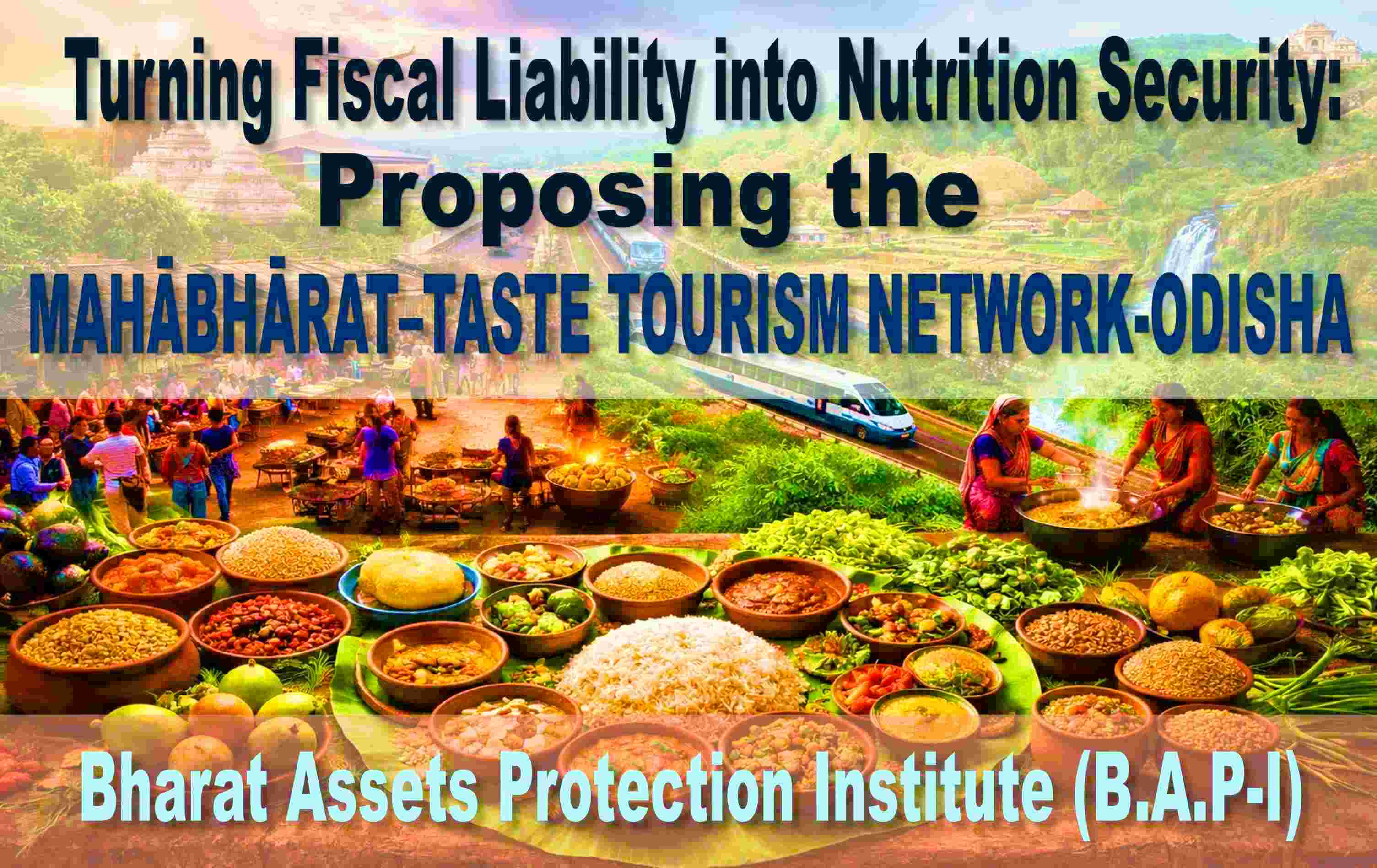
Turning Fiscal Liability into Nutrition Security: Proposing the MAHĀBHĀRAT–TASTE TOURISM NETWORK-ODISHA: A Statewide Antardaya-Integrated Food Sovereignty, Disaster
Nutrition and Heritage Tourism Infrastructure Framework |
|
Policy
White Paper for Institutional Adoption, Pilot
Implementation and Statutory Structuring |
|
|
|
This White Paper proposes a fundamental restructuring of Odisha’s
food security and tourism architecture by transforming nutrition from a
recurring fiscal liability into a self-financing public infrastructure
system. It advances the Mahābhārat–Taste Tourism Network as a statewide civilisational food
circulation framework that integrates tourism movement, decentralised
livelihood generation, Antardaya-positioned welfare provisioning and standing
disaster nutrition readiness into a single territorial governance field. The
proposed architecture redefines tourism as regulated public circulation
rather than hospitality commerce, and formalises food as a stabilising public
medium through which dignity feeding, hospital nutrition continuity, surplus
redistribution and emergency feeding capacity are institutionalised as
permanent public functions. Through the Antardaya Seva Bhojan Sangrahalaya pooling
architecture, routine tourism consumption is converted into a continuous
nutrition financing stream that sustains orphanages, old-age homes, hospital
attendant feeding networks and disaster nutrition vaults. Temple annadānam corridors, tribal superfood belts, forest produce kitchens,
highway millet parks, coastal night districts and urban heritage rasoi zones
are structurally reorganised as living public food infrastructure estates
operated by local families, Self-Help Groups and tribal collectives.
Inter-state heritage food corridors are further proposed to formalise India’s
diverse culinary traditions as regulated public nutrition economies embedded
within Odisha’s territorial circulation field. The White Paper introduces a unified Single Window Control
Architecture, integrated digital governance grids, consolidated fiscal
routing gateways, sanitation and food safety control systems, transport
mobility command networks, ecological compliance frameworks and professional
human resource cadres to institutionalise accountability, transparency,
disaster readiness and employment continuity across the entire network.
Collectively, the framework positions Odisha as India’s first Food
Sovereignty Tourism State, where daily tourism movement functions as
deployable nutrition infrastructure, decentralised livelihood machinery and
permanent disaster feeding capacity embedded within routine public
circulation rather than episodic welfare intervention. |
Keywords : Mahābhārat–Taste Tourism Network, Food Sovereignty Tourism State, Antardaya-integrated nutrition infrastructure, disaster nutrition readiness, temple annadānam corridors, tribal superfood belts, highway millet nutrition parks, coastal night food districts, Antardaya Seva Bhojan Sangrahalaya (ASBS), decentralised livelihood generation, tourism-financed dignity feeding
|
This White Paper
proposes a structural transition in Odisha’s food-security architecture by
converting what is currently a recurring fiscal liability into a
self-financing public nutrition infrastructure. The proposed Mahābhārat–Taste Tourism
Network can re-engineer tourism circulation into a sovereign food economy
that can continuously generate livelihoods, finances dignity feeding and
institutionalise disaster nutrition readiness as standing public capacity. The present
subsidy- and ration-centric welfare model has gradually transformed nutrition
security into a permanent fiscal burden while weakening local food economies
and work participation. The proposed framework, if implemented in full, has
the potential to replace this dependency architecture with an entrepreneurial
food sovereignty model where nutrition is produced through a community
participatory living economic circulation rather than as government delivered
static entitlement. Under this
framework, temple food corridors, tribal superfood belts, forest produce
kitchens, coastal and highway food districts, inter-state heritage food
corridors and mobile disaster kitchens can be formalised into regulated
public food enterprises. These enterprises then can generate employment,
stabilise rural and tribal livelihoods, preserve indigenous crop lineages and
finance Antordaya nutrition provisioning through ASBS pooling embedded inside
daily tourism movement. This will enable
nutrition security to become a measurable economic output rather than a
budgetary expense. Disaster feeding then will gradually take a shift from
reactive relief to institutional readiness. Welfare recipients progressively
can become kitchen operators, logistics handlers, sanitation workers, storage
managers, food processors, packaging units owners, heritage chefs and
redistribution coordinators embedded inside the proposed Mahābhārat–Taste
circulation grid. This transition
will drastically alter Odisha from a nutrition deficient State to evolve into
India’s first Food Sovereignty Tourism State where civilisational food
systems operate as living public infrastructure, tourism finances dignity
nutrition, employment is decentralised and resilient, and disaster feeding
capacity functions as standing State readiness rather than emergency charity. 2. Foundational Doctrine The Mahābhārat–Taste Tourism
Network is proposed to be constituted as a public food circulation
infrastructure system and must not be interpreted or administered as a
hospitality, catering or leisure commerce activity. The Network is to
structurally integrate food, tourism movement, social obligation and
disaster-ready nutrition into a single statewide circulation field. Tourism
within this framework is defined as a regulated movement of people, goods and
services through protected food corridors, heritage kitchens and nutrition
continuity infrastructure, wherein food functions as the primary stabilising
medium connecting economic activity with livelihood continuity, social
redistribution and standing emergency preparedness. The operational
doctrine of the Network is then governed by Antordaya positioning, under
which the weakest households, migrant labour populations, displaced families,
dependent children and vulnerable persons are legally designated as the first
beneficiaries within the food circulation chain. Access to nutrition for
these groups is embedded directly into routine tourism movement. Every paid
food transaction within the Network automatically activates a parallel
nutrition stream that sustains free-meal sanctums, hospital feeding
corridors, orphanage and old-age home supply lines and disaster reserve stock
systems. Nutrition security within the Network is therefore institutionalised
as a continuous public capacity rather than as an episodic welfare response. Temple annadānam corridors,
tribal seed and superfood ecologies, forest produce kitchens, coastal food
lanes and urban heritage rasoi districts are formally constituted as
permanent living food infrastructure assets. These units maintain indigenous
crop circulation, sustain rural kitchen operations and preserve native food
lineages as active economic systems. Then, visitors are routed through
functioning civilisational supply fields rather than isolated commercial food
outlets, thereby ensuring that heritage food systems remain operational,
economically viable and socially productive. Disaster-exposed
districts maintain standing food strongrooms and nutrition vaults under
continuous readiness protocols. National highway corridors host millet-based
nutrition kitchens functioning simultaneously as transit food parks and
ration continuity nodes. Coastal night districts operate surplus routing
corridors designed to sustain food circulation during seasonal slowdowns and
emergency disruptions. Hospitals, shelters and orphanages remain permanently
linked to these circuits so that nutrition continuity remains uninterrupted
across all climatic, market and disaster cycles. Local families,
Self-Help Groups and tribal collectives function as the primary operating
entities of all kitchens and food parks under regulated empanelment
frameworks. Public agencies create estates, corridors and statutory safety
frameworks. Tourism institutions manage routing, visibility and visitor
circulation. Health systems, disaster management authorities, energy
utilities, export logistics networks and supply chain systems remain
structurally integrated within a single circulation command field, thereby
ensuring that livelihood generation, welfare provisioning and resilience
readiness operate as a unified public infrastructure continuum. 3. Proposed Mahābhārat–Taste Tourism
Network, Odisha The Mahābhārat–Taste Tourism
Network, Odisha is conceived as a statewide public food circulation and
disaster-ready nutrition infrastructure capable of repositioning tourism as a
continuity system rather than as a hospitality-led consumption industry. It
is designed to operate as a unified circulation architecture in which
heritage kitchens, temple annadānam corridors, tribal superfood belts, forest produce kitchens,
coastal night food districts, highway millet nutrition parks, urban heritage
rasoi zones, export food gateways and disaster nutrition vaults can be
integrated inside a single regulated operating field. This circulation field
is structured to carry nutrition continuity, livelihood security, surplus
redistribution and emergency feeding readiness as embedded functions of
routine tourism movement across the State. Within this
architecture, every tourism corridor, destination zone and transit cluster
can be structurally aligned with Antardaya-positioned nutrition provisioning.
Visitor movement can function as a permanent public resource stream that will
progressively sustain free-meal sanctums, hospital attendant feeding grids,
orphanage and old-age home supply corridors and disaster reserve kitchens
through the Antardaya Seva Bhojan Sangrahalaya pooling system. Hunger
reduction, dignity nutrition and disaster feeding readiness can thereby
operate as standing public capacities rather than as episodic welfare
responses. The Network is
intended to function through permanent working food infrastructure spaces
notified across temple towns, coastal belts, forest and tribal districts,
hill zones, riverfront settlements, highway corridors and urban heritage
districts. These spaces can be operated primarily by trained local families,
Self-Help Groups and tribal collectives, allowing indigenous food lineages to
remain active economic systems while stabilising decentralised livelihood
structures. SIDCO can undertake estate creation and MSME incubation. OTDC can
administer zoning, routing and tourism safety frameworks. ITDC can integrate
national and international tourism circuits into the unified circulation
field. Through structural
integration with ORMAS, OSIC, OSDMA, NHM, APICOL, OCCL, OFDC, ICDS, logistics
and cold-chain networks, renewable energy utilities and public supply
systems, the Network can convert tourism corridors into nutrition continuity
grids, disaster feeding command spaces and export-linked heritage food
corridors. Daily tourism movement can thereby carry embedded functions of
livelihood security, nutrition provisioning, supply chain resilience and
disaster readiness as standing public infrastructure within the territorial
governance field of Odisha. 4. Strategic Positioning
and Territorial Tourism Architecture Under the proposed
Mahābhārat–Taste Tourism
Network, Odisha can function as a Food Sovereignty Tourism State by
structurally integrating nutrition continuity, livelihood stabilisation and
disaster-feeding readiness into daily tourism circulation through deployable
infrastructure, regulated zoning and institutional command frameworks. Odisha
already carries the physical, ecological and administrative feasibility to
operationalise this model due to its high pilgrimage density, highway freight
spines, forest and coastal food belts, district-level disaster command
systems, ICDS and PDS networks, extensive Self-Help Group coverage and
state-owned tourism land banks. These existing systems can be reorganised
into a unified territorial food circulation architecture that converts
routine visitor movement into standing nutrition infrastructure rather than
treating feeding as episodic welfare intervention. Temple and
pilgrimage corridors across Puri, Konark, Bhubaneswar, Jajpur, Baripada and
Taratarini can be operationally aligned with existing annadānam kitchens,
hospital clusters, district relief stockyards and OTDC land assets to form
permanent nutrition corridors capable of supporting daily free-meal sanctums,
pilgrim feeding lines and disaster fallback food vaults. Satvik and
Jain-compatible pure vegetarian tourism parks in temple hinterlands can
function as regulated high-integrity kitchen zones serving verified
vegetarian circuits, religious tour groups and long-stay pilgrim populations
while preserving indigenous kitchen lineages under certified hygiene and
traceability protocols. Highway stopover
parks along NH-16, NH-57 and NH-326 can be operationalised as millet-based
transit nutrition hubs integrated with toll plaza logistics, state highway
maintenance depots, cold-chain points and district emergency stockpiles,
enabling them to simultaneously serve tourist traffic, freight drivers and
first 48-hour disaster ration response needs. Tribal and Vanavasi heritage
circuits across Koraput, Rayagada, Kandhamal, Malkangiri and Mayurbhanj can
be structured as protected forest superfood circulation corridors that route
millets, tubers, honey, sal seed, tamarind and herbal produce directly into
tourism kitchens under minimum return procurement floors, stabilising tribal
nutrition economies while supplying continuous heritage food volumes. Coastal nightlife
and family leisure districts in Puri, Gopalpur, Chandipur and Paradeep can
function as surplus routing food zones aligned with fisheries harbours,
coastal cold rooms, ice plants and marine police infrastructure, ensuring
that these districts remain operational during seasonal downturns and cyclone
recovery phases. The Balasore to Ganjam coastal belt can operate as a
maritime food circulation corridor integrating rice belts, seafood landing
centres and export-linked heritage kitchens under traceable supply protocols. Hill and eco
forest zones such as Daringbadi, Mahendragiri, Deomali and Satkosia can be
organised as herbal, honey and millet nutrition belts linked to ICDS, NHM and
district relief stock systems, thereby serving both wellness tourism and
fallback disaster nutrition needs. Riverfront and ghat heritage towns
including Cuttack, Sambalpur, Baleswar and Talcher can function as
ritual-linked feeding hubs and redistribution nodes connected to PDS godowns,
municipal kitchens and hospital clusters. Urban heritage districts can
stabilise living rasoi economies within walkable heritage cores integrated
with municipal sanitation and waste to energy systems. Handloom, craft
and GI villages can integrate craft tourism with food corridors to stabilise
artisan livelihoods while supplying indigenous ingredient lines to nearby
kitchens. Wetland, island and mangrove zones can operate as eco nutrition
circuits aligned with forest department zoning, bird sanctuary tourism flows
and eco restoration programmes. Adventure, wellness, festival and night
bazaar zones can operate as seasonal circulation amplifiers feeding into the
same unified nutrition continuity grid. Through this
territorially zoned, institutionally anchored and logistics-integrated
architecture, Odisha can be positioned as India’s first Food Sovereignty
Tourism State where daily tourism movement can function as deployable
nutrition infrastructure, livelihood stabilisation machinery and
disaster-ready feeding command systems embedded inside routine public
circulation rather than as parallel welfare operations. 5. Antardaya Seva Bhojan Sangrahalaya
(ASBS) – Universal Food Contribution and Redistribution Architecture Within the Mahābhārat–Taste Tourism
Network, the Antardaya Seva Bhojan Sangrahalaya (ASBS) is designed to
function as the central fiscal–nutrition command architecture through which
tourism movement can be converted into standing dignity feeding and disaster
readiness capacity. Every beneficiary who consumes food within any notified
Mahābhārat–Taste tourism
corridor, park, district or transit hub can contribute a small dignified seva
amount into a unified sacred nutrition pool administered through ASBS. This
pooled seva flow is intended to operate as a continuous public nutrition
financing stream rather than as a donation-based welfare mechanism. It is
proposed that: • ASBS is structured to integrate with all territorial food
circulation domains and is designed to manage four permanent redistribution
and readiness grids. •
Surplus Redistribution Corridors can route verified safe surplus
food from tourism kitchens, highway hubs, coastal night districts and urban
rasoi zones into slum feeding points, night shelters, pilgrim rest houses,
orphanages and old age homes through geo tagged, cold chain supported routing
lines. • Hospital Nutrition Contribution Grids can provide daily free
meals for patient attendants, long stay treatment families and government
hospital wards through continuous routing from nearby Mahābhārat–Taste kitchens
and transit hubs. • Disaster Rescue Nutrition Facilities can maintain permanent
cyclone, flood and heatwave food vaults, mobile kitchen fleets and first
48-hour survival ration stockpiles integrated with district disaster command
centres and emergency transport corridors. • Orphan and Old Age Home Nutrition Networks can ensure weekly
ration provisioning and cooked meal financing for orphanages, widow ashrams,
old age homes and special child care institutions through standing ASBS
supply lines. • Through ASBS, daily tourism consumption can be structurally
converted into a permanent nutrition continuity engine that finances
invisible household feeding, institutional care provisioning and disaster
survival readiness, thereby embedding Antardaya as a measurable, auditable
and deployable public infrastructure function inside routine tourism
circulation. 6.Inter-State Heritage Food Corridors:
Formalisation, Commercialisation, Employment Continuity and Socialisation of
India’s Culinary Nutrition Traditions Within the Mahābhārat–Taste Tourism
Network, the Inter-State Heritage Food Corridors can function as a national
civilisational interface through which India’s diverse culinary lineages and
nutrition traditions can be formalised into regulated public food economies,
commercialised through protected circulation systems and socialised into
everyday public life. These corridors are not limited to presenting regional
cuisines as tourism attractions. They are designed to institutionalise them
as working nutrition cultures, allowing diverse food habits, ritual diets,
medicinal food systems, fasting traditions, forest and millet nutrition
ecologies and pilgrimage-linked feeding practices to circulate continuously
within a unified Antardaya-aligned food grid. Each corridor can
be notified as a heritage food estate or food village and can be integrated
into OTDC zoning, SIDCO estate development and ITDC tourism routing
frameworks. These estates can host heritage rasois, GI product galleries,
live culinary museums, ingredient aggregation yards, cold chain rooms, drying
courts, packaging units and ASBS surplus routing nodes. Through this
architecture, diverse culinary traditions from across India can be preserved
as active living systems, embedded inside formal hygiene, traceability and
food safety regimes while remaining anchored to their source communities
through protected procurement corridors and minimum return pricing floors. These corridors
can socialise diverse nutrition cultures into everyday public circulation.
Satvik temple diets, tribal forest superfoods, Himalayan herbal nutrition,
coastal rice and seafood ecologies, fermented food traditions, millet-based
resilience diets, ayurvedic therapeutic foods and pilgrimage feeding
practices can become part of routine food exposure for residents, travellers,
patients, migrant workers and disaster affected populations. This
socialisation process can progressively restore dietary diversity, can
improve micro nutrient access, can stabilise indigenous crop demand and can
revive disappearing food lineages. Layered employment
ecosystems can emerge across heritage chefs, forest produce and farm
aggregators, cold chain technicians, packaging and branding workers, digital
sales managers, logistics handlers, sanitation and water integrity staff,
culinary trainers and apprenticeship cadres drawn from Self-Help Groups,
tribal cooperatives and youth skilling programmes. Formal certification and
entrepreneurship pipelines can institutionalise long cycle livelihoods rather
than seasonal tourism employment. Embedded inside
ASBS redistribution grids, hospital feeding networks and disaster nutrition
vaults, these inter-state corridors can transform tourism circulation into a
continuous nutrition socialisation and employment generation engine,
repositioning Odisha as the only Indian state where daily public movement can
structurally carry civilisational dietary diversity, livelihood continuity
and standing disaster ready feeding capacity as embedded public
infrastructure rather than episodic welfare activity. 7.Management Verticals
Through Single Window Control Design: Generation of Professionalism, Sectoral
Development, Employment Expansion and 360 Degree Transformation of Odisha’s
Culinary Heritage and Tourism Potential The Mahābhārat–Taste Tourism
Network requires a sovereign, unified and legally empowered command structure
capable of converting Odisha’s dispersed culinary traditions, informal food
economies and fragmented tourism assets into a regulated, professional and
employment generating public infrastructure system. The Single Window Control
Design is conceived as the institutional architecture through which Odisha’s
culinary heritage can be formalised into modern regulated food economies,
diversified sectoral growth can be activated, and tourism circulation can be
shaped into a standing livelihood, nutrition and disaster readiness system
rather than remaining a seasonal commercial activity. 7.1
Unified Operating Authority The Mahābhārat–Taste Tourism
Network can function under one Unified Operating Authority constituted either
as a new statutory agency, a notified nodal government corporation or a
licensed public private consortium operating under formal Government charter.
Only one such authority can exercise statewide jurisdiction. All planning,
zoning, approvals, routing, empanelment, pricing regulation, compliance
supervision and enforcement functions can flow through this Authority.
Parallel institutional structures can be progressively phased out so that
fragmented governance, informal operations and unregulated commercialisation
do not dilute territorial food security or disaster readiness capacity. This Authority can
function as the food tourism command of the State and can exercise
comprehensive control over licensing and grading of kitchens and food
estates, heritage conformity standards, real time data command and visitor
movement analytics, meal volume accounting, ASBS seva pooling supervision,
disaster nutrition stock governance, integrated banking gateways, vendor
empanelment and performance guarantees, insurance coverage systems, unified
transport routing grids, sanitation and water integrity controls,
environmental compliance frameworks, marketing and branding governance and
consolidated food safety and traceability enforcement. Through this
unified command field, Odisha can professionalise heritage kitchens,
formalise decentralised food economies, integrate MSME, Self Help Group and
tribal production belts into regulated tourism supply chains, and generate
continuous employment across culinary, logistics, sanitation, cold chain,
digital commerce, training and disaster response sectors. The Unified
Operating Authority can operate as the institutional engine that converts
Odisha’s civilisational food capital into a modern, accountable and
nationally positionable Food Sovereignty Tourism Infrastructure System. 7.2.
Single Regulation Point The Mahābhārat–Taste Tourism
Network is designed to operate through one consolidated State Regulatory
Window that can function as the sole legally recognised authority for all
licensing, registration, food safety compliance, heritage conformity
certification, pricing band approvals, Antardaya seva contribution rules and
disaster ration governance. This regulatory window can replace fragmented
departmental permissions, local discretionary clearances and parallel
licensing channels that presently govern food, tourism and welfare activities
in isolation. By consolidating regulatory authority into a single
institutional point, Odisha can reduce procedural ambiguity, remove
field-level discretion and establish a predictable governance field capable
of supporting large scale tourism movement, decentralised livelihood systems
and disaster feeding readiness. All empanelment of
heritage kitchens, Self Help Group food enterprises, tribal collectives,
highway food parks, night districts, food villages and export linked heritage
food units can be routed exclusively through this single regulatory window.
Permissions, certificates or approvals issued outside this window can carry
no legal validity. Field-level discretionary exemptions can be progressively
eliminated. This structure can professionalise heritage food operations,
standardise hygiene and pricing behaviour, protect consumer trust and
stabilise long-cycle employment creation across tourism, logistics,
sanitation, cold chain and food processing sectors. Through this
regulatory vertical, Odisha can institutionalise uniform food safety, pricing
integrity, heritage authenticity and Antardaya compliance across the Mahābhārat–Taste
circulation grid, thereby converting dispersed informal kitchens into a
regulated public food infrastructure economy. 7.3
Integrated Digital Governance System and Single Data Command Grid The Mahābhārat–Taste Tourism
Network can operate through a single Integrated Digital Governance System
that functions as the authoritative public interface between visitors,
operators and participating government agencies. This system can replace
fragmented departmental portals, private booking platforms and unregulated
food tourism applications that currently dilute routing control, compliance
supervision and disaster coordination. It can serve as the digital command
core of the Network and can centralise routing governance, Antardaya seva
contribution routing, compliance supervision and disaster readiness
interfaces within one verified public command architecture. This system can
host a statewide public website carrying verified destination listings,
notified food villages, temple corridors, night districts, free meal
sanctums, disaster nutrition points and hospital feeding locations. A unified
mobile application can provide visitor mapping, menu and nutrition
visibility, transparent pricing information, Antardaya seva contribution
display, safety advisories and grievance reporting. Operator dashboards can
manage supply intake, daily meal volumes, sanitation audits, stock positions,
cold chain movements and disaster readiness indicators. A central command
console can monitor surplus routing flows, hospital feeding volumes, disaster
vault stock levels, mobile kitchen deployment status and night district
safety in real time. Digital seva
pooling, QR based ingredient and meal traceability, emergency alert
integration and automated audit trail generation for food safety, sanitation,
insurance and environmental compliance can remain embedded functions of this
system. Parallel digital platforms, private aggregation portals and
unauthorised booking and listing systems can be progressively excluded,
allowing command continuity, public trust and disaster time operability to
remain institutionally protected. A unified State
Data Command Grid can function as the central nervous system of the Mahābhārat–Taste Tourism
Network. This grid can operate through a real time digital dashboard that
records visitor movement flows, meal production and consumption volumes,
Antardaya seva contribution accruals, surplus redistribution routing,
disaster reserve stock levels and hospital nutrition supply volumes across
tourism zones, food parks, night districts and transit hubs. All kitchens, food
estates, mobile food fleets, storage vaults, hospital feeding corridors and
ASBS redistribution nodes can remain digitally integrated with this grid
through mandatory geo tagged reporting interfaces. Data feeds generated
through this grid can serve as the primary control input for district and
State level oversight, disaster readiness assessments, nutrition continuity
audits, employment monitoring and policy recalibration. Through this digital
command field, Odisha can embed transparency, real time oversight, corruption
prevention and disaster readiness intelligence directly into everyday tourism
circulation and public nutrition operations. 7.4
Single Banking and Seva Pool Gateway The Mahābhārat–Taste Tourism
Network can operate through one integrated State Banking and Seva Pool
Gateway that functions as the authorised financial circulation channel for
all commercial receipts and Antardaya seva contributions generated within the
Network. This gateway can remain digitally linked with the Antardaya Seva
Bhojan Sangrahalaya and can serve as the exclusive conduit through which
tourism linked food transactions, seva pooling flows, institutional
settlements and redistribution funding streams are processed. By centralising
fiscal movement into a single monitored gateway, Odisha can prevent
fragmentation of nutrition financing, preserve Antardaya integrity and
maintain continuous visibility across all public feeding flows. This gateway can
replace informal pooling practices, parallel settlement routes and unverified
cash handling that currently weaken auditability and increase fiscal leakage
risks. All kitchens, food parks, night districts, transit hubs, mobile
kitchen fleets, heritage food villages and export linked heritage food
corridors can remain digitally integrated with this gateway through mandatory
account linkage, transaction tagging and automated reporting interfaces. This
integration can ensure that every tourism linked food transaction contributes
to the nutrition continuity architecture without dilution. All audits,
settlements, redistribution releases, disaster stock financing and hospital
feeding disbursements can be executed only through this unified gateway.
Automated accounting trails can record source level transactions, Antardaya
accruals, redistribution routing and beneficiary side releases across all
districts and corridors. This structure can enable real time monitoring of
nutrition financing flows, prevent diversion, and allow public agencies to
maintain continuous fiscal situational awareness during both routine
operations and disaster activation cycles. Through this
fiscal vertical, Odisha can convert tourism commerce into a traceable public
nutrition financing infrastructure that supports institutional care
provisioning, invisible household feeding and disaster survival readiness as
permanent public capacities embedded within daily tourism circulation. 7.5
Single Vendor Selection Window All Self-Help
Groups, tribal collectives, family kitchens, food MSMEs and heritage food
enterprises seeking participation within the Mahābhārat–Taste Tourism
Network can be selected, graded, certified and empanelled exclusively through
one State Level Vendor Selection Window constituted under the Unified
Operating Authority. District level empanelment committees, private
aggregators, franchise networks and informal licensing channels can remain
outside the recognised selection field. This structure can allow the Network
to preserve a unified quality threshold while preventing fragmented
gatekeeping and unregulated entry into protected food corridors. This window can
evaluate applicants on hygiene compliance, heritage authenticity, Antardaya
contribution adherence, disaster readiness capacity, green compliance and
service quality benchmarks. Formal grading, performance guarantees and
renewal eligibility can be issued only through this window. This architecture
can allow decentralised kitchens and heritage food enterprises to enter
formal tourism supply chains under predictable compliance expectations rather
than informal negotiation. Through this
vertical, Odisha can professionalise heritage food entrepreneurship,
formalise decentralised kitchen economies, standardise service quality,
create predictable MSME growth pipelines and generate structured employment
ecosystems across culinary, logistics, sanitation, training and disaster
response sectors. 7.6
Beneficiary Performance Guarantee System Every empanelled
kitchen operator, Self Help Group unit, tribal collective, family rasoi and
MSME enterprise functioning within the Mahābhārat–Taste Tourism
Network can be required to submit formal digital undertakings constituting a
Beneficiary Performance Guarantee. These undertakings can cover food
continuity obligations, hygiene and sanitation compliance, disaster response
readiness standards, Antardaya seva contribution adherence, green
contribution responsibilities and declared hospitality service norms. All undertakings
can remain digitally recorded within the Unified Data Command Grid and can be
treated as enforceable compliance instruments rather than voluntary
declarations. Performance guarantees can form the basis for grading, renewal
eligibility, incentive allocation and corrective enforcement actions. Through
this vertical, Odisha can institutionalise accountability, stabilise service
quality, secure nutrition continuity and embed disaster readiness as
contractual public obligations inside routine tourism operations. 7.7
Single Insurance and Risk Coverage Window A statewide
insurance and risk coverage framework can be instituted through one approved
insurance provider designated under the Unified Operating Authority. This
framework can provide comprehensive coverage for visitors, kitchen staff,
mobile kitchen fleets, surplus redistribution operations, disaster feeding
deployments and food contamination liabilities across the Mahābhārat–Taste Tourism
Network. All kitchens, food
estates, transit hubs, mobile fleets and storage vaults can remain
mandatorily covered under this unified insurance architecture. Independent
insurance arrangements, fragmented private coverage schemes and parallel risk
frameworks can be progressively excluded. Through this vertical, Odisha can
institutionalise risk protection, ensure rapid compensation, safeguard public
trust and stabilise tourism linked employment ecosystems. 7.8
Single Transport and Mobility Network The movement of
raw materials, cooked food, mobile kitchen fleets, surplus redistribution
cargo, disaster ration consignments and export linked heritage food shipments
within the Mahābhārat–Taste Tourism Network can operate under one Unified Transport
and Mobility Command Network. This network can define fixed routing
corridors, emergency priority lanes, cold chain movement grids, GPS tracked
vehicle fleets and disaster time rapid deployment lanes integrated with
district disaster control rooms and highway authorities. Untracked,
unauthorised or informal logistics operators can remain outside the
recognised mobility field. This structure can institutionalise predictable
supply chains, enable rapid disaster response capability, protect food
integrity, stabilise logistics sector employment and convert tourism
circulation into a resilient food mobility infrastructure grid. 7.9
Single Sanitation, Water and Hygiene Control System All kitchens, food
parks, coastal night districts, highway food hubs, mobile kitchen fleets and
storage vaults operating within the Mahābhārat–Taste Tourism Network can function under one unified
Sanitation, Water and Hygiene Integrity Control Grid administered through the
Unified Operating Authority. This grid can regulate water sourcing and
purification standards, kitchen sanitation protocols, waste segregation and
disposal practices, vector and pest control regimes, effluent treatment
systems and drainage integrity across tourism food infrastructure zones. Hygiene audits,
laboratory testing, water quality certifications and sanitation compliance
reporting can be conducted exclusively through this unified grid. Parallel
sanitation frameworks, informal hygiene certifications and fragmented
municipal compliance regimes can be progressively excluded. This architecture
can institutionalise uniform public health protection, prevent contamination
risks, standardise sanitation employment cadres and convert dispersed
kitchens into a safe, auditable and disaster resilient public food
infrastructure ecosystem. 7.10
Single Window Green Commitment Fund and Environmental Responsibility Grid A State level
Green Commitment Fund can be constituted under the Unified Operating
Authority as the ecological finance engine of the Mahābhārat–Taste Tourism
Network. All empanelled operators, food estates, night districts, transit
hubs and mobile kitchen fleets can contribute mandatorily to this fund,
ensuring that ecological responsibility remains embedded within daily tourism
food circulation. The Fund can
finance biodegradable and leaf based packaging transitions, renewable energy
kitchen installations, composting and biomass conversion systems, tree and
wetland regeneration programmes near tourism corridors and carbon offset
plantation belts linked to food circulation routes. Environmental compliance,
green contribution adherence and waste reduction performance can remain
embedded within operational audits and performance grading systems. Through
this ecological vertical, Odisha can embed restoration, low carbon food
systems and green employment generation into routine tourism circulation
while protecting climate resilience and environmental integrity. 7.11
Single Window Marketing, Branding and Visitor Routing System All communication,
tourism promotion, festival calendars, travel trade partnerships, online
platform listings and international marketing engagements associated with the
Mahābhārat–Taste Tourism
Network can operate through one Unified Marketing, Branding and Visitor
Routing Command System administered by the Unified Operating Authority. This
system can centralise naming rights governance, visual identity standards,
heritage branding protocols, pricing transparency rules, digital booking
frameworks, festival and event calendars and structured visitor routing plans
across temple corridors, food villages, night districts, highway hubs and eco
tourism zones. Independent
branding campaigns, parallel promotions, unregulated digital listings and
unauthorised tour packaging can remain outside the recognised circulation
field. Through this vertical, Odisha can establish a coherent global identity
for its Food Sovereignty Tourism doctrine, prevent market fragmentation,
protect heritage authenticity, ensure transparent pricing behaviour and
channel visitor flows in a manner that stabilises employment, protects
ecological zones and strengthens nutrition continuity circuits. 7.12
Single Window Food Safety, Supply and Compliance All sourcing,
procurement, cooking, storage, transport and serving activities within the
Mahābhārat–Taste Tourism
Network can function under one consolidated Food Safety, Supply and
Compliance Window. This window can govern ingredient origin certification,
organic and indigenous crop traceability, cold chain integrity, shelf life
tracking, storage and handling standards, cooking process audits, laboratory
testing regimes, contamination control measures, recall protocols and full
traceability from farm, forest and fishery to plate. Parallel food
safety certification regimes and fragmented departmental compliance channels
can be progressively excluded. Through this vertical, Odisha can
institutionalise end to end food integrity, safeguard public health, protect
indigenous crop economies, professionalise food handling employment and
convert tourism kitchens into globally credible, audit ready public food
infrastructure. 7.13
Integrated Digital Governance System The Mahābhārat–Taste Tourism
Network can operate through one Integrated Digital Governance Platform that
functions as the authoritative interface between visitors, operators and
participating government agencies. This platform can serve as the digital
command core of the Network and can replace fragmented departmental portals,
private booking platforms and unregulated food tourism applications. The platform can
host a statewide public website carrying verified destination listings,
notified food villages, temple corridors, night districts, free meal
sanctums, disaster nutrition points and hospital feeding locations. A unified
mobile application can provide visitor mapping, menu and nutrition
visibility, transparent pricing information, Antardaya seva contribution
display, safety advisories and grievance reporting. Operator dashboards can
manage supply intake, daily meal volumes, sanitation audits, stock positions,
cold chain movements and disaster readiness indicators. A central command
console can monitor surplus routing flows, hospital feeding volumes, disaster
vault stock levels, mobile kitchen deployment status and night district
safety in real time. Digital seva
pooling, QR based ingredient and meal traceability, emergency alert
integration and automated audit trail generation for food safety, sanitation,
insurance and environmental compliance can remain embedded functions of this
platform. Parallel digital platforms, private aggregation portals and
unauthorised booking and listing systems can be progressively excluded.
Through this digital vertical, Odisha can institutionalise real time command,
transparency, public trust, corruption prevention and disaster time
operational continuity as built in features of its Food Sovereignty Tourism
Infrastructure. 7.14
Single Window Tourist Parking, Refreshment and Transit Hub Grid All tourism
clusters, heritage food parks, night districts, pilgrimage corridors and
highway food parks operating under the Mahābhārat–Taste Tourism
Network can function within one Unified Tourist Parking, Refreshment and
Transit Hub Grid administered through the Unified Operating Authority. This
grid can constitute the physical mobility and visitor support backbone of the
Network and can regulate the planning, construction and operation of parking
bays, transit shelters, refreshment courts, water and sanitation points,
electric vehicle charging stations, fuel safety corridors, rest zones for
drivers and pilgrims and emergency assembly points. All hubs can remain geo
tagged, digitally integrated with the State Data Command Grid and
structurally linked with district disaster control rooms and hospital feeding
corridors. No informal,
unregistered or parallel parking, refreshment or transit operations can
remain inside notified Mahābhārat–Taste corridors and districts. This structure can allow
Odisha to institutionalise predictable visitor mobility, crowd safety,
sanitation integrity and rapid emergency response while generating structured
employment across parking management, sanitation, security, transport
coordination and visitor assistance services. Design Standards
and Operational Control: This Unified Tourist Parking, Refreshment and
Transit Hub Grid can regulate design standards, location planning, capacity
thresholds and operational protocols of all vehicle parking bays for private
vehicles, buses and organised tourist fleets. It can structure resting and
refreshment zones for drivers, pilgrims and transit visitors, drinking water
supply and sanitation refresh points, electric vehicle charging bays and fuel
safety corridors. Waiting shelters for elderly visitors, children and persons
with reduced mobility can remain structurally linked with tourist help
counters integrated into district control rooms. All parking zones,
refreshment hubs and transit shelters can remain geo tagged, digitally mapped
and continuously monitored through the Integrated Digital Governance Platform
and the State Data Command Grid. Parallel or unregistered parking,
refreshment and transit operations can remain outside the recognised
circulation field. Through this grid, Odisha can embed safe visitor mobility,
emergency readiness, sanitation integrity and structured employment
generation across transit operations, sanitation services, visitor assistance
and safety coordination as permanent public infrastructure functions. 7.16.
Local Organic Production and Supply Chain Procurement and Integration Grid All Mahābhārat–Taste
operating units can procure food, raw materials and kitchen inputs
exclusively through the Local Organic Production and Supply Chain Procurement
and Integration Grid, which can function as the authorised primary sourcing
architecture of the Network. This grid can replace open market, anonymous and
long haul procurement practices and can embed kitchens directly within
Odisha’s native farm, forest and homestead production belts as a regulated
public food supply system. By anchoring sourcing inside verified territorial
production zones, the Network can retain food integrity, shorten supply
chains and stabilise producer livelihoods. This grid can
integrate district wise certified organic farm clusters supplying cereals,
millets, pulses, oilseeds, vegetables, fruits and medicinal herbs. It can
integrate temple linked agriculture lines supplying annadānam corridors with
ritual grade rice, pulses, vegetables, oils and ghee. It can integrate tribal
forest produce aggregation zones sourcing honey, mahua, tamarind, sal seed,
jackfruit, millets, roots, tubers and herbal ingredients. It can integrate
registered indigenous seed and crop lineage farms preserving traditional rice
and millet varieties. It can integrate village level backyard dairy and
poultry units supplying milk, curd, ghee and eggs. It can integrate urban and
peri urban community kitchen garden belts supplying leafy greens, vegetables
and medicinal plants. District
Processing and Buffer Continuity System: Primary sorting, cleaning, grading,
drying and dehusking yards can be authorised for pre delivery processing.
District level cold rooms and grain vaults can hold buffer stocks and
disaster fallback reserves. Minimum return procurement floors and guaranteed
procurement volumes can protect registered producers, while dedicated
disaster buffer procurement pools can secure uninterrupted kitchen operations
during flood, cyclone and transport disruption periods. The Grid can
regulate district organic farmer clusters, millet belts, temple linked farm
lines, tribal aggregation zones, backyard dairy and poultry networks,
community seed banks, heritage crop corridors, chemical free input supply
lines, on farm primary processing yards, local cold room clusters and direct
farmer to kitchen routing corridors. All production clusters, aggregation
yards and storage facilities can remain geo tagged, digitally audited and
routed only through the Integrated Digital Governance Platform. Anonymous,
unregistered or external bulk sourcing can remain outside the recognised
procurement field. Through this
vertical, Odisha can institutionalise traceable local sourcing, stabilise
rural and tribal livelihoods, protect indigenous crop diversity, ensure food
integrity and secure disaster ready supply continuity as embedded public
infrastructure functions of the Mahābhārat–Taste Tourism Network. 7.17
Human Resource Architecture and Employment Continuity System The Mahābhārat–Taste Tourism
Network can operate through a formally constituted State controlled Human
Resource Architecture designed to professionalise heritage food systems,
stabilise long cycle employment and embed governance, safety, science and
disaster readiness functions within routine tourism circulation. All
personnel can be empanelled, graded and deployed under a unified human
resource command administered by the Unified Operating Authority. This
architecture can replace informal hiring practices, ad hoc staffing and
unverified labour sourcing with a regulated employment field anchored in
training, accountability and continuity. Strategic and
Supervisory Cadres: The strategic and supervisory cadre can comprise Chief Food
Systems Officers, Tourism Circuit Operations Managers, Agricultural and
Indigenous Seed Resource Managers, Food Science and Quality Assurance Heads,
Nutrition and Hospital Feeding Managers, Dairy and Gopalak System Managers,
Disaster Nutrition Command Heads, Digital and Traceability Managers, Language
and International Visitor Services Managers, Green Compliance and
Environmental Managers and Supply Chain and Storage Command Heads. These
cadres can carry responsibility for governance oversight, food integrity,
Antardaya compliance, disaster readiness, digital traceability, visitor
services, ecological compliance and end to end supply continuity across all
corridors and districts. Operational
Cadres: The operational cadre can comprise trained heritage chefs,
kitchen and service staff, mobile kitchen crews, parking and transit hub
staff, visitor help desk operators, warehouse and cold room technicians,
transport drivers and dispatch teams and sanitation and water integrity
workers. These cadres can manage on ground kitchen operations, visitor
handling, logistics movement, storage management, hygiene maintenance and
emergency deployment functions under structured reporting and performance
oversight. Through this
structured human resource architecture, Odisha can generate decentralised,
dignified and long-term employment across culinary, logistics, sanitation,
digital governance, disaster response and environmental management sectors
while professionalising heritage food systems into a modern public
infrastructure economy. 8. Comprehensive Critical
Outcomes 8.1
Structural Recalibration of the Tourism Economy The
institutionalisation of the Mahābhārat–Taste Tourism Network can recalibrate Odisha’s tourism
economy from a fragmented hospitality-led sector into a unified
civilisational food circulation infrastructure capable of generating
permanent livelihoods, stabilising nutrition security and embedding disaster
readiness within daily public movement. Tourism can move away from
functioning only as consumption traffic and can evolve into a regulated
circulation system that continuously finances Antardaya nutrition
provisioning, sustains decentralised rural and tribal kitchen economies and
embeds surplus redistribution as standing public capacity inside routine
mobility flows. 8.2
Professionalisation of Heritage Food Systems and Employment Expansion Heritage kitchens,
tribal superfood belts, temple annadānam corridors, coastal night food districts and highway millet
nutrition hubs can transition from informal and seasonal operations into
professionalised, digitally governed and legally protected public food
estates. This transition can generate structured employment across culinary
services, cold chain logistics, sanitation, digital operations, food science,
disaster response, green compliance and visitor services. Indigenous crop
lineages can remain active economic systems while minimum return procurement structures
can stabilise income security for farmers, forest gatherers and gopalak
households. 8.3
Nutrition Continuity and Disaster Readiness Transformation The ASBS pooling
architecture can convert routine tourism consumption into a continuous
financing engine for hospital attendant feeding, orphanage and old age home
nutrition networks, night shelter feeding and permanent disaster nutrition
vaults. This shift can reposition Odisha’s feeding systems from episodic
relief mechanisms to institutional readiness frameworks. Disaster exposed
districts can acquire standing food vaults, mobile kitchen fleets and first
48 hour survival ration capacity integrated with tourism circulation and
district disaster command systems. 8.4
Public Infrastructure Governance and Ecological Accountability The unified
digital governance, transport mobility, sanitation, food safety and green
compliance grids can establish Odisha as a nationally auditable and globally
credible food tourism infrastructure state. Traceable sourcing, standardised
hygiene, ecological accountability and transparent fiscal flows can become
embedded features of daily tourism circulation. Tourism movement can function
as a measurable public infrastructure system that simultaneously carries
livelihood generation, nutrition continuity, disaster readiness and
ecological restoration as integrated operational functions. 8.5
Territorial Positioning and Civilisational Infrastructure Transition Collectively,
these transformations can position Odisha as India’s first Food Sovereignty
Tourism State where civilisational food systems are preserved as living
public infrastructure, tourism circulation finances dignity nutrition,
employment is decentralised and resilient, and disaster feeding capacity
operates as standing state readiness rather than emergency charity. 9. The Expected Outcome The Mahābhārat–Taste Tourism
Network can enable Odisha to execute a civilisational correction in its food
security architecture by shifting the State away from a dependency driven
ration and subsidy regime that has progressively converted large sections of
the population into permanent recipients of free food transfers, weakened
work participation, eroded local food economies and turned nutrition security
into a fiscal liability. Under this
framework, welfare dependence can be structurally replaced by enterprise
based nutrition production. The same households that presently exist as
subsidy dependent ration consumers can be reorganised into kitchen operators,
raw material producers, logistics handlers, sanitation workers, storage
managers, food processors, packaging units, mobile kitchen crews, heritage
chefs and redistribution coordinators operating inside the Mahābhārat–Taste
circulation grid. In this system, beneficiaries can progressively move away
from remaining passive recipients of State rations and can become
contributors, service providers and entrepreneurs within the food economy
itself. Nutrition security
can therefore be generated through continuous economic participation rather
than permanent fiscal handouts. Antardaya protection can remain guaranteed,
yet it can be financed through tourism linked enterprise circulation, ASBS
pooling and decentralised food production rather than static subsidy
dependence. Odisha can thereby transition from a subsidy consumption welfare
state into an entrepreneurial food sovereignty state, where dignity, work,
livelihood continuity and disaster readiness can be produced as living public
infrastructure rather than delivered as perpetual charity. 10. Methodology This White Paper
has been developed through a structural–doctrinal policy design methodology
rather than a programme evaluation or welfare modelling approach. The purpose
of the methodology is not to optimise existing schemes but to re-engineer
Odisha’s food security, tourism and disaster nutrition architecture into a
unified public infrastructure system. The methodology
proceeds from territorial, institutional and circulation-based system design
principles. Odisha has been treated as an integrated civilisational operating
field in which food, movement, livelihoods, public welfare and disaster
readiness are examined as interlinked infrastructure layers rather than
isolated sectoral functions. Existing welfare programmes, tourism assets,
disaster command systems, ICDS, PDS, SHG networks, temple annadānam corridors,
forest produce belts, coastal fisheries infrastructure, highway mobility
corridors and municipal kitchen ecosystems were conceptually mapped as living
public assets capable of being reorganised into a single circulation
architecture. A doctrinal
modelling approach was applied to define the Mahābhārat–Taste Tourism
Network as public infrastructure rather than hospitality commerce. This
involved constructing Antardaya as a legally embedded positioning doctrine,
defining tourism as regulated circulation, and formalising food as a
stabilising public medium. From this doctrinal base, the ASBS pooling
architecture, disaster nutrition vault systems, surplus redistribution
corridors, hospital feeding grids and inter-state heritage food corridors
were designed as permanent public capacities rather than discretionary
welfare schemes. Territorial zoning
logic was then applied to Odisha’s pilgrimage belts, coastal districts,
forest and tribal regions, hill ecologies, riverfront cities, highway
corridors and urban heritage cores to construct deployable nutrition,
livelihood and disaster readiness grids embedded inside routine tourism
movement. Institutional design methodology was used to develop the Single
Window Control Architecture, unified digital governance systems, fiscal
routing gateways, transport mobility grids, sanitation and food safety
control fields, human resource cadres and ecological compliance systems as
legally enforceable governance instruments rather than project frameworks. The methodology is
therefore prescriptive, architectural and civilisational in nature. It
constructs a sovereign public infrastructure doctrine for food security and
disaster readiness, and translates it into territorially deployable
governance, financial, digital, mobility and institutional command
architectures capable of statutory codification, pilot deployment and
statewide scaling. 11. Artificial
Intelligence (AI) Use and Authorship Statement This White Paper
is an original civilisational infrastructure and public policy architecture
conceived, structured and authored by Dr. Padmalochan Dash. Artificial
intelligence tools, including language assistance systems, were utilised
strictly as editorial and linguistic support instruments for grammar
correction, sentence refinement and formatting standardisation. No generative
systems were permitted to design, conceptualise, interpret, derive, alter or
originate any doctrinal, architectural, legal, institutional, fiscal,
territorial, disaster governance or food sovereignty frameworks contained in
this document. All conceptual
frameworks, structural models, governance architectures, circulation
doctrines, institutional mechanisms, fiscal designs, territorial zoning
logics and public infrastructure formulations are entirely the intellectual
creation of the author and constitute original policy architecture intended
for statutory consideration, institutional adoption and pilot implementation
by the Government of Odisha and allied public authorities. This White Paper
does not reproduce, adapt or algorithmically synthesise any external
proprietary frameworks. It represents an original, sovereign public policy
and infrastructure doctrine developed for long-cycle food security, disaster
readiness and civilisational livelihood continuity of the State of Odisha. |