National Resilience | Deep Tech Enterprise | Strategic Preparedness
The Sector at a Glance
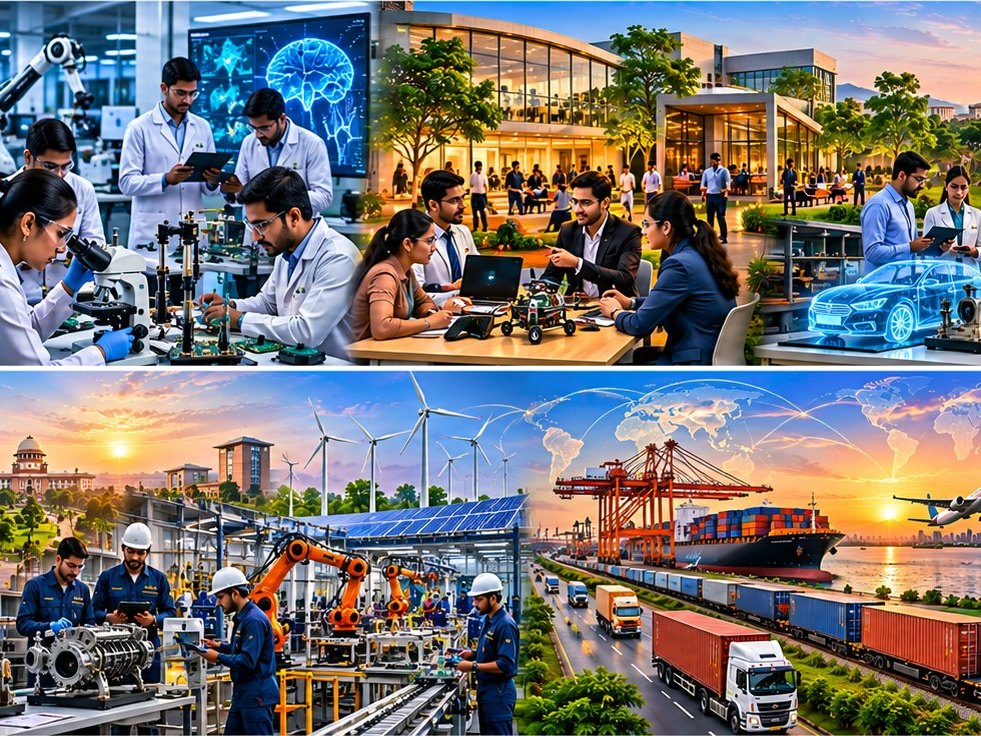
Deep tech refers to enterprises built on substantial scientific or engineering advances rather than on business model innovation alone: semiconductors and electronics, quantum technologies, artificial intelligence and advanced computing, space technology, robotics and drones, advanced materials, biotechnology, clean energy and climate technology, and defence technologies. Such ventures take longer to mature, need more capital before revenue, and depend heavily on laboratories, testing facilities and specialised talent. The sector covered under this tab is not any one technology but the support system that allows deep tech start-ups to be born, survive and scale.
That support system includes incubators and research parks, proof-of-concept and translational grants, seed, venture and patient capital, shared infrastructure such as fabrication, testing and pilot facilities, intellectual property and technology transfer offices, mentorship, regulatory guidance, public procurement as an early customer, and pathways to global markets. It is the strength and connectedness of this whole system, and not the count of start-ups registered, that determines whether Bharat's research base converts into sovereign technology capability.
Why This Sector Is Critical
In the technologies that will define security and prosperity in the coming decades, capability increasingly originates in small, research-intensive firms before it is absorbed by large industry or the state. Nations that nurture such firms gain an early position in critical technologies; nations that do not must later import them, often under conditions of denial or dependence. Deep tech start-ups also provide agility that large institutions lack, as recent developments in drones, satellite services and artificial intelligence have shown, and they are often the fastest route from a laboratory result to a deployed capability for defence, infrastructure or public services.
The vulnerabilities of the sector are well known. Long gestation periods meet short-term capital; prototypes fail to cross the valley between demonstration and qualified product; access to expensive testing and fabrication facilities is limited; and promising firms are acquired by foreign entities or relocate abroad in search of capital and customers, taking intellectual property and talent with them. If the support system fails, Bharat's investment in research yields papers and patents but not products, and its strategic sectors remain reliant on technologies developed elsewhere.
The Bharat Context
Bharat has built one of the world's largest start-up ecosystems, and deep tech now forms a growing part of it, in space, drones, semiconductor design, artificial intelligence, clean energy and biotechnology. Yet most venture funding has historically flowed to consumer internet and services models with faster returns. Deep tech founders frequently report difficulty in raising growth capital, accessing specialised infrastructure, obtaining certification and winning the first significant order from government or large industry. Technology transfer from public research institutions remains slow and uneven.
The enabling architecture has expanded considerably. Startup India, the Startup India Seed Fund Scheme, the Fund of Funds for Startups managed by SIDBI and the Credit Guarantee Scheme for Startups address finance; the Atal Innovation Mission, DST's NIDHI programme, BIRAC's bio-incubators and the MeitY Startup Hub address incubation; the Anusandhan National Research Foundation strengthens research funding. Sector missions such as the National Quantum Mission, the IndiaAI Mission and the India Semiconductor Mission, along with iDEX in defence and IN-SPACe in the space sector, connect start-ups to strategic demand. What remains missing is an integrated, evidence-based understanding of where deep tech ventures fail and which interventions work; and this is the research-to-resilience gap that BAP-I seeks to address through this tab.
Importance of the Sector
Economy
Deep tech ventures produce high-value intellectual property, exportable products and the technological base on which future industries are built. Their economic importance lies in their spillovers: they raise the technological capability of suppliers and customers, attract specialised investment, create new markets for domestic manufacturing and reduce the import of high-technology goods and services. A deep tech firm that succeeds in a strategic niche can anchor an entire supply chain. It is argued that patient public and private capital in deep tech should be judged not only by financial returns but by the sovereign capability and industrial depth it creates.
Employment
Deep tech enterprises create relatively few jobs individually in their early years, but those jobs are among the most skill-intensive in the economy: researchers, engineers, data scientists, designers, test and certification specialists and technology managers. As firms scale into manufacturing and services, they generate wider employment in production, field deployment and support. Equally important, deep tech start-ups offer Bharat's doctoral graduates and engineers a reason to build careers at home rather than abroad. The sector therefore serves as a retention mechanism for national talent as much as an employment generator.
Entrepreneurship
Entrepreneurship is the core of this tab. The research questions here concern how a scientist or engineer becomes a founder, how a laboratory result becomes a company, and how a company moves from grant support to commercial revenue. Key enablers include clear institutional policies on faculty entrepreneurship and equity, fair and fast technology licensing, shared access to fabrication and testing, structured procurement routes for innovative products, and a deeper pool of domestic growth capital. The design of these enablers will determine whether Bharat's next generation of strategic technology firms remains Indian in ownership and location.
Partnership
Deep tech success depends on partnership between research institutions and founders, between start-ups and large companies acting as customers and integrators, between government departments as funders and buyers, and between domestic and trusted international investors. Public sector undertakings and strategic agencies can serve as anchor customers, while industry associations and incubators connect firms to markets. International collaboration can open markets and expertise, but ownership, data and intellectual property safeguards must be considered for firms working in sensitive technologies. BAP-I positions itself as a convening platform for these stakeholders around shared research questions.
Research Focus Possibilities
BAP-I invites original research articles, policy papers, technical reports, diagnostic assessments, case studies and white papers across the following indicative research streams. The list is open-ended; contributions that connect a new question to the resilience objective of this tab are equally welcome.
A. Capital and the Valley of Death
- Analysis of funding gaps across the deep tech lifecycle, from proof-of-concept to growth stage, and the role of public funds of funds
- Design of patient capital instruments, blended finance and credit guarantees suited to long-gestation ventures
- Foreign acquisition and relocation of strategic start-ups: risks and policy responses
B. Infrastructure, Translation and Intellectual Property
- Access to shared fabrication, testing, certification and pilot facilities for start-ups in hardware-intensive fields
- Technology transfer from national laboratories and universities: licensing models, timelines and bottlenecks
- Faculty entrepreneurship policies and their effect on spin-off formation
- Intellectual property strategy and protection for deep tech ventures
C. Demand, Procurement and Strategic Linkage
- Effectiveness of innovation procurement routes for start-ups in defence, space, health and infrastructure
- Outcomes of mission-linked start-up programmes in quantum, artificial intelligence, semiconductors and space
- Pathways from successful prototype to sustained public and industrial orders
D. Ecosystem, Talent and Regional Spread
- Mapping deep tech clusters across Bharat and the conditions for emerging ecosystems beyond major metropolitan centres
- Performance assessment of incubators and research parks attached to academic institutions
- Talent retention of researchers and engineers in domestic deep tech ventures
- Women and first-generation founders in deep tech: barriers and enabling measures
Who Can Participate
This tab invites participation from deep tech founders and start-up teams, incubators, research parks and Atal Incubation Centres, IITs, IISc, IISERs, NITs and CSIR laboratories, DST, DBT, BIRAC, MeitY and other funding agencies, SIDBI and venture and angel investors, defence, space and health agencies acting as customers, large industry and public sector undertakings, technology transfer offices, intellectual property professionals, industry associations, policy think tanks and individual researchers with domain expertise. Contributions from practitioners, policymakers and academics carry equal standing within the BAP-I research framework.
The Resilience Objective
Every contribution under this tab must serve one purpose: strengthening Bharat's capacity to turn its scientific research into sovereign, scalable and globally competitive deep tech enterprises. BAP-I treats research as the instrument through which the gaps in the support system are identified, measured and closed, so that strategic technologies are created and owned within the nation.