Search

Banner critical infra 2026

B.A.P-I JOURNAL OF
Critical Infrastructure Innovation & Manufacturing

The B.A.P-I Journal of Critical Infrastructure Innovation & Manufacturing (JCIIM) is a peer-reviewed, interdisciplinary journal of the Bharat Assets Protection Institute™ (B.A.P-I), published by Bharat Assets Publication. It advances research on protecting, modernising and innovating the critical infrastructure on which national life depends, and on building the indigenous manufacturing and technology base that keeps it running.

JCIIM connects infrastructure protection with industrial capability. Energy grids, transport, telecommunications, health, finance, space, nuclear and urban systems are only as secure as the components, materials, software and skills behind them. The journal therefore brings engineers, manufacturers, technologists, economists, regulators and researchers together to study critical infrastructure and strategic manufacturing as one national system, measured against global best practice and built for Atmanirbhar Bharat.

Key focus areas include:

  • Critical infrastructure protection, interdependency and cascading failure modelling
  • Critical and strategic manufacturing, industrial clusters and MSME capability
  • Indigenisation, defence-industrial production and technology sovereignty
  • Semiconductors, advanced sensors, critical minerals and electric mobility
  • Digital infrastructure, AI, automation, robotics and cyber-physical systems
  • Standards, testing and certification for infrastructure resilience
  • Climate-resilient and sustainable infrastructure design and life-cycle planning
  • Energy transition, net-zero pathways and green hydrogen
  • Deep-tech commercialisation, start-ups and intellectual property
  • Measuring resilience, including the Bharat National Resilience Index (BNRI)

JCIIM welcomes original research articles, technical briefs, case studies and policy analyses, and is committed to research that supports evidence-based decisions in infrastructure and manufacturing resilience.

B.A.P-I Journal of Critical Infrastructure Innovation & Manufacturing
JCIIM is the B.A.P-I journal for critical infrastructure, strategic manufacturing and technology sovereignty. It publishes peer-reviewed work that links the protection of national lifelines with the industrial, digital and innovation capacity needed to build, run and renew them.Aims and scopeThe ...

JCIIM is the B.A.P-I journal for critical infrastructure, strategic manufacturing and technology sovereignty. It publishes peer-reviewed work that links the protection of national lifelines with the industrial, digital and innovation capacity needed to build, run and renew them.

Aims and scope

The journal examines how critical sectors are designed, operated, protected and modernised, and how Bharat can manufacture, at scale and to world standards, the systems and components they depend on. It covers the full chain from research and design through production, testing, certification and deployment to operation and renewal, and gives equal weight to engineering, economics, policy and governance.

Research Focus clusters covered

  • Critical Sectors Specifics: aerospace, banking and finance, chemicals, critical manufacturing, digital infrastructure, energy, food and agriculture, health care, mining and strategic minerals, nuclear, petrochemicals, transport, space, urban infrastructure and smart cities, telecommunications and satcom, education and government facilities.
  • Indigenisation & Technology Sovereignty Specifics: defence technology and indigenisation, technology transfer, railways, renewable energy, quantum computing, semiconductors, sensors and MEMS, biotechnology, defence-industrial corridors, deep-tech start-ups, electric mobility and critical minerals processing.
  • Research to Resilience Specifics: sustainable and climate-resilient infrastructure, disruptive technology research, waste-to-energy, bio-security, standards, testing and certification, climate adaptation research and the energy transition.
  • Digital Revolution & Critical Automation Specifics: IT and communication, AI, automation and robotics, drones, quantum communication, geospatial infrastructure and digital health infrastructure.
  • Commercial-Industrial Complex Specifics: agro-tech, automotives, electronics, pharmaceuticals, textiles, polymers, construction, food processing, MSMEs, rural industrialisation, green industrial zones and the circular economy.
  • Business Innovation & Products Commercialisation Specifics: business innovation, IT-BPM, start-up and incubation ecosystems, deep-tech commercialisation and the intellectual property ecosystem.

Four lenses on every question

  • Theoretical: infrastructure resilience theory, systems of systems, interdependency and risk, and the economics of industrial capability.
  • Applied: engineering, materials, digital and process research that improves the safety, reliability and performance of infrastructure and manufacturing.
  • Practical: plant-level, utility-level and programme-level experience that operators, manufacturers and regulators can put to work.
  • Futuristic: Industry 5.0, autonomous and self-healing infrastructure, quantum and semiconductor futures, and the industrial base Bharat will need by 2047.

What the journal publishes

  • Original research articles
  • Review and state-of-the-art articles
  • Policy analyses and policy briefs
  • Technical notes, frameworks and standards papers
  • Case studies from government, industry and the field
  • Industry perspectives and practitioner insights
  • Commentaries, book reviews and conference outputs

Who the journal serves

Infrastructure owners and operators, manufacturers and MSMEs, technology developers and start-ups, standards and certification bodies, regulators and ministries, investors, researchers and students of engineering, management and public policy, and international partners in resilient infrastructure.

Editorial standards

Every manuscript submitted to JCIIM is screened by the editorial desk and assessed through double-blind peer review by its Editorial Board and Peer Review Panel. The journal follows the publication ethics, originality, disclosure and citation norms of Bharat Assets Publication. Articles are published online under the B.A.P-I imprint, with full citation details for scholarly and professional reference.

Submit to the journal

Researchers, academics, industry professionals, policy practitioners and doctoral scholars in India and abroad are invited to submit. Read the guidance on Write With Us, or write to the editorial desk at info@bharatassetsprotection.org or bharatassetsprotection@gmail.com. Experts interested in reviewing or serving on the board can join the editorial team.

Read More
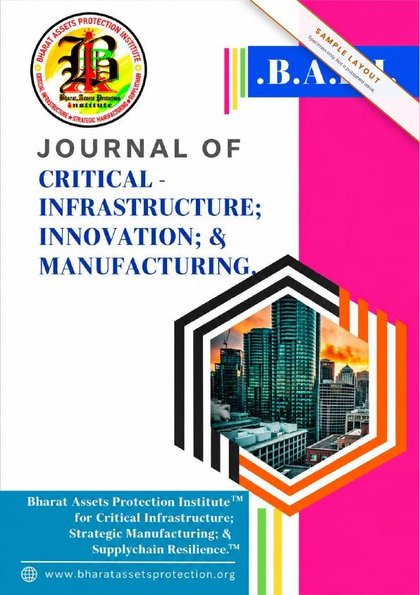
Jnl journal of critical infrastructure innovation manufacturing cover

Sample layout

See how an issue of this journal is set out

A specimen with the cover, publication details, structure and page layout, with guidance for authors in each section. It is a template only and does not report research.

Journal Focus Map

What this journal publishes

Sectors may intersect, but lenses may not. Every manuscript is routed by the question it asks, not by the sector it mentions.

The question this journal asksHow is this designed, built, made, standardised and improved in Bharat?

Lens

Build, make, engineer and innovate: assets, plants, technology, production, standards, R&D, indigenisation

Typical article types

Original engineering and technology research, standards and frameworks papers, indigenisation case studies, industrial policy analyses, technical notes

Primary readers

Infrastructure owners and operators, manufacturers and MSMEs, technology developers, standards bodies, industrial ministries

The B.A.P-I Journal of Critical Infrastructure Innovation & Manufacturing (JCIIM) holds the build, make, engineer and innovate lens. Its governing question is how an asset, a plant, a product, a component or a technology is designed, built, manufactured, tested, standardised and improved, and how Bharat can do each of these at scale, to world standards and under its own control. Where the security journal asks what may go wrong, and the logistics journal asks how things move, JCIIM asks how things are made and made better.

The journal therefore owns the engineering and industrial core of the Institute's research. It covers the critical sectors as engineered systems: energy grids, transport assets, telecommunications, health facilities, space and nuclear infrastructure, digital infrastructure and urban systems. It covers strategic manufacturing as national capability: the defence-industrial base, electronics and semiconductors, sensors and components, automotives and electric mobility, textiles, food processing and the MSME base that supplies them all. It covers technology sovereignty as a research and production problem: indigenisation, technology transfer, absorption capacity, intellectual property and deep-tech commercialisation. Standards, testing and certification sit here because they are the grammar of building well.

JCIIM gives equal weight to engineering, industrial economics, innovation policy and institutional design. It reads programmes such as Make in India, the PLI schemes, the India Semiconductor Mission, iDEX and the Anusandhan National Research Foundation against the plant-level and laboratory-level reality, and asks what it will take for the industrial base of Viksit Bharat 2047 to be built on Indian design, Indian materials and Indian standards.

Topics under the six focus areas

  • Design for resilience: engineering methods that build redundancy, graceful degradation and recoverability into energy, transport and telecom assets.
  • Interdependency and systems-of-systems modelling for critical sectors, as an engineering input to design and investment.
  • Climate-resilient and sustainable infrastructure design, life-cycle planning and whole-life costing.
  • Modernisation and renewal of ageing grids, rail assets, water works and urban networks.
  • Engineering of space, nuclear and satcom infrastructure as long-life national assets.
  • Digital twins, condition monitoring and predictive maintenance for critical assets.
  • Infrastructure standards, testing and certification regimes, and their calibration to Indian conditions.
  • Health care infrastructure design, from district hospitals to critical care and diagnostic capacity.
  • Energy transition infrastructure: renewable integration, storage, green hydrogen facilities and grid modernisation.
  • The defence-industrial base: capacity, depth, defence corridors and the national military-defence industrial complex.
  • Critical manufacturing capability mapping, and the identification of single points of industrial failure.
  • Industrial clusters, MSME capability and the supplier tiers behind strategic products.
  • Electronics, electricals and automotive manufacturing as pillars of an export-capable industrial base.
  • Railways and rolling stock manufacturing, signalling and track systems.
  • Textiles, apparel, handlooms and rural industrialisation as manufacturing for employment and value.
  • Food processing and agro-tech manufacturing, from machinery to processing technology.
  • Construction technology, prefabrication and the industrialisation of infrastructure delivery.
  • Green industrial zones, zero emission manufacturing and the circular economy in production.
  • Design for supply: product and plant design choices that reduce dependence on single-source components.
  • Indigenisation roadmaps for critical components, spares and sub-assemblies.
  • Supplier development, vendor qualification and the deepening of domestic tiers.
  • Production-linked incentives and their effect on domestic value addition.
  • Manufacturing capacity reserves and surge production for national emergencies.
  • Electric mobility and battery manufacturing value chains seen from the production side.
  • Make in India and the build-out of component ecosystems around anchor manufacturers.
  • Quality infrastructure as a precondition for integrating Indian manufacturers into global supply.
  • Semiconductor manufacturing, design, packaging and the India Semiconductor Mission.
  • Advanced sensors, MEMS and the indigenous component ecosystem.
  • Quantum computing and quantum communication research and its path to applications.
  • AI, automation and robotics in industrial and infrastructure settings.
  • Unmanned aerial systems and drone manufacturing as a strategic technology base.
  • Technology transfer, socialisation and absorption capacity in public and private enterprise.
  • Deep-tech start-ups, incubation, accelerators and the commercialisation of laboratory research.
  • Intellectual property creation, patent quality and innovation incentives.
  • Digital public infrastructure and IT systems as engineered national platforms.
  • Geospatial and remote sensing infrastructure as an engineering and data asset.
  • Defence technology and indigenisation: platforms, subsystems and the reduction of import dependence.
  • Engineering for security: hardening, physical protection and secure-by-design infrastructure.
  • Trusted electronics and trusted hardware in critical networks.
  • Testing and evaluation infrastructure for defence and dual-use technologies.
  • Aerospace and airpower industrial ecosystems as a national security capability.
  • Secure design of digital and telecom infrastructure from the engineering side.
  • Disruptive technology research and its implications for future capability.
  • Manufacturing readiness for sustained operations and wartime production.
  • Strategic manufacturing partnerships, co-development and co-production with trusted partners.
  • International standards bodies and Bharat's role in shaping technical standards.
  • Technology partnerships in critical and emerging technologies.
  • Export of Indian infrastructure engineering, digital platforms and manufactured goods.
  • Joint research and development programmes and their governance.
  • Recognition of Indian testing and certification in partner markets.
  • Collective resilience through shared engineering standards for disaster-resilient infrastructure.
  • Indian manufacturing as a trusted alternative source for partner economies.

Sectors this journal leads

Calls for papers and reviewer panels for these sectors sit with this journal. Highlighted sectors are the ones it draws on most.

Aerospace, Airpower & Aero-Industrial EcosystemsCritical ManufacturingDigital InfrastructureEnergyHealth Care & Emergency Health Management SystemsMining, Minerals & Strategic Raw MaterialsNuclearSpace Infrastructure & ApplicationsUrban Infrastructure & Smart CitiesTelecommunications & Satcom NetworksEducation & Skill InfrastructureSustainable Infrastructure Design & Life-Cycle PlanningClimate-Resilient InfrastructureDisruptive Technology ResearchWaste-to-Energy Models & Material Recycling TechnologyCritical Infrastructure Standards, Testing & CertificationEnergy Transition, Net-Zero Pathways & Green Hydrogen MissionDefence Technology & IndigenisationTechnology Transfer, Socialisation & Absorption CapacityRailwaysRenewable EnergyQuantum Computing & ApplicationsSemiconductor ManufacturingAdvanced Sensors, MEMS & Indigenous Component EcosystemBiotechnology & Bio-Pharma InnovationNational Military-Defence Industrial Complex & CorridorsDeep Tech & Start-up Support SystemsElectric Mobility & Advanced Energy Storage SystemsBusiness Innovation ResearchIT & Business Process ManagementEdTech, Creative Industries & Content Innovation EcosystemStart-Up India Ecosystem & Support ArchitectureBusiness Incubation & Accelerator HubsDeep-Tech Commercialisation EcosystemIntellectual Property Ecosystem & Innovation IncentivesStrategic Manufacturing Partnerships & Co-productionIT & CommunicationAI, Automation & RoboticsUAS & Drone DynamicsQuantum Communication NetworksNational Digital Health Mission InfrastructureGeospatial & Remote Sensing InfrastructureDigital Public InfrastructureAgro-Tech and AgribusinessAutomotives & AutomobilesWaste Recycling & Management SystemsElectronics and ElectricalsFood Technology & Food ProcessingHandicrafts & HandloomsInfra & ConstructionMedia & MarketingTextiles & ApparelMSME Support Systems & Development EcosystemRural Industrialisation & Craft InfrastructureGreen Industrial Zones & Zero Emission Infrastructure

Sectors where it carries companion papers

These sectors are led by another journal; this journal takes manuscripts on them that answer its own question.

Banking, Commerce & Financial ServicesChemical & Allied IndustriesFood & AgriculturePetrochemicalsTransportWater Resources & River InfrastructureGovernment Facilities, Legal & Administrative ServicesEmergency Services & First Responder SystemsMulti-Modal Transport CorridorsSupply Chain Traceability & Blockchain ApplicationsLast-Mile Connectivity & Urban Freight SystemsAerial Logistics SystemsNational Logistics Portal & Gati Shakti IntegrationDeep-Water Infrastructure & Ocean-Energy DynamicsShip Life Cycle ManagementEnergy Supply Chain & NetworksWater Infrastructure & LinkagesWater Innovation & TechnologyPM Gati Shakti-Integrated Planning & CoordinationExport & Import EcosystemsRural Entrepreneurship & Value Chain LinkagesLegal & Conformance ManagementTRIPS Compliance & Trade-Related IP GovernanceCorporate Governance Codes & Social Security LinkagesCSR Implementation, Impact Assessment & End-User PlanningDigital Social Security System & PlatformsMSME Financial Governance FrameworkStrategic Investment & Investment DiversificationMultilateral Frameworks & Standards AlignmentGlobal Value Chain Integration StrategiesDiaspora Engagement & Overseas Indian NetworksCyberspace Infrastructure & Digital SovereigntyBlockchain in Public Infrastructure & Supply ChainAI Safety, Ethics & Governance FrameworksClimate Adaptation Technologies & SystemsRural & Tribal Resilience InfrastructureGlacial Lake Outburst & Mountain Ecosystem Risk ManagementInternal Security Technologies & ApplicationsPrivate Security Players & Security Service SolutionsNational Critical Infrastructure Protection SystemsSecure Communication & Surveillance SystemsCybersecurity Infrastructure & Forensic AnalyticsFMCGPharmaceuticals, APIs & Key Starting MaterialsPolymers, Fibres & PlasticsRail Freight, Metro Systems & Allied TransportRetail & E-CommerceCivilisational Heritage & Sanātan Assets ProtectionFertiliser & Agri-Input Security

Not sure which journal fits your manuscript?

  1. The specific domain prevails over the general function. Port security goes to the Bluewater journal, not to the general security journal.
  2. Where no specific domain applies, the dominant verb decides: build and make go to Infrastructure & Manufacturing, move and source to Logistics & Supplychain, protect and govern to Internal Security & Resilience.
  3. Where the verb is balanced, the journal whose primary readers will act on the findings takes the paper.
  4. A paper declined on scope is offered to the companion journal named for its sector before it is returned to the author.

See the full Journal Focus Map for all journals side by side.

Issues

Issues of this journal

New issues are added here as they are published.

B.A.P-I Journal of Critical Infrastructure Innovation & Manufacturing, Vol. 01, Issue 01UPCOMING
Vol. 01, Issue 01 B.A.P-I Journal of Critical Infrastructure Innovation & Manufacturing Upcoming issue