

Education & Skill Infrastructure
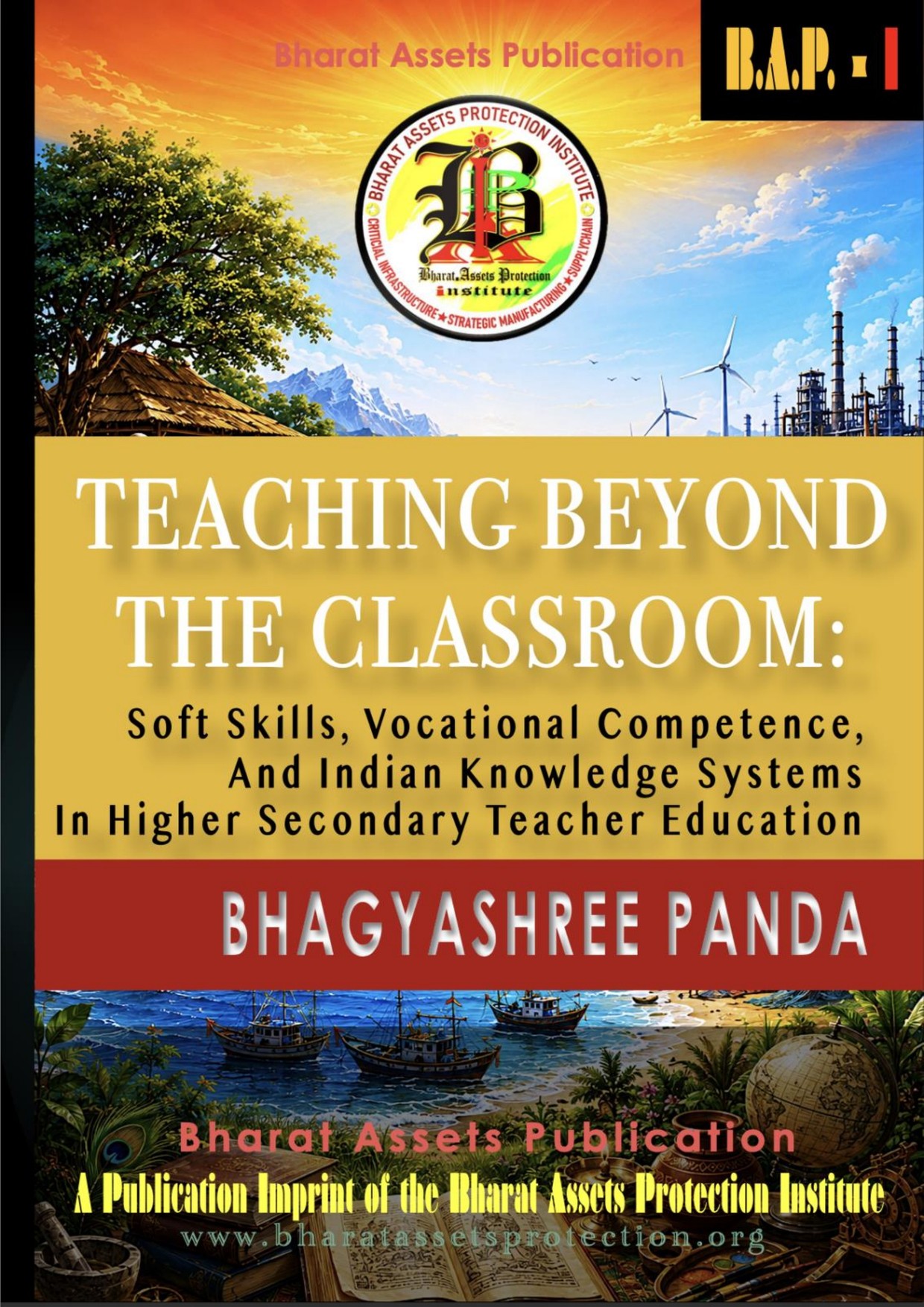
India now expects its higher secondary teachers to deliver vocational learning, draw on Indian Knowledge Systems and teach confidently alongside artificial intelligence, yet teacher education was not designed for any of these demands. This review examines Teaching Beyond the Classroom: Soft Skills, Vocational Competence, and Indian Knowledge Systems in Higher Secondary Teacher Education by Bhagyashree Panda, published by Bharat Assets Publication in 2026. It outlines the book's four-step blended model, built from Bandura's social learning and social cognitive theories, the TPACK framework, the National Curriculum Frameworks and Indian Knowledge Systems, and its nine-cluster map of soft skills, including the new cluster of Vocational Facilitation Skills. It summarises the book's analysis of B.Ed. and M.Ed. curricula and its practitioner's framework for reform, weighs its strengths and limitations, and explains why the book matters to the Bharat Assets Protection Institute™'s work on skilled human capital, strategic manufacturing and national resilience.
Focus areas
Keywords
- Book review
- teacher education
- soft skills
- vocational education
- Indian Knowledge Systems
- NEP 2020
- TPACK
- Bandura
- higher secondary education
- Bhagyashree Panda
- Bharat Assets Publication
Book Review
Preparing the Teachers India Now Needs: A Review of Teaching Beyond the Classroom by Bhagyashree Panda
by Bharat Assets Protection Institute™
1. Introduction
Every reform India announces for its schools eventually lands on one person: the teacher. NEP 2020 asks that teacher to bring vocational learning into the mainstream, to draw on India's own knowledge traditions, and to teach confidently in classrooms where artificial intelligence is already present. Very few teacher education programmes were built to prepare anyone for all three at once. Teaching Beyond the Classroom by Bhagyashree Panda starts from that uncomfortable gap and asks a plain question: are we training teachers for the work we now expect of them?
2. About the Book
The book is subtitled Soft Skills, Vocational Competence, and Indian Knowledge Systems in Higher Secondary Teacher Education. It was published in 2026 as a first online edition by Bharat Assets Publication (ISBN 978-81-904062-0-8). It grew out of the author's M.A. Education dissertation at IGNOU and has been substantially revised and expanded into an academic monograph of eight chapters, four appendices and full subject and author indexes. The author is open about its method: the research is secondary, built on policy documents, curriculum frameworks, institutional syllabi and published studies rather than on fieldwork.
3. The Argument and Its Architecture
The book's theoretical core is a four-step "blended model". It brings together Bandura's Social Learning Theory and Social Cognitive Theory, the TPACK framework of Mishra and Koehler, India's National Curriculum Frameworks, and Indian Knowledge Systems. The steps move from what each source contributes on its own, to paired blends, to integration with TPACK, and finally to a single instrument for both analysis and design. It is an ambitious piece of construction, and the author takes care to explain why each step is needed.
Out of this comes the book's working tool: nine clusters of soft skills. Eight are familiar, from critical thinking and communication to emotional intelligence and self-development. The ninth, Vocational Facilitation Skills, is the book's own contribution. It describes the ability to guide students into vocational pathways through industry interface, apprenticeship mentoring, NSQF-aligned assessment, skill lab management and links with community enterprise. The point is simple and hard to dispute: vocationalisation cannot succeed if the teachers asked to deliver it have never been taught how.
4. What the Curriculum Evidence Shows
Chapter 6 tests B.Ed. and M.Ed. curricula against the nine clusters across five dimensions: curriculum, pedagogy, classroom environment, practicum and outcomes. The findings are clear. Communication and critical thinking are developed fairly consistently. Collaboration gets moderate attention. Creativity, emotional intelligence, adaptability and self-development are left largely to chance, treated as qualities a student-teacher either has or lacks. Vocational facilitation skills are almost entirely absent. And Indian Knowledge Systems appear as content to be studied rather than as ways of teaching. Perhaps the sharpest observation is that courses which list soft skills as outcomes but teach them by lecture and test them by written examination produce knowledge about soft skills, not the skills themselves.
5. The Practitioner's Framework
Chapter 7 turns diagnosis into proposal. Its four principles are dual-track integration of academic and vocational skills, Indian Knowledge Systems as pedagogical method, alignment between Bandura and TPACK as a design guide, and reform across all five dimensions at once. The idea of IKS as method deserves attention. The guru-shishya tradition of sustained mentoring, the artisan-apprentice tradition of learning through production, and the Jnan-Vignan-Jeevan Darshan integration of knowledge, application and ethics are presented not as heritage to admire but as practical models for running a teacher education programme. The appendices on course mapping, sample rubrics and an IKS glossary make the framework easier to put to work.
6. Strengths
The book does three things well. It names a real and largely unexamined gap, the missing vocational layer in teacher education, and gives it a precise definition. It treats Indian Knowledge Systems seriously without romanticising them, placing them in dialogue with established learning theory instead of in competition with it. And it writes for people who make decisions: curriculum committees, institutional heads, accrediting bodies and policymakers will find recommendations they can act on.
7. Limitations
The book's main limitation is one the author states herself. The practitioner's framework is a proposal, not a tested intervention, and its value now depends on the field studies outlined in Chapter 8. Readers will also notice that the theoretical scaffolding is dense in places, a trace of the book's dissertation origins, and that some of the curriculum analysis would gain force from classroom observation and interviews with teacher educators. None of this weakens the argument; it marks where the next stage of work should begin.
8. Why It Matters to B.A.P-I
At first sight, a book on teacher education may seem far from an institute that works on critical infrastructure, strategic manufacturing and supply chain resilience. It is not. The institute's own work treats skilled people as part of the nation's critical assets. Factories, logistics corridors and digital networks run on technicians, operators and supervisors, and those people are shaped long before they reach a workplace, in higher secondary classrooms where vocational pathways are opened or closed. A teacher who cannot connect a classroom to an industry floor quietly narrows the talent pipeline that strategic manufacturing depends on.
The book's insistence on Indian Knowledge Systems as a working pedagogy also fits the institute's view of self-reliance as something deeper than production capacity. Confidence in one's own intellectual traditions, applied with rigour, is part of what makes a knowledge system resilient. In that sense, Teaching Beyond the Classroom speaks to the foundations on which every other form of national resilience is built.
9. Verdict
Teaching Beyond the Classroom is a careful, well-structured and timely study. It identifies a real weakness in how India prepares its teachers, offers a coherent theory to explain it, and proposes a framework practical enough to test. Its proposals now need evidence from real classrooms, and the book says so honestly. For teacher educators, policymakers and anyone concerned with India's skills future, it is worth reading and worth building on.
Disclosure: This book is published by Bharat Assets Publication, the publishing imprint of the Bharat Assets Protection Institute™, and the author acknowledges the contribution of Dr. Padmalochan Dash, Director of the Institute, to its development. This review is published by the Bharat Assets Publication Editorial Desk.
References 4 sources
- Panda, B. (2026). Teaching beyond the classroom: Soft skills, vocational competence, and Indian Knowledge Systems in higher secondary teacher education (1st ed., online). Bharat Assets Publication. ISBN 978-81-904062-0-8. Retrieved from https://bharatassetsprotection.org/test/bharatassetsprotection/Book/Teaching-Beyond-the-Classroom
- Ministry of Human Resource Development, Government of India. (2020). National Education Policy 2020. Retrieved from https://www.education.gov.in/sites/upload_files/mhrd/files/NEP_Final_English_0.pdf
- Bandura, A. (1977). Social learning theory. Englewood Cliffs, NJ: Prentice Hall.
- Mishra, P., & Koehler, M. J. (2006). Technological pedagogical content knowledge: A framework for teacher knowledge. Teachers College Record, 108(6), 1017-1054.
How to cite this article
Bharat Assets Protection Institute™ (2026). Preparing the Teachers India Now Needs: A Review of Teaching Beyond the Classroom by Bhagyashree Panda. Bharat Assets Online, Bharat Assets Protection Institute™. B.API-BOI-2026-10-WB-BR-O-00013-6. https://bharatassetsprotection.org/test/bharatassetsprotection/Article/Book-Review-Teaching-Beyond-the-Classroom
© 2026 Bharat Assets Protection Institute™ (B.A.P-I). All rights reserved.
Reviewed by

Bharat Assets Protection Institute™
Editorial Desk
About the author of the book

Bhagyashree Panda
Educator and Researcher