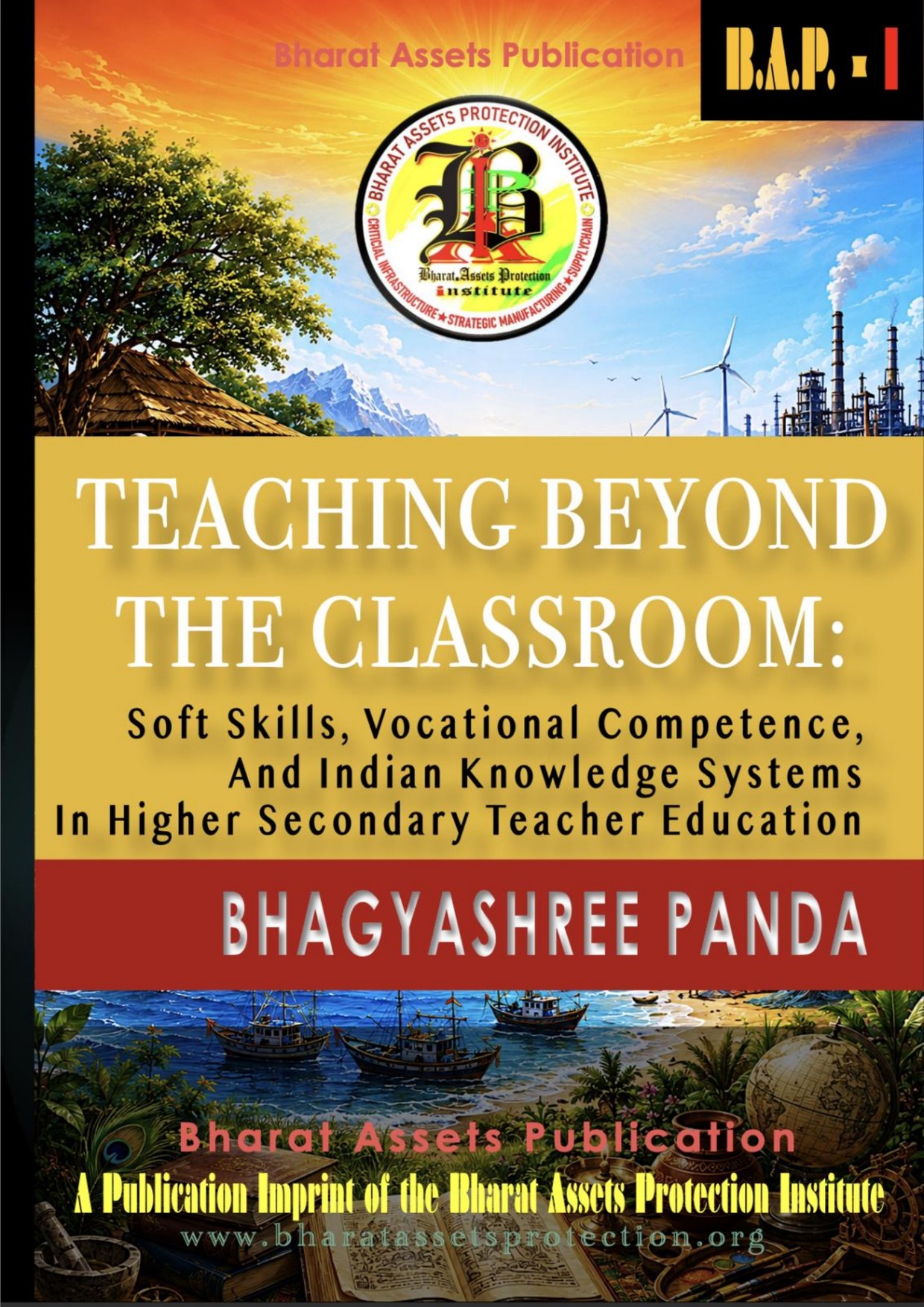
India's higher secondary teacher stands at the meeting point of three pressures. Artificial intelligence is changing what happens in the classroom, the National Education Policy 2020 asks schools to bring vocational education into the mainstream, and there is a renewed call to draw on India's own knowledge traditions in teaching. Each of these pressures asks something new of the teacher, and Bhagyashree Panda's Teaching Beyond the Classroom asks a plain and important question: has teacher education prepared teachers for any of them? Her answer, built carefully over eight chapters, is that it has not, at least not deliberately, and that the missing piece is a set of competencies the field usually calls soft skills.
The book's opening chapter frames the problem well. When an AI system can deliver content more efficiently than a lecture, the teacher's role moves from information transmitter to learning facilitator, from evaluator to guide. At the same time, teachers are expected to prepare students for higher education and for the world of work, in a system where no policy document yet requires teacher education to prepare graduates for vocational facilitation.
Panda calls this a structural policy-practice gap. The national documents, from NEP 2020 to ITEP 2021 and the National Curriculum Frameworks, describe an ambitious vision, but delivery across roughly 17,000 recognised teacher education institutions remains uneven.
What gives the book its distinct character is the way it treats Indian Knowledge Systems. IKS is not presented as a cultural ornament. The guru-shishya and artisan-apprentice traditions are read as a historical precedent for exactly the integration that present policy seeks: a form of learning in which knowledge, skill and character were never separated. The author argues that the academic-vocational divide in Indian education is a relatively recent inheritance, and that the country's own pedagogical heritage offers resources for repairing it. This is a measured argument, and it is made with references to specific traditions rather than general appeals.
The theoretical core of the book is a four-step blended model that brings together Bandura's Social Learning Theory and Social Cognitive Theory with the TPACK framework of Mishra and Koehler, enriched by the National Curriculum Frameworks and IKS principles. The logic is clear. Bandura explains how soft skills are acquired, through observation, modelling, practice and reinforcement, and TPACK explains how technology, pedagogy and content must work together in the modern classroom. Used together, they become an instrument for asking not only whether a curriculum mentions soft skills, but whether it develops them in the way skills are actually learned.
Chapter 5 is one of the strongest in the book. It sets out nine soft skill clusters: critical thinking and problem-solving, collaboration, communication, creativity, adaptability, emotional intelligence, cultural competence, self-development, and a ninth cluster the author names Vocational Facilitation Skills. This ninth cluster is the book's most original contribution. It covers industry-interface communication, apprenticeship mentoring, NSQF-aligned assessment, skill lab management and community-enterprise linkage, competencies that the existing literature, which treats soft skills through an academic lens, has largely ignored. Each cluster is examined through academic, vocational and IKS perspectives, and each is linked to specific traditions, such as vasudhaiva kutumbakam for cultural competence and swadhyaya and tapas for self-development.
The empirical chapter examines representative B.Ed. and M.Ed. curricula, including the M.Ed. programme of the Central University of Gujarat and the B.Ed. programme of Gujarat University, across five dimensions: curriculum, pedagogy, classroom environment, practicum and real-world outcomes. The findings are consistent with the author's analytical propositions. Academic soft skills are addressed partially and unevenly, often through methods that do not match how such skills are acquired. Vocational soft skills are largely absent. IKS tends to be taught as content to be studied rather than as a pedagogical method to be used. The five-dimension approach is a real strength, because each dimension reveals something the others would have missed.
The book does not stop at diagnosis. Chapter 7 offers a practitioner's framework built on four principles: dual-track integration, IKS as pedagogical method, Bandura-TPACK alignment, and scalability. Its proposals are concrete. It recommends a three-part practicum combining school-based teaching, a placement in a vocational setting and a community enterprise project; three new courses in Vocational Facilitation, IKS-Based Pedagogy, and AI Literacy and Digital Pedagogy; and multi-modal assessment that combines rubrics with self, peer and mentor evaluation. The appendices, which include a sub-skill inventory, course mapping, sample rubrics and an IKS glossary for teacher education, make the framework usable by institutions and teacher educators.
The author is candid about the limits of the work. The study is a desk-based qualitative analysis of policy documents and curricula, not a field study of classrooms, and the gap between prescribed and enacted curricula is acknowledged. The practitioner's framework is offered as a theoretically grounded proposal awaiting empirical validation, and Chapter 8 sets out a research agenda for that purpose. This honesty strengthens rather than weakens the book, because it makes clear what has been established and what remains to be tested.
Readers will find the book written in a clear and orderly academic style, with chapter summaries that make its argument easy to follow. It will be of value to teacher education policymakers looking for evidence for regulatory reform, to institutional leaders redesigning programmes, to teacher educators searching for methods of soft skills development, and to researchers who need an analytical instrument for studying the field.
Teaching Beyond the Classroom closes on a note that is both sober and hopeful. The gaps it identifies are structural, but the building blocks for change already exist: a policy mandate in NEP 2020, a pedagogical heritage in Indian Knowledge Systems, theoretical foundations in Bandura and TPACK, and now a practitioner's framework that brings them together. It is a timely and useful contribution to the conversation about what Indian teacher education should become.