

Critical Supply Chain Alternatives & Strategies
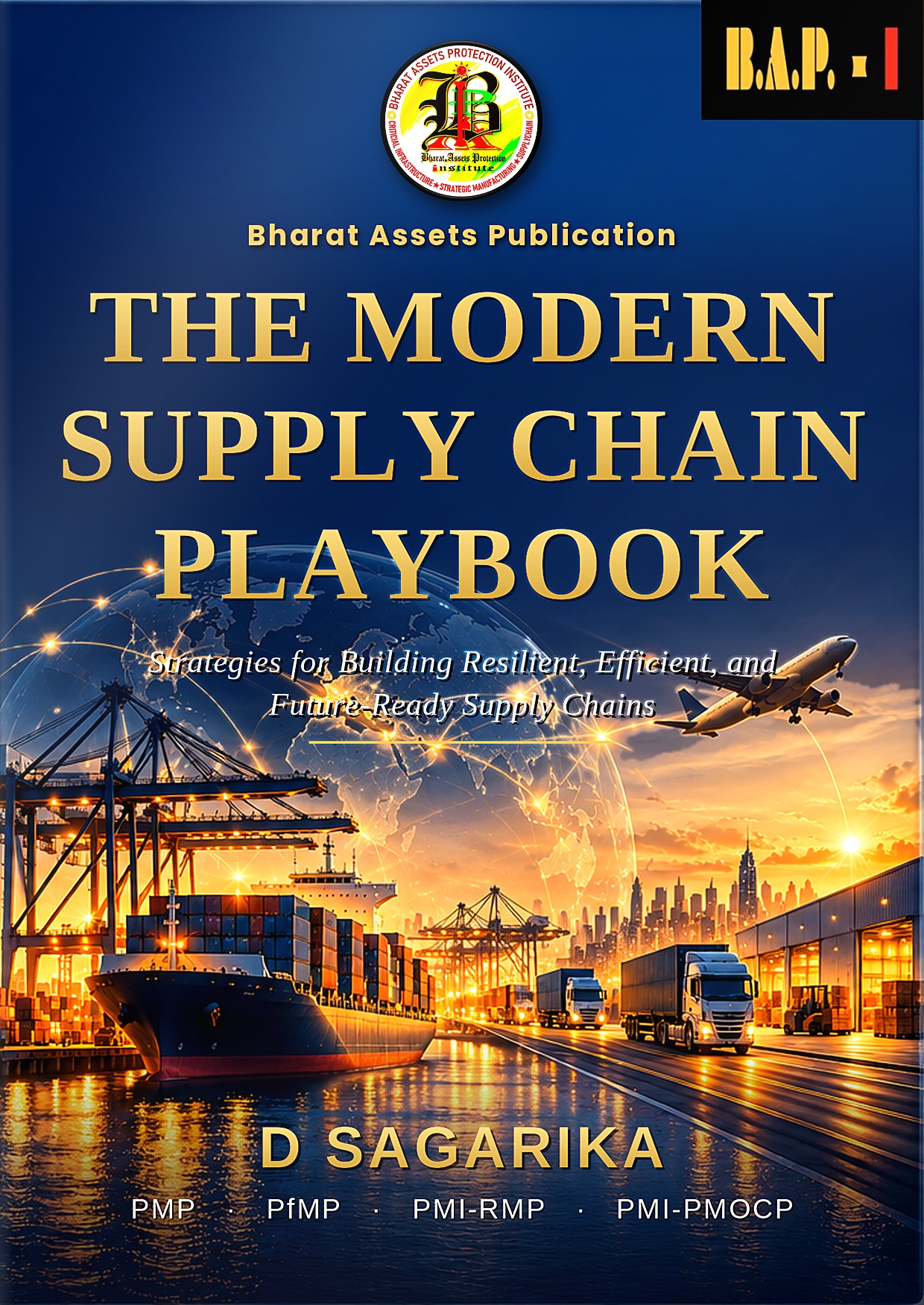
Supply chains built only for efficiency have struggled with the volatility of recent years. This review examines The Modern Supply Chain Playbook: Governance, AI, Human Capability, and Customer-Driven Excellence by D Sagarika, a forthcoming book from Bharat Assets Publication. Drawing on the manuscript overview, chapter plan and research structure, it follows the book's eighteen chapters across five parts: foundations and customer-backwards design; system design, governance and risk; people, capability and organisational maturity; AI, platforms and the capability gap in Indian manufacturing; and the integrating idea of the Supply Chain Flywheel. It identifies the book's strengths as its research base of thirty-six supporting articles, its treatment of governance as design, its serious attention to people and its view of power in platform-led freight markets, sets out what readers will look for in the published text, and considers its relevance to India.
Keywords
- Supply chain governance
- book review
- risk-led design
- KPI systems
- PMO
- AI in supply chains
- human capability
- supply chain flywheel
- Make in India
- D Sagarika
- Bharat Assets Publication
Book Review
Designing Supply Chains as One System: A Review of The Modern Supply Chain Playbook by D Sagarika
by Bharat Assets Protection Institute™
1. Introduction
For a long time, supply chains were judged mainly on cost. The best network was the cheapest one that delivered on time, and the work of supply chain teams was to remove waste from a system that was assumed to be stable. That assumption has not survived the last few years. Pandemic shutdowns, conflict at sea, export controls, cargo theft and sudden swings in demand have shown that a lean network with no room to absorb a shock can fail at the moment it is needed most. At the same time, customers expect more, artificial intelligence is changing how decisions are made, and the people who run supply chains are being asked to carry more load with tools many of them were never trained to use.
The Modern Supply Chain Playbook: Governance, AI, Human Capability, and Customer-Driven Excellence by D Sagarika is written for this changed setting. Its central claim is that strategy, governance, technology, human capability and day-to-day execution have to be designed as one connected system and not managed as separate disciplines. This review is based on the manuscript overview, the chapter plan, the research structure and the reference lists shared with Bharat Assets Publication ahead of release.
2. About the Book and Its Author
The book is arranged in eighteen chapters across five parts, followed by four appendices: a complementary article on launching a supply chain logistics business, diagnostic templates, maturity assessment frameworks, and case examples with an applied model. It will be published in English by Bharat Assets Publication. At the time of writing, the edition details, page extent and ISBN have not been announced.
D Sagarika is a supply chain and program leader with more than twelve years of experience across Amazon, Cummins, Tata Motors and other Fortune 500 companies. She holds a MicroMasters in Supply Chain Management from MITx and a Master's in Industrial Engineering Management from Purdue University, and carries the PMP, PfMP, PMI-RMP and PMI-PMOCP credentials. She is also recognised as a Regional Mentor of Change for the Atal Innovation Mission of NITI Aayog. The mix of operations, program management and risk credentials shows in the book, which spends as much time on how decisions are governed and executed as on what the right decisions are.
3. Structure and Scope
Part I: Foundations of the Modern Supply Chain. The opening three chapters set out the problem and the starting point. The first examines structural volatility and the limits of networks built only for efficiency, tracing the move from efficiency-driven globalisation towards resilient regionalisation. The second argues for designing supply chains from the customer backwards, separating what customers say they need from what they imply and what they actually do. The third treats reliability as the foundation of trust, and trust as something closer to a psychological contract than a service level.
Part II: System Design, Governance, and Risk Management. This is the longest part, with six chapters. It covers risk-led network design and resilience as an operating discipline; key performance indicator (KPI) systems built to support decisions rather than to report history; how often performance should be reviewed and why the rhythm of review shapes accountability; the Project Management Office (PMO) as a driver of transformation; portfolio governance for choosing between competing priorities; the balance between agility and standardisation in operating models; and data-driven prevention of loss and risk, including a frank treatment of cargo theft and its effect on trust between partners.
Part III: People, Capability, and Organizational Maturity. Four chapters turn to the workforce: structured, bar-raising hiring and the definition of critical competencies; measuring workload across job families and redesigning roles around real complexity and skills; the cycle of overextension and burnout, and how AI can reduce cognitive load without lowering the quality of work; and organisational readiness for change, including the cultural and psychological barriers that stop technology from being adopted.
Part IV: Technology, Automation, and Future Operating Models. Three chapters look ahead. The first covers AI-enabled decision systems and where the boundary between machine execution and human oversight should sit. The second studies platform-led freight ecosystems, the changing relationship between brokers, carriers and digital platforms, and the market consolidation that follows. The third addresses India directly, assessing the capability gap between the country's manufacturing ambitions and its present supply chain base, and the pathways for closing it.
Part V: Integration, Maturity and Flywheel Thinking. The closing two chapters bring the argument together in the idea of a Supply Chain Flywheel, in which governance, capability, data, customer experience and continuous improvement reinforce one another, and in a unified operating manual supported by learning loops that let excellence be repeated and scaled.
4. Strengths of the Work
A research base behind every part. Each of the five parts rests on a research paper, and the eighteen chapters are supported by thirty-six articles, two for each chapter. The reference lists run to several hundred sources, drawing on standards bodies such as ISO and ASCM, international organisations such as the OECD, the World Bank and UNCTAD, Indian official sources including PIB, DPIIT and the Ministry of MSME, peer-reviewed journals and established texts in operations and supply chain management. For a book aimed at practitioners, this is an unusually firm foundation.
Governance treated as design. Many supply chain books mention governance in passing. Here it is the core of the argument. The chapters on KPI design, review cadence, PMO-led execution and portfolio governance deal with the quiet failures that most organisations recognise: measures nobody acts on, reviews that come too late, and projects that compete for the same people without anyone deciding which matters more.
Serious attention to people. The book's statement that technology without capability creates fragility, not progress, is backed by four full chapters on hiring, role design, workload and change readiness. The treatment of burnout as a design problem, and of AI as a way of reducing cognitive load rather than simply replacing people, is timely.
A clear view of power and platforms. The chapter on freight platforms and consolidation goes beyond technology to ask who gains and who loses influence as markets concentrate. That question is often missing from writing on digital logistics.
An integrating model. The flywheel gives readers a way to connect the many parts of the book into one picture, and the appendices on diagnostics and maturity assessment promise tools that can be used directly.
5. What Readers Will Look For
Because this review is based on the manuscript structure and research outline, some questions can only be answered by the finished text. Readers will look for worked examples that show the frameworks applied in real organisations, including Indian firms and MSMEs, and not only global corporations. They will want the diagnostic templates and maturity frameworks in the appendices to be practical enough to use without outside help. Given the breadth of the book, they will also value clear guidance on where an organisation at an early stage of maturity should begin.
6. Who Should Read It
The book will be useful to supply chain and operations leaders, programme and PMO heads, risk and continuity managers, and human resources leaders who design roles in operations. Founders of logistics businesses will find the complementary article in the first appendix directly relevant. Teachers and students of supply chain management can use its research structure as a map of the field as it stands today, and policymakers will find the chapter on India's capability gap a useful companion to current manufacturing and logistics policy.
7. Relevance to India
India's ambitions under Make in India, the production-linked incentive schemes, the National Logistics Policy and PM GatiShakti all depend on supply chains that are reliable, well governed and run by capable people. The book speaks to each of these needs. Its chapter on India's capability gap ties the wider argument to national priorities, and its emphasis on governance, workforce capability and resilience fits closely with the Bharat Assets Protection Institute™'s work on strategic manufacturing, supply chain resilience and critical infrastructure.
8. Verdict
The Modern Supply Chain Playbook takes on a large task: to show how governance, AI, human capability and customer focus can work together as one system. Its structure is clear, its research base is broad, and its attention to people and governance sets it apart from books that treat supply chains mainly as a technology problem. Its full value will depend on the depth of the examples and tools in the published text. For leaders who need supply chains that adapt, learn and hold up under pressure, it is a book to watch for.
Disclosure: This book is to be published by Bharat Assets Publication, the publishing imprint of the Bharat Assets Protection Institute™. This review is published by the Bharat Assets Publication Editorial Desk.
References 4 sources
- Sagarika, D. (forthcoming). The modern supply chain playbook: Governance, AI, human capability, and customer-driven excellence. Bharat Assets Publication. Retrieved from https://bharatassetsprotection.org/test/bharatassetsprotection/Book/The-Modern-Supply-Chain-Playbook
- Department for Promotion of Industry and Internal Trade, Ministry of Commerce and Industry, Government of India. (2022). National Logistics Policy. Retrieved from https://dpiit.gov.in
- Government of India. (2021). PM GatiShakti National Master Plan for Multi-modal Connectivity. Retrieved from https://pmgatishakti.gov.in
- Government of India. (2014). Make in India. Retrieved from https://www.makeinindia.com
How to cite this article
Bharat Assets Protection Institute™ (2026). Designing Supply Chains as One System: A Review of The Modern Supply Chain Playbook by D Sagarika. Bharat Assets Online, Bharat Assets Protection Institute™. B.API-BOI-2026-10-WB-BR-O-00035-7. https://bharatassetsprotection.org/test/bharatassetsprotection/Article/Book-Review-The-Modern-Supply-Chain-Playbook
© 2026 Bharat Assets Protection Institute™ (B.A.P-I). All rights reserved.
Reviewed by

Bharat Assets Protection Institute™
Editorial Desk