
Critical Logistics & Supplychain
Global supply chains now operate in an environment where
regulation, transparency, and accountability are no longer optional. Compliance
has become the threshold for market access, continuity, stakeholder confidence,
and competitive strength. Organisations that internalise this shift use
compliance as a catalyst for resilience, growth, and credibility. This book is
written for professionals navigating this reality. It consolidates trade
regulations, sector-specific rules, digital governance standards, environmental
expectations, and operational requirements into one practical reference. The
frameworks, insights, and real-world examples support organisations in meeting
regulatory expectations while elevating operational integrity and trust across
supply ecosystems. Whether the reader is a supply chain manager, logistics
specialist, compliance officer, policymaker, consultant, or aspiring
professional, this work offers both a practical guide and a long-term
reference. More than a collection of rules, it provides a roadmap for building
supply chains that are secure, responsible, resilient, and globally trusted.
Keywords : Supply Chain Compliance, Global Trade Regulations, Logistics Governance, Regulatory Risk Management, Digital Compliance, Customs and Import-Export Control, ESG and Ethical Sourcing, Transportation and Warehouse Compliance, Cybersecurity and Data Integrity, Strategic Compliance Advantage
UPCOMING
BOOK ANNOUNCEMENT
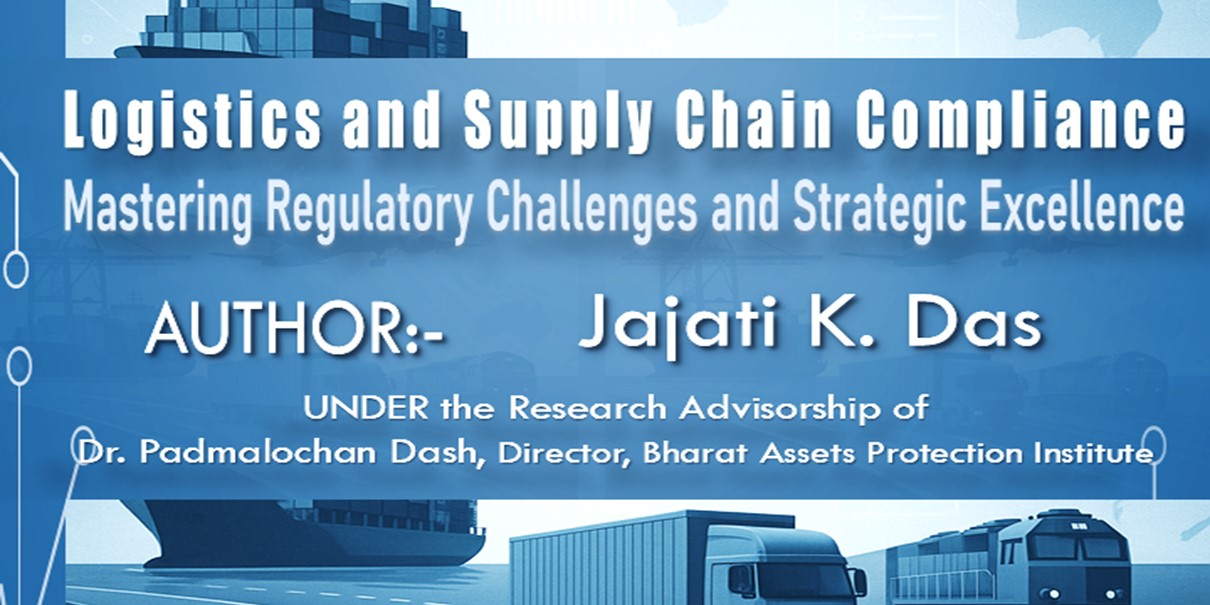
Logistics and Supply Chain
Compliance: Mastering Regulatory Challenges and Strategic Excellence
presents a comprehensive exploration of compliance as
a foundational discipline within modern supply chain management. The manuscript
explains how global trade dynamics, evolving regulatory frameworks,
accelerating digital transformation, and sustainability imperatives are
reshaping logistics systems and operational models across multiple sectors. It
captures a significant transition where compliance is no longer a compulsory
administrative requirement but a strategic enabler of business continuity, competitive
advantage, ethical conduct, and enduring organisational legitimacy.
Across twelve chapters, the work
progresses logically from strategic fundamentals to operational implementation,
governance maturity, and future preparedness. The chapters examine global
customs systems, sector-specific regulatory obligations, environmental
accountability, ethical sourcing, warehouse and transport compliance, digital
governance, data protection, risk intelligence, leadership behaviour, and the
cultural alignment required for sustained compliance maturity. The narrative
also demonstrates how robust compliance frameworks support market access,
strengthen partnerships, enhance traceability, and elevate stakeholder trust.
Designed for practitioners, industry
leaders, policymakers, and academic audiences, the book blends applied insight
with structured analytical models and real-world application. It offers
organisations seeking resilient and transparent supply chains a pathway to
leverage advanced technologies and operate confidently in regulated
environments. The result is a reference work that enables compliance thinking
to evolve into strategic capability and operational excellence in an
increasingly integrated and regulation-driven global logistics ecosystem.

About the Book
Logistics and Supply Chain
Compliance: Mastering Regulatory Challenges and Strategic Excellence
by J.K.Das is scheduled for international publication and is
intended as both a strategic guide and operational reference for the rapidly
transforming logistics domain. It responds to a global landscape where
regulatory clarity, compliance maturity, and ethical operational alignment have
become essential to competitive performance. The book is written for leaders,
practitioners, regulators, and academic communities tasked with navigating
rising complexity while safeguarding transparency, resilience, and trust across
integrated supply networks.
A dedicated advisory engagement
strengthened the manuscript’s relevance and depth. Under the Research
Advisorship of Dr. Padmalochan Dash, Director, Bharat Assets Protection
Institute, the work aligns scholarly rigor with industry practicality. The
advisorship reinforces the core objective: to equip organisations with
conceptual frameworks, operational architectures, and strategic models that
convert compliance from obligation into measurable organisational value.
The discussion begins with The Strategic
Imperative of Compliance, positioning compliance as a central component of
strategic planning rather than an administrative function. The premise
establishes compliance as a mechanism that protects continuity, sustains
reputation, and underwrites responsible participation in global trade.
The regulatory landscape is
then explored. Global Trade and Customs Compliance provides practical insight
into cross-border documentation, customs processes, and regulatory structures.
This progresses into Sector-Specific Compliance Challenges, clarifying
how pharmaceutical, food, aerospace, automotive, and technology supply chains
face distinct regulatory pressures. Environmental and Ethical Compliance
broadens the discourse to sustainability expectations, responsible sourcing,
and ESG-aligned reporting frameworks now embedded in global procurement and
contracting systems.
Operational execution
forms the next layer. Excellence in Warehouse and Inventory Management
emphasizes traceability, audit readiness, safety requirements, and secured
physical controls. Transportation Compliance and Strategic Management
addresses implementation across road, rail, air, and maritime modes, including
hazardous materials handling and carrier certification. Digital Compliance
and Data Integrity highlights cybersecurity, data protection standards, and
emerging compliance-enabling technologies including AI-driven monitoring,
automated reporting, and blockchain-based verification.
Governance maturity follows. Risk
Management Frameworks for Compliance presents structured approaches for
identifying, prioritising, and mitigating compliance-related risks across
supply networks. Leadership and Building a Compliance-Driven Culture
focuses on the human dimension, reinforcing accountability, communication,
capability development, and aligned decision-making across roles and functions.

The closing chapters are
forward-facing. Strategic Compliance as a Competitive Advantage demonstrates
how organisations use compliance to differentiate, build trust, and gain access
to regulated markets. Preparing for Future Regulatory Landscapes examines
shifting trade policies, sustainability-driven regulation, geopolitical
influence, and the increasing role of emerging technology in shaping regulatory
expectations. The final chapter centres on preparedness, continuous
improvement, and the sustained evolution of compliance maturity.
Across twelve chapters, the volume
brings clarity and structure to an operating environment where compliant supply
chains equate to trusted supply chains and trusted supply chains drive
competitive outcomes.
This work will serve as both a
handbook and a strategic development resource. Supply chain professionals will
find actionable frameworks applicable to day-to-day practice. Executives will
gain structured insight to shape governance and operating models. Educators and
researchers will benefit from an integrated reference foundation. Regulators
and auditors will recognise a shared compliance vocabulary that supports
alignment across systems. Students and early-career professionals will gain a
coherent basis for developing real-world readiness. By integrating strategy,
operations, regulation, technology, and culture into a single reference, the
book supports the creation of supply chains that are responsible, secure,
efficient, and globally credible.